Matheson Brittany E, Gorrell Sasha, Bohon Cara, Agras W Stewart, Le Grange Daniel, Lock James
Department of Psychiatry and Behavioral Sciences, Stanford University School of Medicine, Stanford, CA, United States.
Department of Psychiatry, University of California San Francisco School of Medicine, San Francisco, CA, United States.
Front Psychiatry. 2020 Feb 28;11:92. doi: 10.3389/fpsyt.2020.00092. eCollection 2020.
This secondary data analysis seeks to replicate and extend findings that early response to treatment in adolescent bulimia nervosa (BN) predicts outcome, resulting in earlier identification of patients who might need a different treatment approach.
Participants were 71 adolescents ( ± : 15.69 ± 1.55 years; 93% female; 75% non-Hispanic) with a Diagnostic and Statistical Manual of Mental Disorders, 4 Edition (DSM-IV) diagnosis of BN or partial BN enrolled in a two-site treatment study. Participants were randomized to cognitive behavioral therapy for adolescents (CBT-A), family-based treatment for BN (FBT-BN), or supportive psychotherapy (SPT). The Eating Disorder Examination was administered at baseline, end-of-treatment (EOT), 6-month, and 12-month follow-up. Binge eating and purge symptoms were self-reported at each session. Outcome was defined as abstinence of binge eating and compensatory behaviors (self-induced vomiting, laxative use, diet pills, diuretics, compensatory exercise, fasting) in the 28 days prior to assessment. Receiver operating characteristic (ROC) analyses were utilized to assess the viability of predicting treatment outcomes based on reduction of symptoms within the first 10 sessions of treatment.
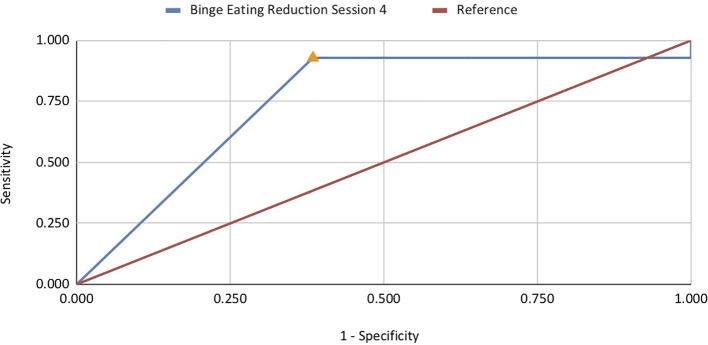
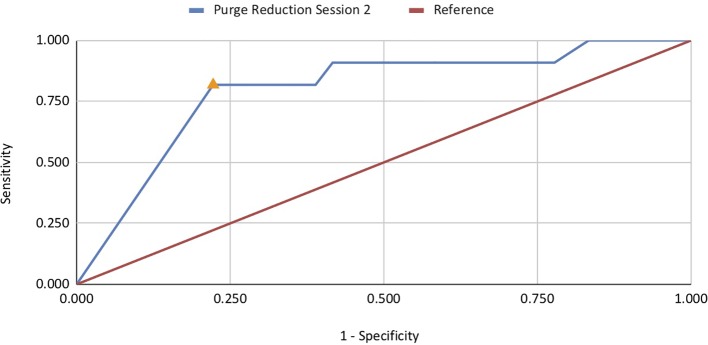
ROC analyses suggest that reduction in purging at session 2 (AUC =.799, < .001) and binge eating at session 4 (AUC =.750, < .01) were independently related to abstinence of symptoms at EOT, regardless of treatment type. Symptom reduction later in treatment predicted outcome at follow-up, as change in binge eating at session 8 and purging at session 9 were the strongest predictors of abstinence at 6-month follow-up (AUCs =.726-.763, s < .01). Change in binge eating, but not purging behaviors, was significantly related to abstinence at 12-month follow-up (AUC =.766, < .01). Only slight differences emerged based on treatment group, such that reductions in symptoms most predictive of abstinence at EOT occurred one session sooner in FBT-BN than SPT.
Reductions in binge eating and purge symptoms early in adolescent BN treatment suggest better outcome, regardless of treatment modality. Additional research with larger samples is needed to better understand which treatments, if any, contribute to earlier change in BN symptoms and/or likelihood of improved patient response.
本二次数据分析旨在重复并扩展以下研究结果,即青少年神经性贪食症(BN)对治疗的早期反应可预测治疗结果,从而能更早识别可能需要不同治疗方法的患者。
参与者为71名青少年(平均年龄:15.69±1.55岁;93%为女性;75%为非西班牙裔),他们符合《精神疾病诊断与统计手册》第四版(DSM-IV)中BN或部分BN的诊断标准,参与了一项双地点治疗研究。参与者被随机分配到青少年认知行为疗法(CBT-A)、BN家庭治疗(FBT-BN)或支持性心理治疗(SPT)。在基线、治疗结束时(EOT)、6个月和12个月随访时进行饮食失调检查。每次治疗时自我报告暴饮暴食和清除症状。结局定义为评估前28天内无暴饮暴食和代偿行为(自我催吐、使用泻药、减肥药、利尿剂、代偿性运动、禁食)。采用受试者工作特征(ROC)分析来评估基于治疗前10次治疗中症状减轻来预测治疗结果的可行性。
ROC分析表明,第2次治疗时清除行为的减少(AUC = 0.799,P < 0.001)和第4次治疗时暴饮暴食的减少(AUC = 0.750,P < 0.01)与EOT时症状的戒除独立相关,无论治疗类型如何。治疗后期症状的减轻可预测随访时的结局,因为第8次治疗时暴饮暴食的变化和第9次治疗时清除行为的变化是6个月随访时戒除的最强预测因素(AUCs = 0.726 - 0.763,P < 0.01)。暴饮暴食的变化而非清除行为与12个月随访时的戒除显著相关(AUC = 0.766,P < 0.01)。基于治疗组仅出现轻微差异,即FBT-BN组中最能预测EOT时戒除的症状减轻比SPT组提前一个疗程出现。
青少年BN治疗早期暴饮暴食和清除症状的减轻提示预后较好,无论治疗方式如何。需要更多样本的进一步研究,以更好地了解哪些治疗(如果有的话)有助于BN症状的更早改善和/或患者反应改善的可能性。