Topalović Olivera, Hussain Muzammil, Heuer Holger
Institute for Epidemiology and Pathogen Diagnostics, Julius Kühn-Institut, Federal Research Centre for Cultivated Plants, Braunschweig, Germany.
State Key Laboratory of Mycology, Institute of Microbiology, Chinese Academy of Sciences, Chaoyang, China.
Front Microbiol. 2020 Feb 28;11:313. doi: 10.3389/fmicb.2020.00313. eCollection 2020.
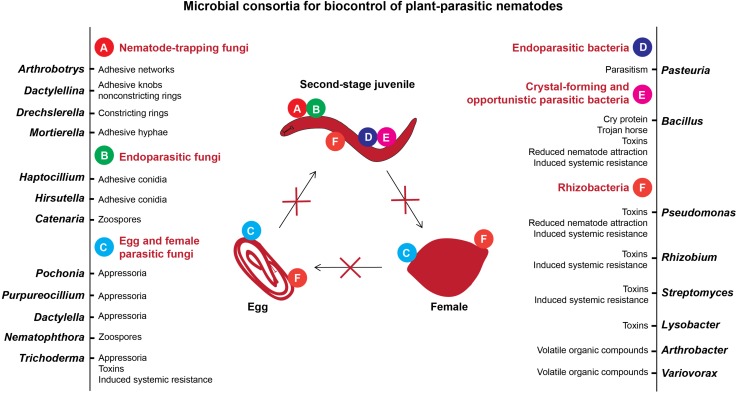
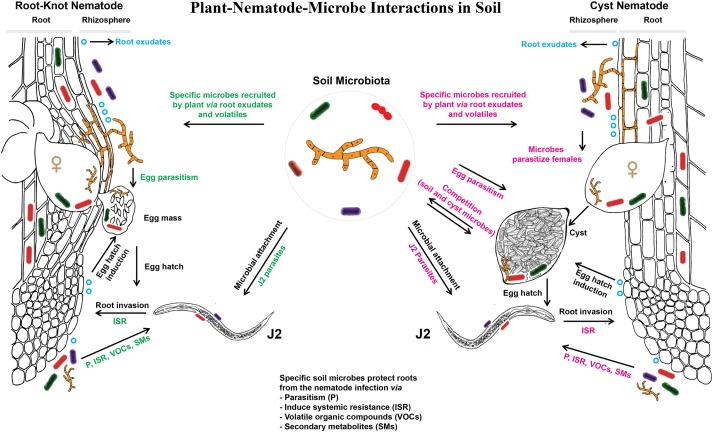
Disease suppressive soils with specific suppression of soil-borne pathogens and parasites have been long studied and are most often of microbiological origin. As for the plant-parasitic nematodes (PPN), which represent a huge threat to agricultural crops and which successfully defy many conventional control methods, soil progression from conducive to suppressive state is accompanied by the enrichment of specific antagonistic microbial consortia. However, a few microbial groups have come to the fore in diminishing PPN in disease suppressive soils using culture-dependent methods. Studies with cultured strains resulted in understanding the mechanisms by which nematodes are antagonized by microorganisms. Recent culture-independent studies on the microbiome associated with soil, plant roots, and PPN contributed to a better understanding of the functional potential of disease suppressive microbial cohort. Plant root exudation is an important pathway determining host-microbe communication and plays a key role in selection and enrichment of a specific set of microbial antagonists in the rhizosphere as first line of defense against crop pathogens or parasites. Root exudates comprising primary metabolites such as amino acids, sugars, organic acids, and secondary metabolites can also cause modifications in the nematode surface and subsequently affect microbial attachment. A positive interaction between hosts and their beneficial root microbiota is correlated with a low nematode performance on the host. In this review, we first summarized the historical records of nematode-suppressive soils and then focused on more recent studies in this aspect, emphasizing the advances in studying nematode-microbe interactions over time. We highlighted nematode biocontrol mechanisms, especially parasitism, induced systemic resistance, and volatile organic compounds using microbial consortia, or bacterial strains of the genera , , , , , , and , or fungal isolates of , , , , , , , and . We discussed the importance of root exudates in plant communication with PPN and soil microorganisms, emphasizing their role in microbial attachment to the nematode surface and subsequent events of nematode parasitism. Comprehensive understanding of the plant-beneficial microbial consortia and the mechanisms underlying disease suppression may help to develop synthetic microbial communities for biocontrol of PPN, thereby reducing nematicides and fertilizers inputs.
长期以来,人们一直在研究对土传病原体和寄生虫具有特异性抑制作用的抑病土壤,其抑制作用大多源于微生物。植物寄生线虫(PPN)对农作物构成巨大威胁,且成功抵御了许多传统防治方法,从有利于线虫生长的土壤状态转变为抑病状态的过程中,特定的拮抗微生物群落会富集。然而,通过依赖培养的方法,少数微生物类群在抑病土壤中减少PPN方面崭露头角。对培养菌株的研究有助于了解微生物拮抗线虫的机制。最近关于与土壤、植物根系和PPN相关的微生物组的非培养研究,有助于更好地理解抑病微生物群落的功能潜力。植物根系分泌物是决定宿主与微生物交流的重要途径,在根际中特定一组微生物拮抗剂的选择和富集过程中起着关键作用,作为抵御作物病原体或寄生虫的第一道防线。包含氨基酸、糖类、有机酸等初级代谢产物以及次级代谢产物的根系分泌物,也会对线虫表面产生影响,进而影响微生物的附着。宿主与其有益根际微生物群之间的积极相互作用与宿主上线虫的低繁殖率相关。在本综述中,我们首先总结了抑线虫土壤的历史记录,然后重点关注这方面的最新研究,强调了随着时间推移在研究线虫与微生物相互作用方面取得的进展。我们突出了线虫生物防治机制,特别是利用微生物群落、或芽孢杆菌属、假单胞菌属、伯克霍尔德菌属、沙雷氏菌属、链霉菌属、嗜麦芽窄食单胞菌属和黄杆菌属的细菌菌株、或木霉属、曲霉属、青霉属、根霉属、毛壳菌属、镰刀菌属、粘帚霉属和淡紫紫孢菌属的真菌分离物的寄生作用、诱导系统抗性和挥发性有机化合物。我们讨论了根系分泌物在植物与PPN以及土壤微生物交流中的重要性,强调了它们在微生物附着于线虫表面以及随后的线虫寄生事件中的作用。全面了解植物有益微生物群落以及疾病抑制的潜在机制,可能有助于开发用于PPN生物防治的合成微生物群落,从而减少杀线虫剂和肥料的投入。