St. Joseph's College, 278 Whites Bridge Road, Standish, ME, 04084, USA.
Biodiversity Research Institute, 276 Canco Road, Portland, ME, 04103, USA.
Environ Monit Assess. 2020 Mar 17;191(Suppl 4):817. doi: 10.1007/s10661-019-7925-y.
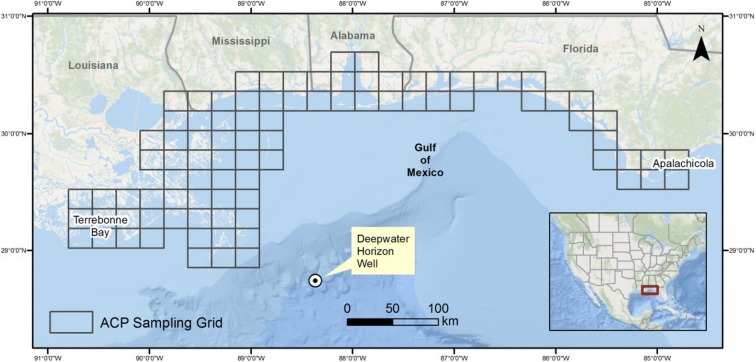
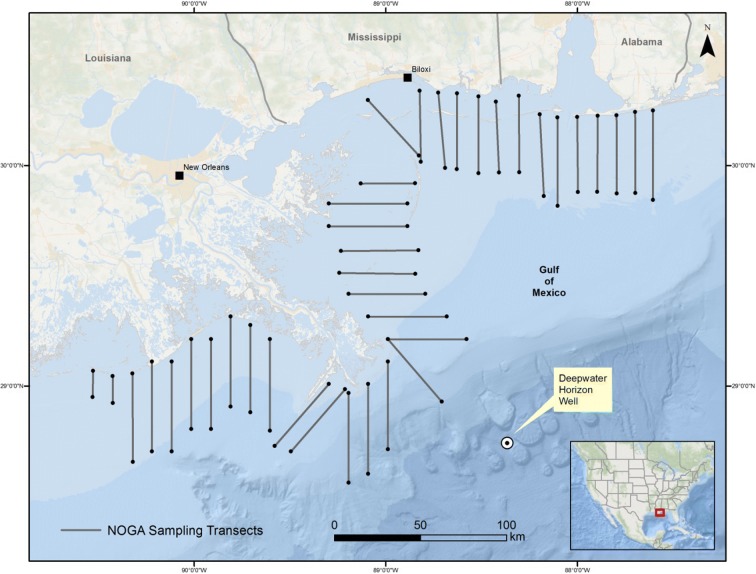
The Natural Resource Damage Assessment and Restoration Trustees for the Deepwater Horizon oil spill assessed the external oiling of migratory bird species dependent on open water in the Gulf of Mexico following the aforementioned spill. The assessment was designed to evaluate birds that use open water during the winter within 40 km of the Gulf shoreline. We focused on the American white pelican (Pelecanus erythrorhynchos), common loon (Gavia immer), and northern gannet (Morus bassanus). Point counts (pelican, loon) or strip transects (gannet) were used and each target species was assessed for oiling (unoiled, trace, light, moderate, or heavy amounts) and photographed. Due to distance at sighting and/or poor visibility, not all visible birds were assessed. The percentage of birds oiled varied by species, with the common loon being the highest (23.6%), followed by American white pelican (16.9%), and northern gannet (6.9%). Most of the American white pelicans and common loons had trace (83% and 72%, respectively) or light levels (11% and 24%, respectively) of oiling. The northern gannet had just trace levels of oiling. Some pelicans (6%) and loons (4%) had moderate amounts of oiling. Based on expert derived-mortality estimates and our estimates of oil exposure, we used Monte Carlo simulations to predict expected decreases of 2.5%, 4%, and 11% in the observed population for the northern gannet, American white pelican, and common loon, respectively. While these values are underestimates of the true values given the long time lag (10-12 months) between the oil spill and the assessment, these data represent some of the few estimates of exposure for these species and describe minimum risk estimates to these species.
墨西哥湾深水地平线溢油事件发生后,自然资源损害评估和恢复托管人为评估受溢油影响的依赖开阔水域的候鸟物种的外部油污情况进行了评估。该评估旨在评估在海湾海岸线 40 公里范围内的冬季使用开阔水域的鸟类。我们重点关注美洲白鹈鹕(Pelecanus erythrorhynchos)、普通潜鸟(Gavia immer)和北方塘鹅(Morus bassanus)。使用了点计数(鹈鹕、潜鸟)或条带横切(塘鹅),并对每种目标物种进行了油污评估(无油、微量、轻度、中度或重度)和拍照。由于在观测点的距离和/或能见度差,并非所有可见鸟类都进行了评估。受油污鸟类的比例因物种而异,普通潜鸟最高(23.6%),其次是美洲白鹈鹕(16.9%)和北方塘鹅(6.9%)。大多数美洲白鹈鹕和普通潜鸟的油污程度为微量(分别为 83%和 72%)或轻度(分别为 11%和 24%)。北方塘鹅只有微量的油污。一些鹈鹕(6%)和潜鸟(4%)有中度油污。根据专家推导的死亡率估计和我们对油污暴露的估计,我们使用蒙特卡罗模拟来预测北方塘鹅、美洲白鹈鹕和普通潜鸟的观测种群分别减少 2.5%、4%和 11%。尽管这些值是由于油污事件和评估之间存在 10-12 个月的长时间滞后而对真实值的低估,但这些数据代表了对这些物种暴露情况的一些少数估计,并描述了这些物种的最低风险估计。