Global Health Institute, School of Life Sciences, EPFL, Lausanne, Switzerland.
Cell Microbiol. 2020 Apr;22(4):e13167. doi: 10.1111/cmi.13167.
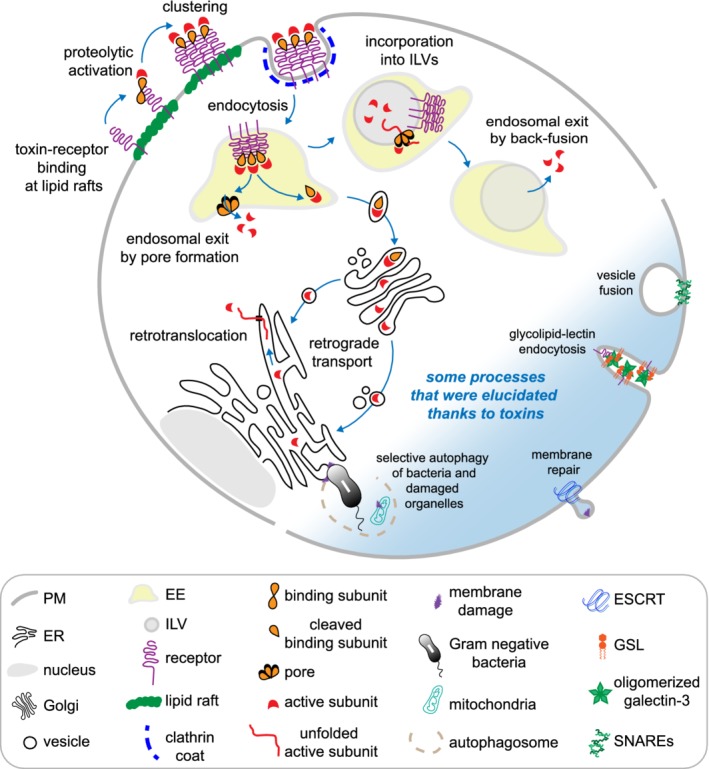
A fundamental question of eukaryotic cell biology is how membrane organelles are organised and interact with each other. Cell biologists address these questions by characterising the structural features of membrane compartments and the mechanisms that coordinate their exchange. To do so, they must rely on variety of cargo molecules and treatments that enable targeted perturbation, localisation, and labelling of specific compartments. In this context, bacterial toxins emerged in cell biology as paradigm shifting molecules that enabled scientists to not only study them from the side of bacterial infection but also from the side of the mammalian host. Their selectivity, potency, and versatility made them exquisite tools for uncovering much of our current understanding of membrane trafficking mechanisms. Here, we will follow the steps that lead toxins until their intracellular targets, highlighting how specific events helped us comprehend membrane trafficking and establish the fundamentals of various cellular organelles and processes. Bacterial toxins will continue to guide us in answering crucial questions in cellular biology while also acting as probes for new technologies and applications.
真核细胞生物学的一个基本问题是膜细胞器如何组织和相互作用。细胞生物学家通过描述膜隔室的结构特征以及协调它们交换的机制来解决这些问题。为此,他们必须依赖各种货物分子和处理方法,以实现特定隔室的靶向扰动、定位和标记。在这种情况下,细菌毒素在细胞生物学中脱颖而出,成为改变观念的分子,使科学家不仅能够从细菌感染的角度,也能够从哺乳动物宿主的角度来研究它们。它们的选择性、效力和多功能性使它们成为揭示我们目前对膜运输机制理解的极好工具。在这里,我们将按照毒素进入细胞内靶标的步骤进行,重点介绍特定事件如何帮助我们理解膜运输,并建立各种细胞细胞器和过程的基础。细菌毒素将继续指导我们回答细胞生物学中的关键问题,同时也作为新技术和应用的探针。