Arrico Lorenzo, De Rosa Chiara, Di Bari Lorenzo, Melchior Andrea, Piccinelli Fabio
Dipartimento di Chimica e Chimica Industriale, Università di Pisa, via Moruzzi 13, 56124 Pisa, Italy.
Luminescent Materials Laboratory, DB, Università di Verona, and INSTM, University of Verona Research Unit, Strada Le Grazie 15, 37134 Verona, Italy.
Inorg Chem. 2020 Apr 6;59(7):5050-5062. doi: 10.1021/acs.inorgchem.0c00280. Epub 2020 Mar 18.
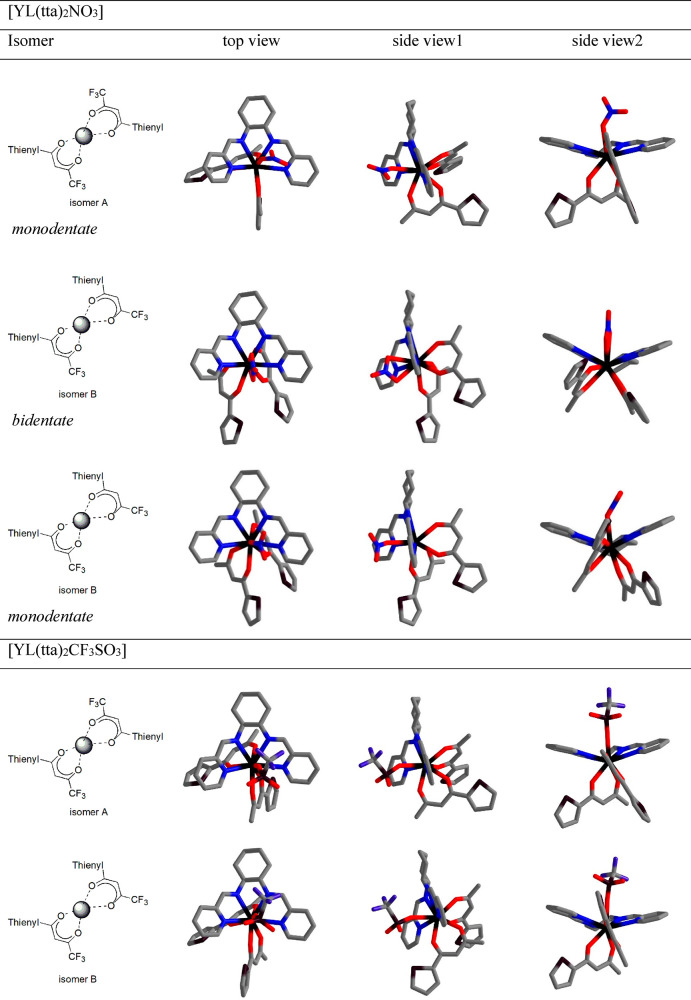
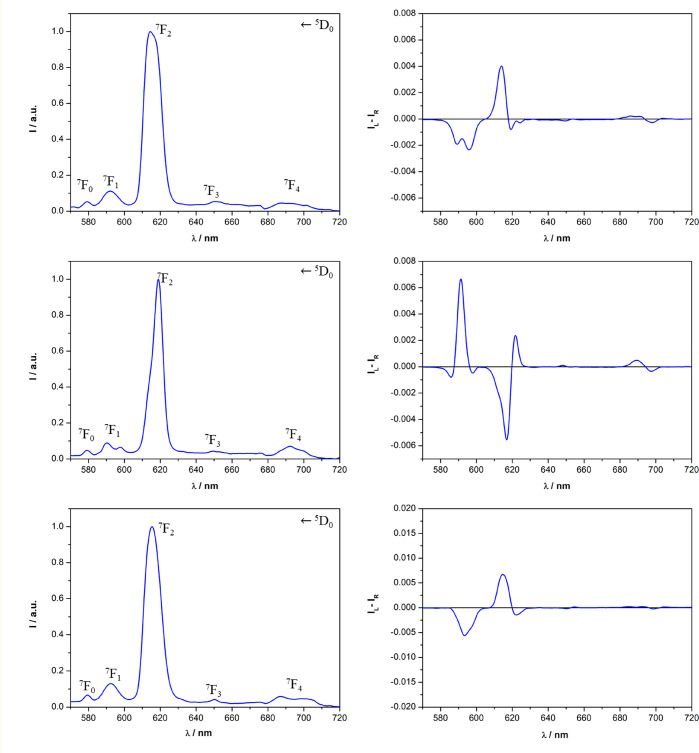
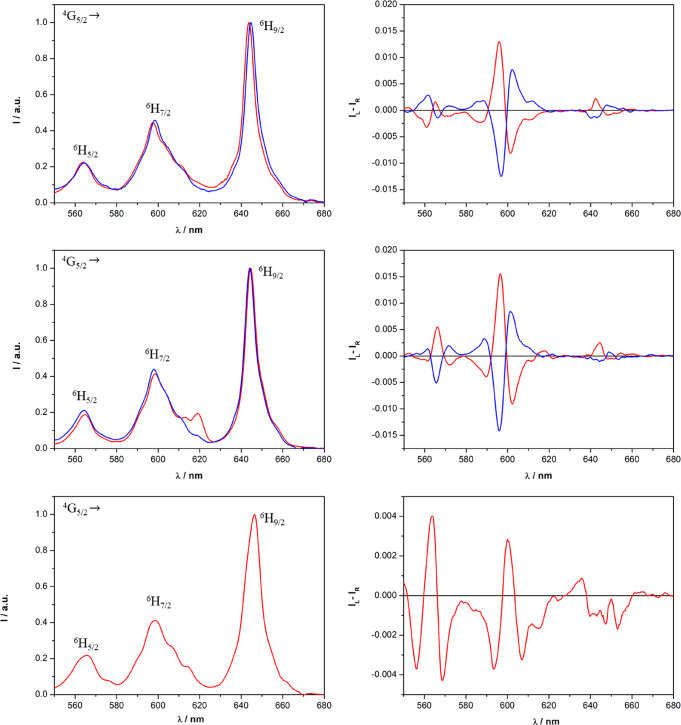
Each enantiopure europium(III) and samarium(III) nitrate and triflate complex of the ligand , with = ,'-bis(2-pyridylmethylidene)-1,2-(, + ,)-cyclohexanediamine ([Ln(tta)]·NO and [Ln(tta)(HO)]·CFSO, where tta = 2-thenoyltrifluoroacetylacetonate) has been synthesized and characterized from a spectroscopic point of view, using a chiroptical technique such as electronic circular dichroism (ECD) and circularly polarized luminescence (CPL). In all cases, both ligands are capable of sensitizing the luminescence of both metal ions upon absorption of light around 280 and 350 nm. Despite small differences in the total luminescence (TL) and ECD spectra, the CPL activity of the complexes is strongly influenced by a concurrent effect of the solvent and counterion. This particularly applies to europium(III) complexes where the CPL spectra in acetonitrile can be described as a weighed linear combination of the CPL spectra in dichloromethane and methanol, which show nearly opposite signatures when their ligand stereochemistries are the same. This phenomenon could be related to the presence of equilibria interconverting solvated, anion-coordinated complexes and isomers differing by the relative orientation of the tta ligands. The difference between some bond lengths (M-N bonds, in particular) in the different species could be at the basis of such an unusual CPL activity.
已合成了配体与铕(III)和钐(III)的硝酸酯及三氟甲磺酸盐的对映体纯配合物(其中配体为 =,'-双(2-吡啶基亚甲基)-1,2-(, +,)-环己二胺([Ln(tta)]·NO 和 [Ln(tta)(HO)]·CFSO,tta = 2-噻吩甲酰三氟丙酮)),并从光谱学角度进行了表征,采用了诸如电子圆二色性(ECD)和圆偏振发光(CPL)等手性光学技术。在所有情况下,两种配体在吸收280和350 nm左右的光时都能够敏化两种金属离子的发光。尽管总发光(TL)和ECD光谱存在细微差异,但配合物的CPL活性受到溶剂和抗衡离子同时作用的强烈影响。这尤其适用于铕(III)配合物,其中乙腈中的CPL光谱可描述为二氯甲烷和甲醇中CPL光谱的加权线性组合,当它们的配体立体化学相同时,这两种光谱显示出几乎相反的特征。这种现象可能与溶剂化、阴离子配位配合物和tta配体相对取向不同的异构体之间相互转化的平衡的存在有关。不同物种中某些键长(特别是M-N键)的差异可能是这种异常CPL活性的基础。