Department of Psychological Sciences, The University of Vermont, Burlington, Vermont, United States of America.
Department of Psychology, Florida International University, Miami, Florida, United States of America.
PLoS One. 2020 Mar 18;15(3):e0229379. doi: 10.1371/journal.pone.0229379. eCollection 2020.
To determine if an internet-based mind/body program would lead to participants experiencing infertility (1) being willing to be recruited and randomized and (2) accepting and being ready to engage in a fertility-specific intervention. Secondary exploratory goals were to examine reduced distress over the course of the intervention and increased likelihood to conceive.
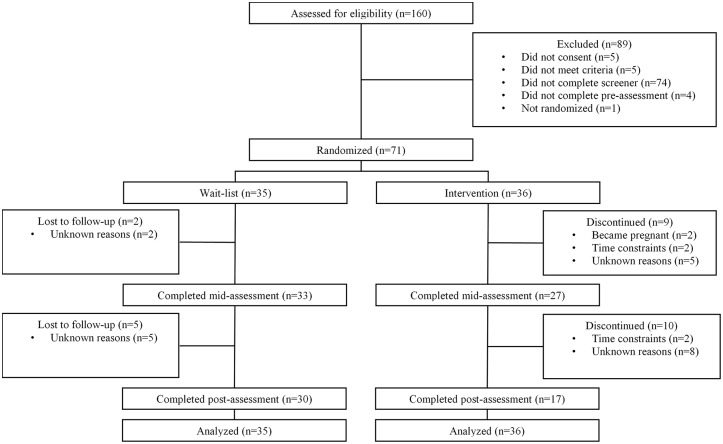
This was a pilot randomized controlled feasibility trial with a between-groups, repeated measure design. Seventy-one women self-identified as nulliparous and meeting criteria for infertility. Participants were randomized to the internet-based version of the Mind/Body Program for Fertility or wait-list control group and asked to complete pre-, mid- and post-assessments. Primary outcomes include retention rates, number of modules completed, and satisfaction with intervention. Secondary exploratory outcomes sought to provide preliminary data on the impact of the program on distress (anxiety and depression) and self-reported pregnancy rates relative to a quasi-control group.
The retention, adherence, and satisfaction rates were comparable to those reported in other internet-based RCTs. Although time between pre- and post-assessment differed between groups, using intent-to-treat analyses, women in the intervention group (relative to the wait-list group) had significant reduction in distress (anxiety, p = .003; depression, p = .007; stress, p = .041 fertility-social, p = .018; fertility-sexual, p = .006), estimated as medium-to-large effect sizes (ds = 0.45 to 0.86). The odds of becoming pregnant was 4.47 times higher for the intervention group participants as compared to the wait-list group, OR 95% CI [1.56, 12.85], p = .005 and occurred earlier. The findings suggest that the research design and program specific to this population are feasible and acceptable. Replication efforts with an active control group are needed to verify distress reduction and conception promotion findings.
确定基于互联网的身心程序是否会使参与者经历不孕(1)愿意被招募和随机分组,(2)接受并准备参与特定的生育干预。次要探索性目标是检查干预过程中的痛苦减轻和怀孕可能性增加。
这是一项具有组间、重复测量设计的试点随机对照可行性试验。71 名妇女自我认同为初产妇,符合不孕标准。参与者被随机分配到基于互联网的身心生育计划或候补对照组,并被要求完成预评估、中期评估和后期评估。主要结果包括保留率、完成的模块数量以及对干预的满意度。次要探索性结果旨在提供关于该计划对困扰(焦虑和抑郁)和自我报告的怀孕率相对于准对照组的影响的初步数据。
保留率、依从性和满意度与其他基于互联网的 RCT 报告的结果相当。尽管两组之间的预评估和后评估之间的时间有所不同,但使用意向治疗分析,干预组(相对于候补组)的焦虑症(p =.003)、抑郁症(p =.007)、压力(p =.041 生育-社会,p =.018;生育-性,p =.006)显著减轻,估计为中到大效应大小(ds = 0.45 至 0.86)。与候补组相比,干预组参与者怀孕的几率高 4.47 倍,OR 95%CI[1.56, 12.85],p =.005,且更早怀孕。这些发现表明,针对该人群的研究设计和方案是可行和可接受的。需要进行有活性对照组的复制研究,以验证减轻痛苦和促进怀孕的发现。