Department of Neurosurgery, Changzheng Hospital, Second Military Medical University, NO. 415 Fengyang Road, Huangpu Distinct, Shanghai, 200003, China.
BMC Med Genet. 2020 Mar 19;21(1):56. doi: 10.1186/s12881-020-0992-7.
The prognosis of the glioblastoma (GBM) is dismal. This study aims to select an optimal RNA signature for prognostic prediction of GBM patients.
For the training set, the long non-coding RNA (lncRNA) and mRNA expression profiles of 151 patients were downloaded from the TCGA. Differentially expressed mRNAs (DEGs) and lncRNAs (DE-lncRNAs) were identified between good prognosis and bad prognosis patients. Optimal prognostic mRNAs and lncRNAs were selected respectively, by using univariate Cox proportional-hazards (PH) regression model and LASSO Cox-PH model. Subsequently, four prognostic scoring models were built based on expression levels or expression status of the selected prognostic lncRNAs or mRNAs, separately. Each prognostic model was applied to the training set and an independent validation set. Function analysis was used to uncover the biological roles of these prognostic DEGs between different risk groups classified by the mRNA-based signature.
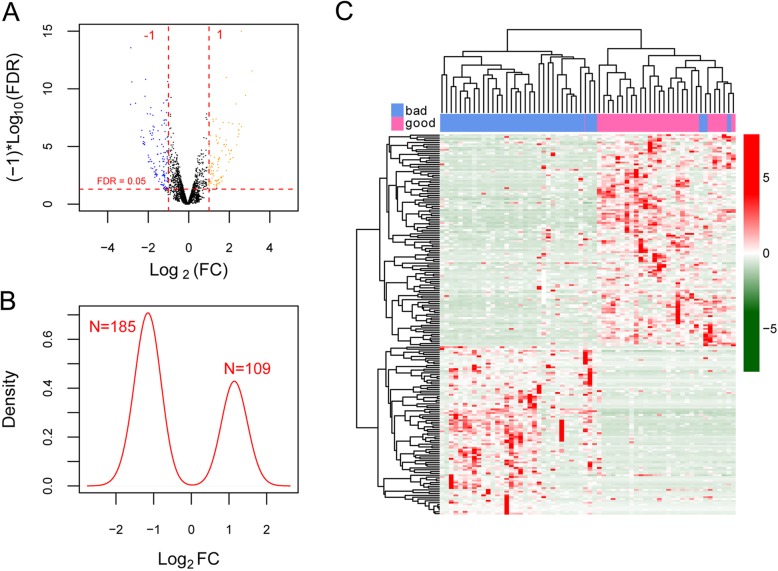
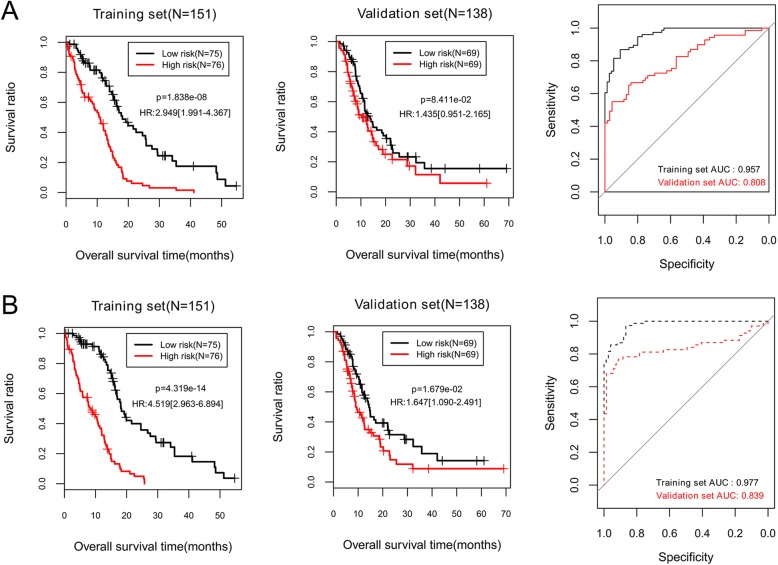
We obtained 261 DEGs and 33 DE-lncRNAs between good prognosis and bad prognosis patients. A panel of eight mRNAs and a combination of ten lncRNAs were determined as predictive RNAs by LASSO Cox-PH model. Among the four prognostic scoring models using the eight-mRNA signature or the ten-lncRNA signature, the one based on the expression levels of the eight mRNAs showed the greatest predictive power. The DEGs between different risk groups using the eight prognostic mRNAs were functionally involved in calcium signaling pathway, neuroactive ligand-receptor interaction pathway, and Wnt signaling pathway.
The eight-mRNA signature has greater prognostic value than the ten-lncRNA-based signature for GBM patients based on bioinformatics analysis.
胶质母细胞瘤(GBM)的预后较差。本研究旨在选择最佳 RNA 标志物,用于预测 GBM 患者的预后。
在训练集中,从 TCGA 下载了 151 名患者的长链非编码 RNA(lncRNA)和 mRNA 表达谱。在预后良好和预后不良的患者之间鉴定出差异表达的 mRNAs(DEGs)和 lncRNAs(DE-lncRNAs)。分别使用单变量 Cox 比例风险(PH)回归模型和 LASSO Cox-PH 模型,选择最佳预后 mRNAs 和 lncRNAs。随后,分别基于选定的预后 lncRNAs 或 mRNAs 的表达水平或表达状态,构建了四个预后评分模型。将每个预后模型应用于训练集和独立验证集。通过功能分析,揭示了根据基于 mRNA 的特征分类的不同风险组之间这些预后 DEGs 的生物学作用。
我们在预后良好和预后不良的患者之间获得了 261 个 DEGs 和 33 个 DE-lncRNAs。通过 LASSO Cox-PH 模型确定了一组 8 个 mRNAs 和一个由 10 个 lncRNAs 组成的组合作为预测性 RNA。在使用 8 个 mRNA 特征或 10 个 lncRNA 特征的四个预后评分模型中,基于 8 个 mRNA 表达水平的模型显示出最大的预测能力。使用这 8 个预后 mRNAs 的不同风险组之间的 DEGs 在功能上涉及钙信号通路、神经活性配体-受体相互作用通路和 Wnt 信号通路。
基于生物信息学分析,与基于 10 个 lncRNA 的特征相比,8 个 mRNA 特征对 GBM 患者具有更大的预后价值。