Centro de Investigaciones en Microbiología y Parasitología Tropical (CIMPAT), Departamento de Ciencias Biológicas, Universidad de los Andes, Bogotá, Colombia.
Laboratorio de Estudio de la Biología de Insectos, Centro de Investigación Científica y de Transferencia Tecnológica a la Producción (CONICET-Prov. Entre Rios-Uader), Diamante, Argentina.
Parasit Vectors. 2020 Mar 18;13(1):142. doi: 10.1186/s13071-020-04013-5.
Studying the behavioral response of blood-sucking disease-vector insects to potentially repellent volatile compounds could shed light on the development of new control strategies. Volatiles released by human facial skin microbiota play different roles in the host-seeking behavior of triatomines. We assessed the repellency effect of such compounds of bacterial origin on Triatoma infestans and Rhodnius prolixus, two important vectors of Chagas disease in Latin America.
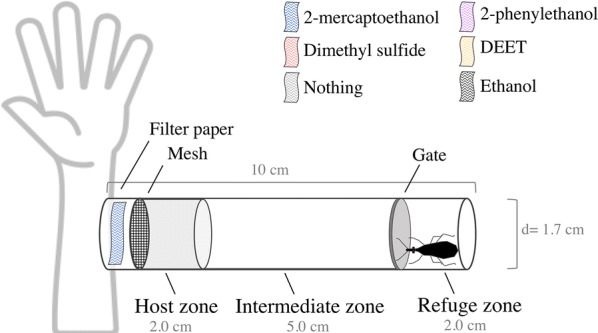
Using an exposure device, insects were presented to human odor alone (control) and in the presence of three individual test compounds (2-mercaptoethanol, dimethyl sulfide and 2-phenylethanol, the latter only tested in R. prolixus) and the gold-standard repellent NN-diethyl-3-methylbenzamide (DEET). We quantified the time the insects spent in the proximity of the host and determined if any of the compounds evaluated affected the behavior of the insects.
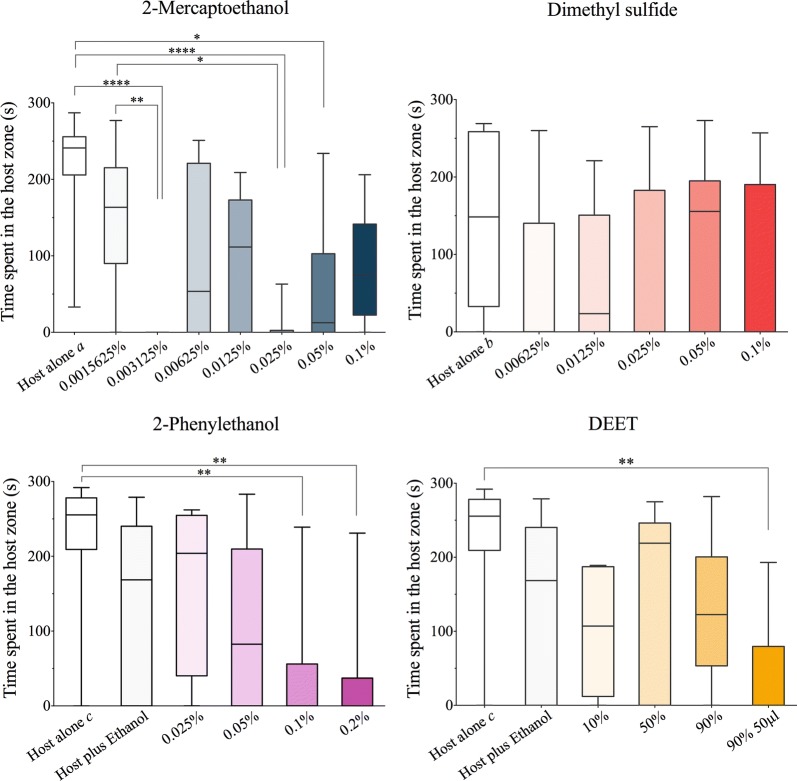
We found volatiles that significantly reduced the time spent in the proximity of the host. These were 2-phenylethanol and 2-mercaptoethanol for R. prolixus, and dimethyl sulfide and 2-mercaptoethanol for T. infestans. Such an effect was also observed in both species when DEET was presented, although only at the higher doses tested.
The new repellents modulated the behavior of two Chagas disease vectors belonging to two different triatomine tribes, and this was achieved using a dose up to three orders of magnitude lower than that needed to evoke the same effect with DEET. Future efforts in understanding the mechanism of action of repellent compounds such as 2-mercaptoethanol, as well as an assessment of their temporal and spatial repellent properties, could lead to the development of novel control strategies for these insect vectors, refractory to DEET.
研究吸血病媒昆虫对潜在驱避挥发物的行为反应,可以为新的控制策略的发展提供线索。人体面部皮肤微生物群释放的挥发物在三锥虫的宿主寻找行为中发挥着不同的作用。我们评估了这些细菌来源的化合物对美洲锥虫和罗氏沼虾的驱避效果,这两种昆虫是拉丁美洲恰加斯病的重要传播媒介。
使用暴露装置,将昆虫暴露于人体气味(对照)和三种单独的测试化合物(2-巯基乙醇、二甲基硫和 2-苯乙醇,后者仅在罗氏沼虾中进行测试)和金标准驱避剂 N,N-二乙基-3-甲基苯甲酰胺(DEET)存在的情况下。我们量化了昆虫在宿主附近停留的时间,并确定了评估的化合物中是否有任何一种影响了昆虫的行为。
我们发现了一些挥发性物质,它们显著减少了昆虫在宿主附近停留的时间。这些挥发性物质包括 2-苯乙醇和 2-巯基乙醇对罗氏沼虾,以及二甲基硫和 2-巯基乙醇对美洲锥虫。当 DEET 存在时,两种物种也观察到了这种效果,尽管只是在测试的较高剂量下。
两种不同的三锥虫属的恰加斯病传播媒介的行为被新的驱避剂所调节,而这是使用比 DEET 达到相同效果所需剂量低三个数量级的剂量实现的。未来努力理解 2-巯基乙醇等驱避化合物的作用机制,以及评估它们的时间和空间驱避特性,可能会为这些对 DEET 有抗药性的昆虫媒介带来新的控制策略。