Puhr Hannah Christina, Pablik Eleonore, Berghoff Anna Sophie, Jomrich Gerd, Schoppmann Sebastian Friedrich, Preusser Matthias, Ilhan-Mutlu Aysegül
Division of Oncology, Medical University of Vienna, Vienna, Austria.
Gastroesophageal Tumors Unit, Comprehensive Cancer Center, Vienna, Austria, Austria.
ESMO Open. 2020 Mar;5(2). doi: 10.1136/esmoopen-2019-000623.
The prognostic value of symptoms at disease presentation of advanced gastro-oesophageal cancer is unknown. Thus, the aim of this study was to characterise these symptoms and correlate them with the outcome, so new prognostic markers can be defined.
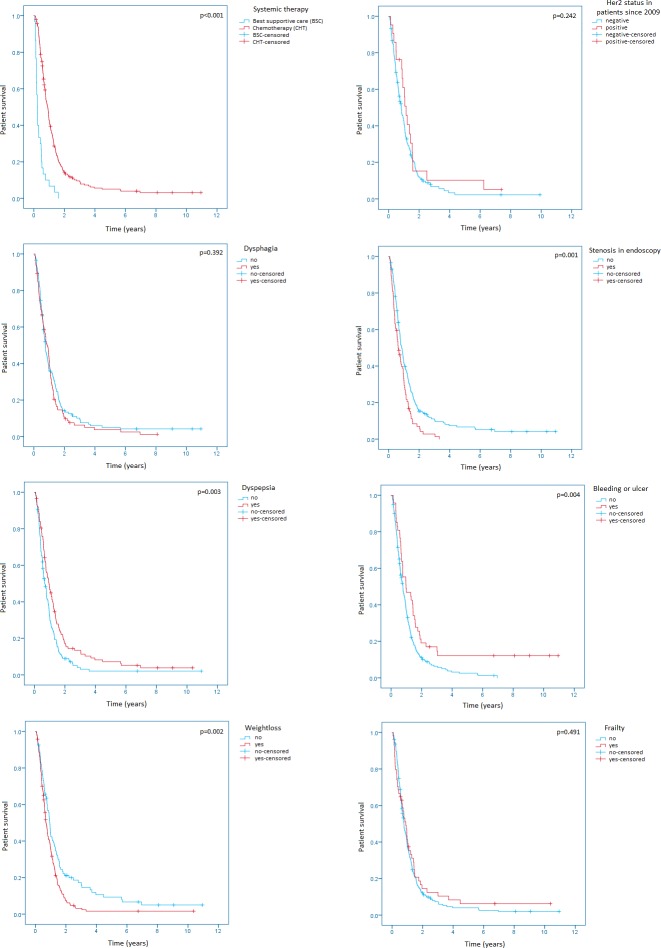
We analysed clinical data including symptoms, therapies and survival of patients with stage IV gastro-oesophageal cancer treated between 2002 and 2018 at the Vienna General Hospital, Austria. Initial symptoms as well as stenosis in endoscopy and HER2 positivity were evaluated in a cross-validation model to ascertain the impact of each variable on patient survival.
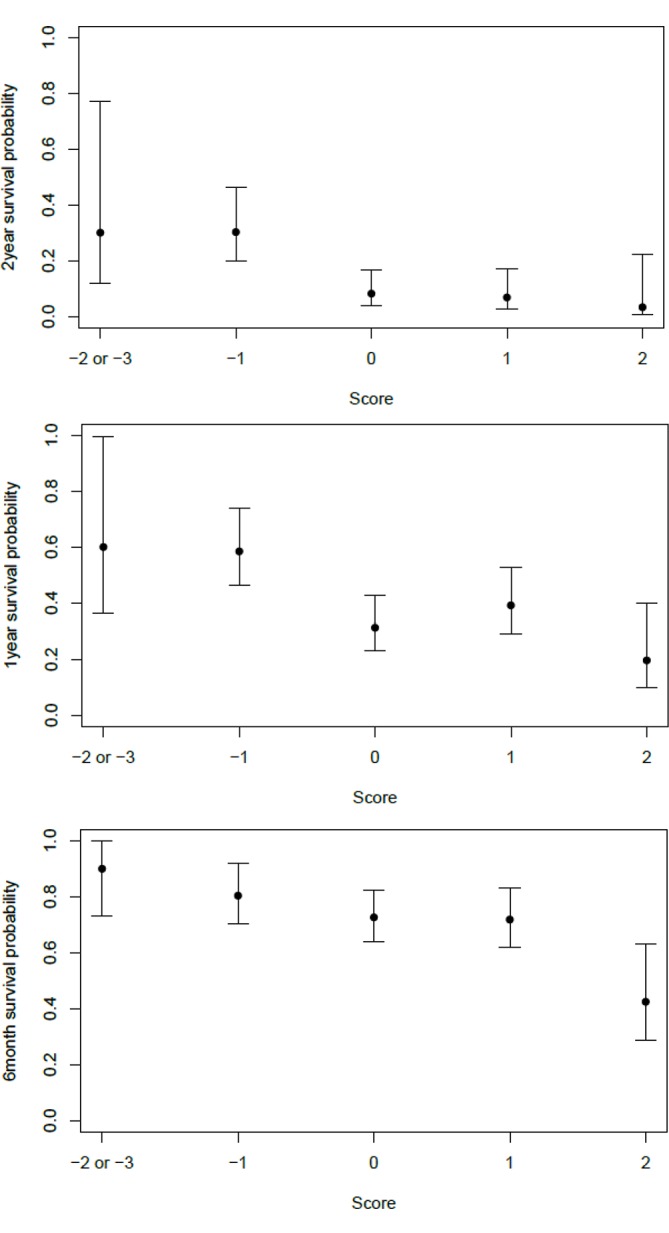
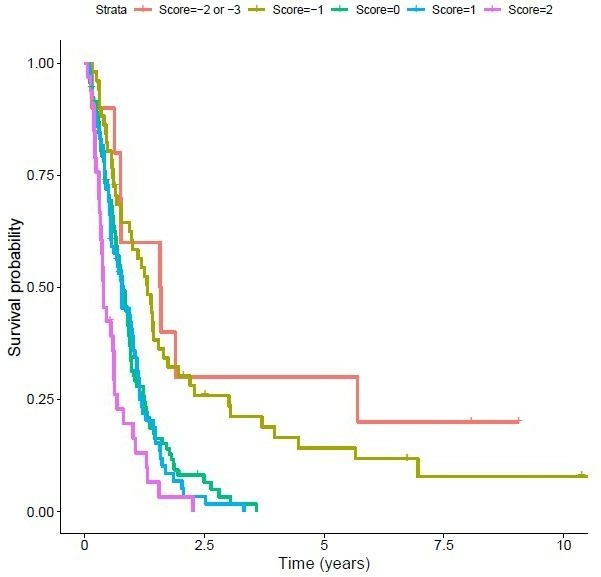
In total, 258 patients were evaluated. Five factors (stenosis in endoscopy, weight loss, HER2 positivity, dyspepsia, ulcer or active bleeding) have proven to be statistically relevant prognostic factors and were given a count of +1 and -1, if applicable. The resulting score ranges between -3 and +2. The survival probability for 180 days with a score of -3/-2, -1, 0, +1 and +2 is 90%, 80%, 73%, 72% and 42%, whereas for 2 years, it is 30%, 30%, 8%, 7% and 3%, respectively. The median overall survival of a score of -3/-2, -1, 0, +1 and +2 was 579 (95% CI 274 to not measurable), 481 (95% CI 358 to 637), 297 (95% CI 240 to 346), 284 (95% CI 205 to 371), 146 (95% CI 120 to 229) days, respectively.
The data from this retrospective study indicate that the Viennese risk prediction score for Advanced Gastroesophageal carcinoma based on Alarm Symptoms score provides independent prognostic information that may support clinical decision making at diagnosis of advanced gastro-oesophageal cancer. Our findings should be evaluated in prospective studies.
晚期胃食管癌发病时症状的预后价值尚不清楚。因此,本研究的目的是对这些症状进行特征描述,并将它们与预后相关联,以便能够定义新的预后标志物。
我们分析了2002年至2018年期间在奥地利维也纳总医院接受治疗的IV期胃食管癌患者的临床数据,包括症状、治疗方法和生存情况。在内镜检查中的初始症状以及狭窄情况和HER2阳性情况在交叉验证模型中进行评估,以确定每个变量对患者生存的影响。
总共评估了258例患者。五个因素(内镜检查中的狭窄、体重减轻、HER2阳性、消化不良、溃疡或活动性出血)已被证明是具有统计学意义的预后因素,适用时分别计为+1和-1。最终得分在-3至+2之间。得分为-3/-2、-1、0、+1和+2时,180天的生存概率分别为90%、80%、73%、72%和42%,而2年的生存概率分别为30%、30%、8%、7%和3%。得分为-3/-2、-1、0、+1和+2时的中位总生存期分别为579天(95%CI 274至不可测量)、481天(95%CI 358至637)、297天(95%CI 240至346)、284天(95%CI 205至371)、146天(95%CI 120至229)。
这项回顾性研究的数据表明,基于警示症状评分的维也纳晚期胃癌风险预测评分提供了独立的预后信息,可能有助于晚期胃食管癌诊断时的临床决策。我们的研究结果应在前瞻性研究中进行评估。