Bahiru Adane, Assefa Ayalew
Sekota Dry Land Agricultural Research Center, P.O. Box 62, Sekota, Ethiopia.
Vet Med Int. 2020 Mar 1;2020:5439836. doi: 10.1155/2020/5439836. eCollection 2020.
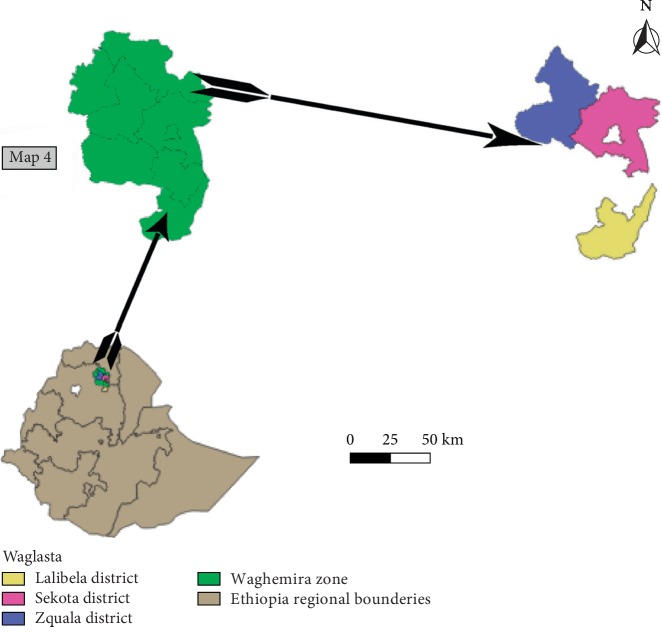
Ethiopia's livestock resource is one of the largest globally. It is estimated at around 59.5 million cattle, about 30.5 million sheep, and 30.2 million goats. The sector is irreplaceable in the means of livelihood of the population as a source of meat, milk, drought power, and income. Yet, the country is unable to exploit the sector entirely because of highly prevalent infectious diseases and lack of appropriate disease control policy. These constraints are worse in districts of Lalibela, Sekota, and Ziquala, where this specific study was carried out. Despite the availability of scanty animal health services in these areas, information on animal health, especially cattle, was never a significant focus of research. This study was conducted with the objectives of identifying and prioritizing primary cattle disease with the aid of participatory epidemiology tools. Focus group discussions (FGD) and questionnaires were used in prioritizing the top economically important cattle diseases of the selected areas. Accordingly, the result of FGD indicated that ectoparasites, CBPP, FMD, blackleg, bloody diarrhea, and pasteurellosis were the major diseases affecting cattle production in the area. These areas can be representative of most of the countries where a mixed farming system is practiced. Therefore, this result can be used as a basis for broader planning of prevention and control strategies for these kinds of diseases. However, a laboratory-supported extensive investigation of these diseases is highly recommended to validate findings of such types of prioritization of diseases.
埃塞俄比亚的牲畜资源是全球最大的之一。据估计,该国约有5950万头牛、约3050万只绵羊和3020万只山羊。作为肉类、奶类、畜力和收入的来源,该行业在民众的生计中具有不可替代的地位。然而,由于传染病高发且缺乏适当的疾病控制政策,该国无法充分开发这一行业。在开展这项具体研究的拉利贝拉、塞科塔和齐夸拉等地区,这些限制更为严重。尽管这些地区的动物卫生服务匮乏,但动物卫生信息,尤其是牛的卫生信息,从未成为研究的重点。本研究旨在借助参与性流行病学工具,确定主要的牛病并对其进行优先级排序。通过焦点小组讨论(FGD)和问卷调查,对选定地区经济上最重要的牛病进行了优先级排序。因此,焦点小组讨论的结果表明,体外寄生虫、牛肺疫、口蹄疫、黑腿病、血性腹泻和巴氏杆菌病是影响该地区养牛业的主要疾病。这些地区可以代表大多数实行混合农业系统的国家。因此,这一结果可作为更广泛规划此类疾病预防和控制策略的基础。然而,强烈建议对这些疾病进行实验室支持的广泛调查,以验证此类疾病优先级排序的结果。