Kebede Sewnet Adem, Liyew Alemneh Mekuriaw, Tesema Getayeneh Antehunegn, Agegnehu Chilot Desta, Teshale Achamyeleh Birhanu, Alem Adugnaw Zeleke, Yeshaw Yigizie
1Department of Epidemiology and Biostatistics, Institute of Public Health, College of Medicine and Health Sciences, University of Gondar, Gondar, Ethiopia.
2School of Nursing, College of Medicine and Health Sciences and Comprehensive specialized hospital, University of Gondar, Gondar, Ethiopia.
Arch Public Health. 2020 Mar 16;78:25. doi: 10.1186/s13690-020-00407-0. eCollection 2020.
Health insurance is one of the instruments to achieve universal health coverage. However, in Ethiopia, the coverage of health insurance is very low and varies from place to place as well. Therefore, exploring the spatial distribution of health insurance is important to prioritize and design targeted intervention programs in the country.
A total of 16,583 reproductive age group women (15-49 years) were included in this study. The Bernoulli model was used by applying Kulldorff methods using the SaTScan software to analyse the purely spatial clusters of health insurance coverage. ArcGIS version 10.3 was used to visualize the distribution of health insurance coverage across the country. Mixed-effect logistic regression analysis was also used to identify predictors of health insurance coverage.
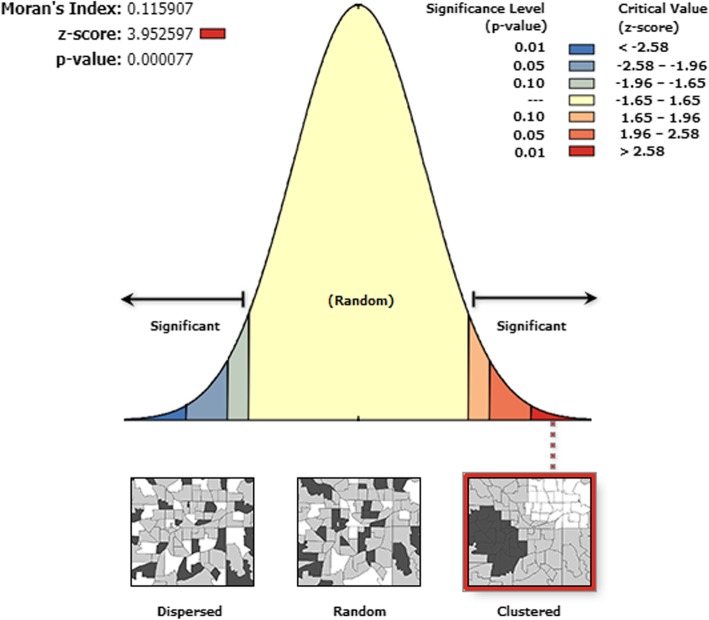
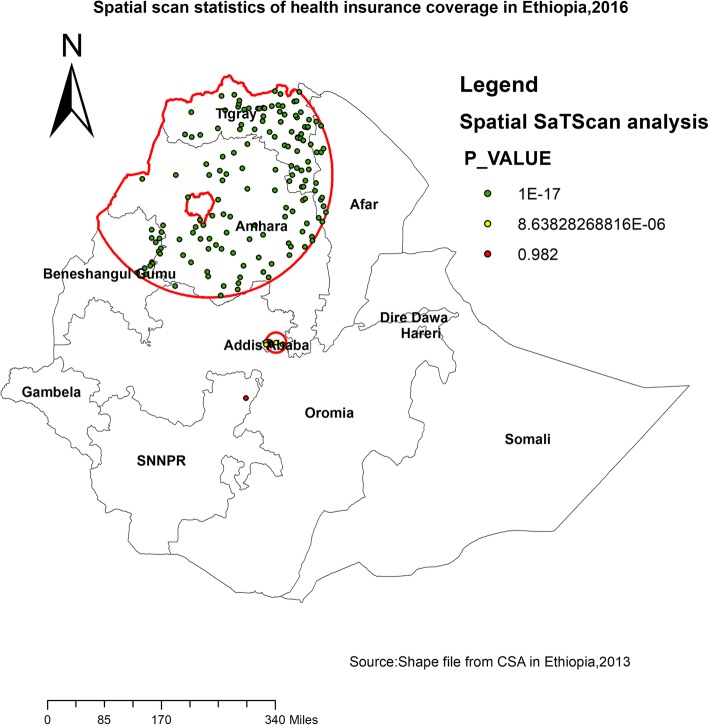
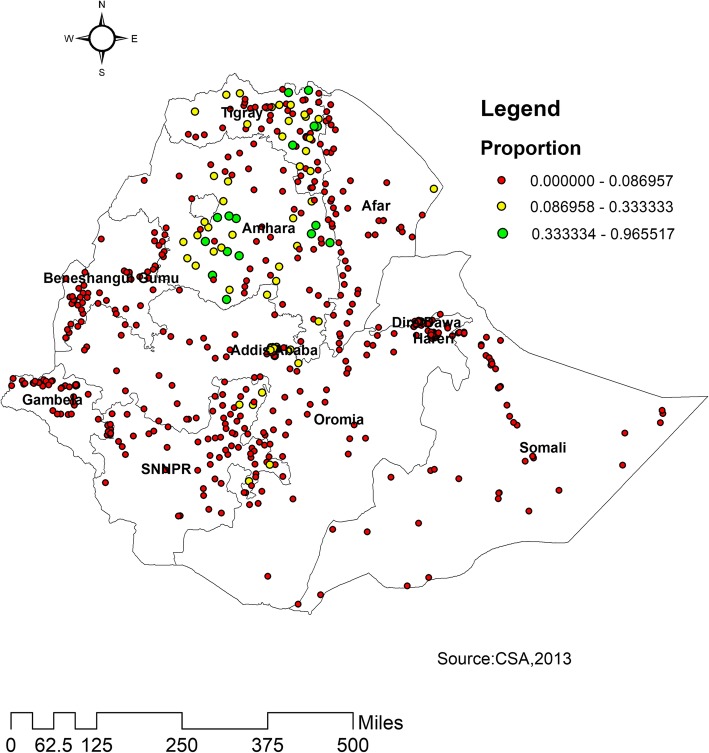
Health insurance coverage among women aged 15-49 years had spatial variations across the country (Moran's I: 0.115, < 0.001). Health insurance coverage in Amhara ( < 0.001) and Tigray ( < 0.001) National Regional States clustered spatially. Reading newspapers at least once a week (Adjusted Odds Ratio (AOR) = 1.78, 95% CI: (1.18-2.68))), 40-44 years of age (AOR = 2.14, 95% CI: (1.37-3.35)), clerical working mothers (AOR = 4.33, 95% CI: (2.50-7.49)), mothers' with secondary school education (AOR = 1.77; 95% CI: (1.21-2.58)), mothers' with higher school education (AOR = 2.62; 95% CI: (1.63-4.23)), having more than 5 family members (AOR = 1.25; 95% CI: (1.01-1.55)) and richest wealth quantile (AOR = 3.43, 95% CI: (1.96-6.01)) were predictors of health insurance coverage among reproductive age group women in Ethiopia.
Health insurance coverage was very low in Ethiopia and had spatial variations across the country. The hot spot areas with low health insurance coverage need more coherent and harmonized action such as strengthening financial protection through national health packages, sharing experience from regions which have better health insurance coverage and using mass media to increase awareness and confidence of potentials in the systems, which may encourage them to enrol.
健康保险是实现全民健康覆盖的手段之一。然而,在埃塞俄比亚,健康保险的覆盖率非常低,而且各地情况也有所不同。因此,探索健康保险的空间分布对于该国确定优先事项和设计有针对性的干预项目很重要。
本研究共纳入16583名育龄妇女(15 - 49岁)。使用SaTScan软件应用Kulldorff方法,采用伯努利模型分析健康保险覆盖的纯空间聚类。使用ArcGIS 10.3版本可视化全国健康保险覆盖情况的分布。还采用混合效应逻辑回归分析来确定健康保险覆盖的预测因素。
15 - 49岁女性的健康保险覆盖在全国存在空间差异(莫兰指数I:0.115,P < 0.001)。阿姆哈拉州(P < 0.001)和提格雷州(P < 0.001)的健康保险覆盖在空间上聚类。每周至少读一次报纸(调整优势比(AOR)= 1.78,95%置信区间:(1.18 - 2.68))、40 - 44岁(AOR = 2.14,95%置信区间:(1.37 - 3.35))、从事文职工作的母亲(AOR = 4.33,95%置信区间:(2.50 - 7.49))、具有中学教育程度的母亲(AOR = 1.77;95%置信区间:(1.21 - 2.58))、具有高中教育程度的母亲(AOR = 2.62;95%置信区间:(1.63 - 4.23))、家庭成员超过5人(AOR = 1.25;95%置信区间:(1.01 - 1.55))以及最富裕财富五分位数(AOR = 3.43,95%置信区间:(1.96 - 6.01))是埃塞俄比亚育龄妇女健康保险覆盖的预测因素。
埃塞俄比亚的健康保险覆盖率非常低,且在全国存在空间差异。健康保险覆盖低的热点地区需要更协调一致的行动,例如通过国家健康套餐加强财务保护、分享健康保险覆盖较好地区的经验以及利用大众媒体提高人们对该体系的认识和信心,这可能会鼓励他们参保。