Department of Community Health Nursing, School of Nursing, College of Medicine and Health Sciences, University of Gondar, Gondar, Ethiopia.
Department of Pediatrics and Child Health Nursing, School of Nursing, College of Medicine and Health Sciences, University of Gondar, Gondar, Ethiopia.
BMC Public Health. 2022 Aug 10;22(1):1523. doi: 10.1186/s12889-022-13950-y.
Community-Based Health Insurance is an emerging concept for providing financial protection against the cost of illness and improving access to quality health services for low-income households excluded from formal insurance and taken as a soft option by many countries. Therefore, exploring the spatial distribution of health insurance is crucial to prioritizing and designing targeted intervention policies in the country.
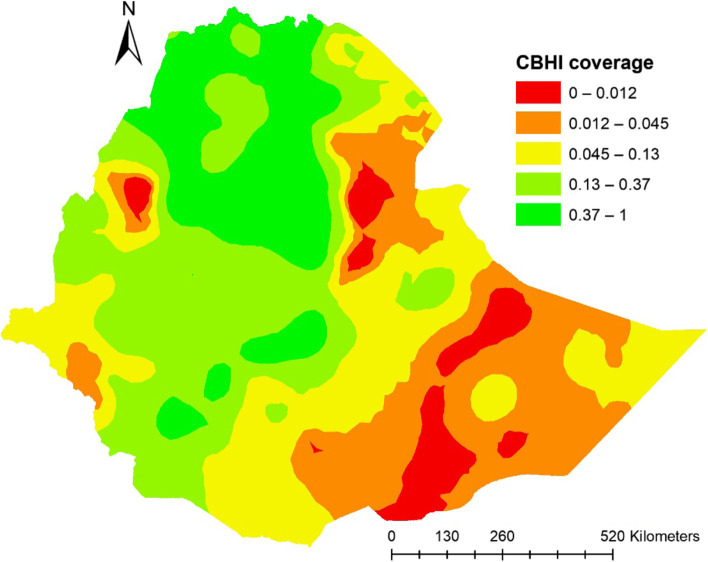
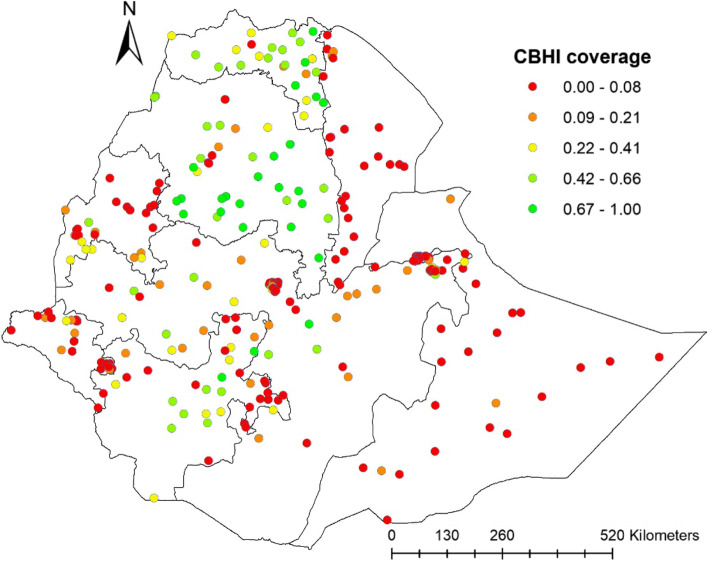
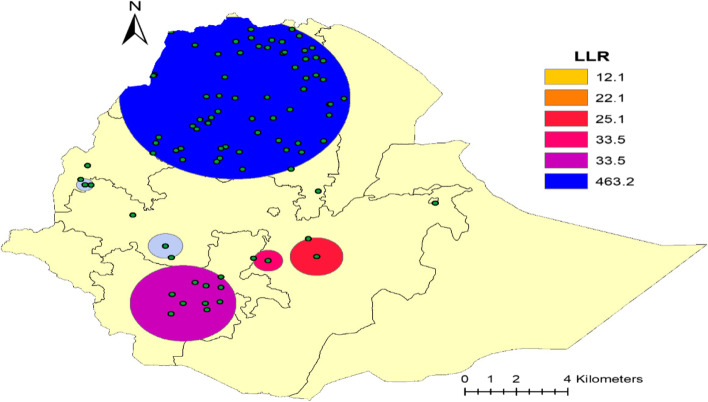
A total of 8,663 households aged 15-95 years old were included in this study. The Bernoulli model was used by applying Kulldorff methods using the SaTScan software to analyze the purely spatial clusters of community based health insurance. ArcGIS version 10.3 was used to visualize the distribution of community-based health insurance coverage across the country. Mixed-effect logistic regression analysis was also used to identify predictors of community-based health insurance coverage.
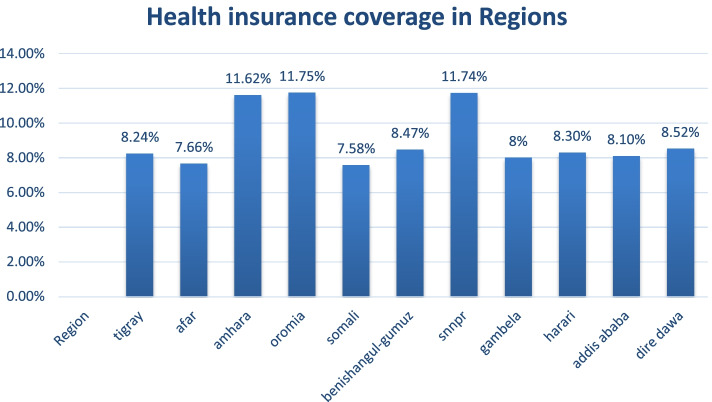
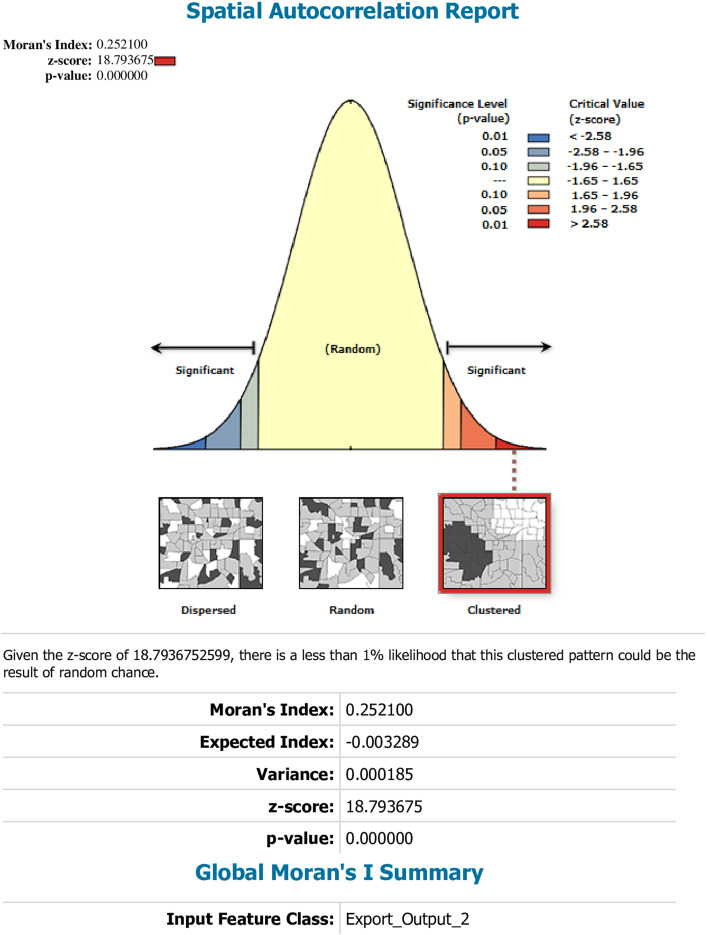
Community based health insurance coverage among households had spatial variations across the country by regions (Moran's I: 0.252, p < 0.0001). Community based health insurance in Amhara (p < 0.0001) and Tigray (p < 0.0001) regions clustered spatially. Age from 15-29 and 30-39 years (Adjusted Odds Ratio 0.46(AOR = 0.46, CI: 0.36,0.60) and 0.77(AOR = 0.77, CI: 0.63,0.96), primary education level 1.57(AOR = 1.57, CI: 1.15,2.15), wealth index of middle and richer (1.71(AOR = 1.71, CI: 1.30,2.24) and 1.79(AOR = 1.79, CI: 1.34,2.41), family size > 5, 0.82(AOR = 0.82, CI: 0.69,0.96),respectively and regions Afar, Oromia, Somali, Benishangul Gumuz, SNNPR, Gambella, Harari, Addis Ababa and Dire Dawa was 0.002(AOR = 0.002, CI: 0.006,0.04), 0.11(AOR = 0.11, CI: 0.06,0.21) 0.02(AOR = 0.02, CI: 0.007,0.04), 0.04(AOR = 0.04, CI: 0.02,0.08), 0.09(AOR = 0.09, CI: 0.05,0.18),0.004(AOR = 0.004,CI:0.02,0.08),0.06(AOR = 0.06,CI:0.03,0.14), 0.07(AOR = 0.07, CI: 0.03,0.16) and 0.03(AOR = 0.03, CI: 0.02,0.07) times less likely utilize community based health insurance than the Amhara region respectively in Ethiopia.
Community based health insurance coverage among households in Ethiopia was found very low still. The government needs to develop consistent financial and technical support and create awareness for regions with lower health insurance coverage.
社区医疗保险是为了减轻低收入家庭因病致贫的风险并提高其获得优质医疗服务的机会而出现的新概念,这些家庭通常被排除在正式保险之外,许多国家也将其视为一种软性选择。因此,探索医疗保险的空间分布对于确定国家的优先事项和制定有针对性的干预政策至关重要。
本研究共纳入了 8663 户 15-95 岁的家庭。采用 Bernoulli 模型,应用 Kulldorff 方法,使用 SaTScan 软件分析社区医疗保险的纯空间聚类。ArcGIS 版本 10.3 用于可视化全国社区医疗保险覆盖范围的分布情况。还使用混合效应逻辑回归分析来确定社区医疗保险覆盖的预测因素。
全国各地区之间的家庭社区医疗保险覆盖范围存在空间差异(Moran's I:0.252,p<0.0001)。阿姆哈拉(p<0.0001)和提格雷(p<0.0001)地区的社区医疗保险呈空间聚集状态。年龄在 15-29 岁和 30-39 岁(调整后的优势比分别为 0.46(AOR=0.46,CI:0.36,0.60)和 0.77(AOR=0.77,CI:0.63,0.96))、小学教育水平(AOR=1.57,CI:1.15,2.15)、中等和较富裕的财富指数(AOR=1.71,CI:1.30,2.24)和 1.79(AOR=1.79,CI:1.34,2.41)、家庭规模>5(AOR=0.82,CI:0.69,0.96),以及阿法尔、奥罗莫、索马里、本尚古勒-古姆兹、南方各族州、甘贝拉、哈拉里、亚的斯亚贝巴和德雷达瓦等地区(AOR=0.002,CI:0.006,0.04)、0.11(AOR=0.11,CI:0.06,0.21)、0.02(AOR=0.02,CI:0.007,0.04)、0.04(AOR=0.04,CI:0.02,0.08)、0.09(AOR=0.09,CI:0.05,0.18)、0.004(AOR=0.004,CI:0.02,0.08)、0.06(AOR=0.06,CI:0.03,0.14)、0.07(AOR=0.07,CI:0.03,0.16)和 0.03(AOR=0.03,CI:0.02,0.07),与阿姆哈拉地区相比,埃塞俄比亚其他地区利用社区医疗保险的可能性分别降低了 0.002 倍、0.11 倍、0.02 倍、0.04 倍、0.09 倍、0.004 倍、0.06 倍、0.07 倍和 0.03 倍。
埃塞俄比亚家庭社区医疗保险的覆盖率仍然很低。政府需要提供持续的财务和技术支持,并为保险覆盖率较低的地区提高认识。