Lao Yi, David John, Torosian Arman, Placencio Veronica, Wang Yalin, Hendifar Andrew, Yang Wensha, Tuli Richard
Department of Radiation Oncology, Cedars-Sinai Medical Center, Los Angeles, USA.
School of Computing, Informatics, Decision Systems and Engineering, Arizona State University, Tempe, AZ, USA.
Phys Imaging Radiat Oncol. 2019 Jan;9:28-34. doi: 10.1016/j.phro.2018.12.003. Epub 2019 Jan 4.
Adaptive radiation planning for pancreatic adenocarcinoma (PA) relies on accurate treatment response assessment, while traditional response evaluation criteria inefficiently characterize tumors with complex morphological features or intrinsically low metabolism. To better assess treatment response of PA, we quantify and compare regional morphological and metabolic features of the 3D pre- and post-radiation therapy (RT) tumor models.
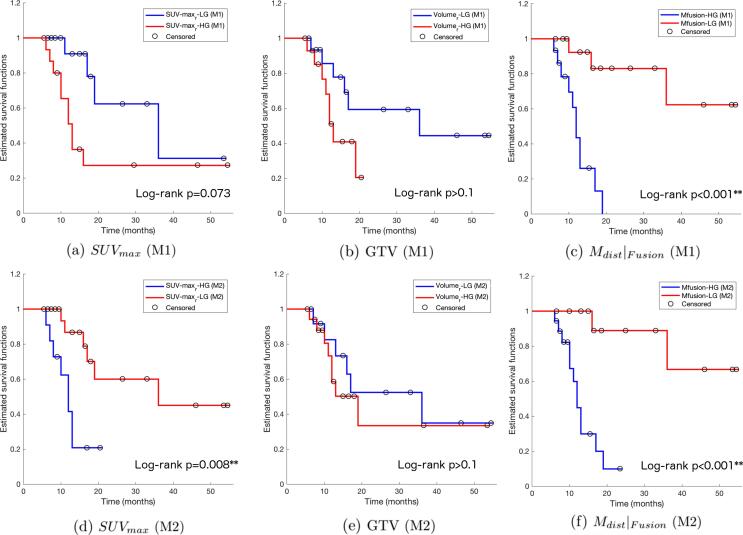
Thirty-one PA patients with pre and post-RT Positron emission tomography/computed tomography (PET/CT) scans were evaluated. 3D meshes of pre- and post-RT tumors were generated and registered to establish vertex-wise correspondence. To assess tumor response, Mahalanobis distances ( ∣) between pre- and post-RT tumor surfaces with anatomic and metabolic fused vectors were calculated for each patient. ∣ was evaluated by overall survival (OS) prediction and survival risk classification. As a comparison, the same analyses were conducted on traditional imaging/physiological predictors, and distances measurements based on metabolic and morphological features only.
Among all the imaging/physiological parameters, ∣ was shown to be the best predictor of OS (HR = 0.52, p = 0.008), while other parameters failed to reach significance. Moreover, ∣ outperformed traditional morphologic and metabolic measurements in patient risk stratification, either alone (HR = 11.51, p < 0.001) or combined with age (HR = 9.04, p < 0.001).
We introduced a PET/CT-based novel morphologic and metabolic pipeline for response evaluation in locally advanced PA. The fused ∣ outperformed traditional morphologic, metabolic, and physiological measurements in OS prediction and risk stratification. The novel fusion model may serve as a new imaging-marker to more accurately characterize the heterogeneous tumor RT response.
胰腺腺癌(PA)的自适应放射治疗计划依赖于准确的治疗反应评估,而传统的反应评估标准在表征具有复杂形态特征或内在低代谢的肿瘤方面效率低下。为了更好地评估PA的治疗反应,我们对三维放疗前和放疗后(RT)肿瘤模型的区域形态和代谢特征进行了量化和比较。
对31例放疗前后均进行正电子发射断层扫描/计算机断层扫描(PET/CT)的PA患者进行评估。生成放疗前和放疗后肿瘤的三维网格并进行配准,以建立逐顶点对应关系。为了评估肿瘤反应,计算了每位患者放疗前和放疗后肿瘤表面之间的马氏距离(∣),该距离结合了解剖学和代谢融合向量。通过总生存期(OS)预测和生存风险分类对∣进行评估。作为比较,对传统的影像学/生理学预测指标以及仅基于代谢和形态特征的距离测量进行了相同的分析。
在所有影像学/生理学参数中,∣被证明是OS的最佳预测指标(HR = 0.52,p = 0.008),而其他参数未达到显著水平。此外,在患者风险分层方面,∣单独使用(HR = 11.51,p < 0.001)或与年龄联合使用(HR = 9.04,p < 0.001)均优于传统的形态学和代谢测量。
我们引入了一种基于PET/CT的新型形态学和代谢流程,用于局部晚期PA的反应评估。融合后的∣在OS预测和风险分层方面优于传统的形态学、代谢和生理学测量。这种新型融合模型可作为一种新的影像学标志物,以更准确地表征异质性肿瘤的放疗反应。