Division of Chemistry and Chemical Engineering, California Institute of Technology, Pasadena, California, United States of America.
Division of Biology and Biological Engineering, California Institute of Technology, Pasadena, California, United States of America.
PLoS Biol. 2020 Mar 19;18(3):e3000652. doi: 10.1371/journal.pbio.3000652. eCollection 2020 Mar.
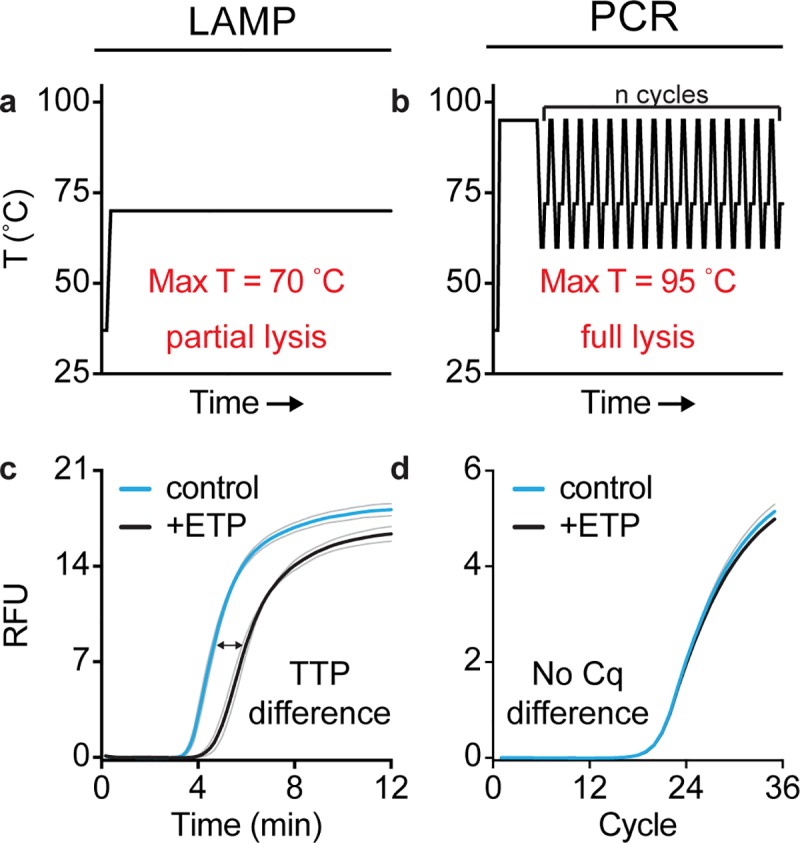
The rise in carbapenem-resistant Enterobacteriaceae (CRE) infections has created a global health emergency, underlining the critical need to develop faster diagnostics to treat swiftly and correctly. Although rapid pathogen-identification (ID) tests are being developed, gold-standard antibiotic susceptibility testing (AST) remains unacceptably slow (1-2 d), and innovative approaches for rapid phenotypic ASTs for CREs are urgently needed. Motivated by this need, in this manuscript we tested the hypothesis that upon treatment with β-lactam antibiotics, susceptible Enterobacteriaceae isolates would become sufficiently permeabilized, making some of their DNA accessible to added polymerase and primers. Further, we hypothesized that this accessible DNA would be detectable directly by isothermal amplification methods that do not fully lyse bacterial cells. We build on these results to develop the polymerase-accessibility AST (pol-aAST), a new phenotypic approach for β-lactams, the major antibiotic class for gram-negative infections. We test isolates of the 3 causative pathogens of CRE infections using ceftriaxone (CRO), ertapenem (ETP), and meropenem (MEM) and demonstrate agreement with gold-standard AST. Importantly, pol-aAST correctly categorized resistant isolates that are undetectable by current genotypic methods (negative for β-lactamase genes or lacking predictive genotypes). We also test contrived and clinical urine samples. We show that the pol-aAST can be performed in 30 min sample-to-answer using contrived urine samples and has the potential to be performed directly on clinical urine specimens.
碳青霉烯类耐药肠杆菌科(CRE)感染的增加已经造成了全球卫生紧急情况,这突出表明迫切需要开发更快的诊断方法以迅速、正确地进行治疗。尽管正在开发快速病原体鉴定(ID)测试,但黄金标准抗生素药敏测试(AST)仍然慢得令人无法接受(1-2 天),因此迫切需要用于快速表型 CREs AST 的创新方法。出于这种需求,在本文中,我们检验了以下假设:在使用β-内酰胺类抗生素治疗后,敏感的肠杆菌科分离株会变得足够通透,从而使一些 DNA 可以被添加的聚合酶和引物接触。此外,我们假设这种可接触的 DNA 可以通过不完全裂解细菌细胞的等温扩增方法直接检测到。我们在此基础上进一步开发了聚合酶可及性 AST(pol-aAST),这是一种用于β-内酰胺类抗生素的新表型方法,β-内酰胺类抗生素是革兰氏阴性感染的主要抗生素类别。我们使用头孢曲松(CRO)、厄他培南(ETP)和美罗培南(MEM)测试了导致 CRE 感染的 3 种病原体的分离株,并证明与黄金标准 AST 具有一致性。重要的是,pol-aAST 可以正确分类目前基于基因型的方法无法检测到的耐药分离株(缺乏β-内酰胺酶基因或缺乏预测基因型)。我们还测试了人工和临床尿液样本。我们表明,pol-aAST 可以在 30 分钟内完成样本到答案的测试,使用人工尿液样本,并且有可能直接在临床尿液标本上进行。