Department of Epidemiology and Biostatistics, University of California, San Francisco, San Francisco, California, United States of America.
Department of Medicine, Stanford University, Stanford, California, United States of America.
PLoS Med. 2020 Mar 19;17(3):e1003064. doi: 10.1371/journal.pmed.1003064. eCollection 2020 Mar.
Drought has many known deleterious impacts on human health, but little is known about the relationship between drought and intimate partner violence (IPV). We aimed to evaluate this relationship and to assess effect heterogeneity between population subgroups among women in 19 sub-Saharan African countries.
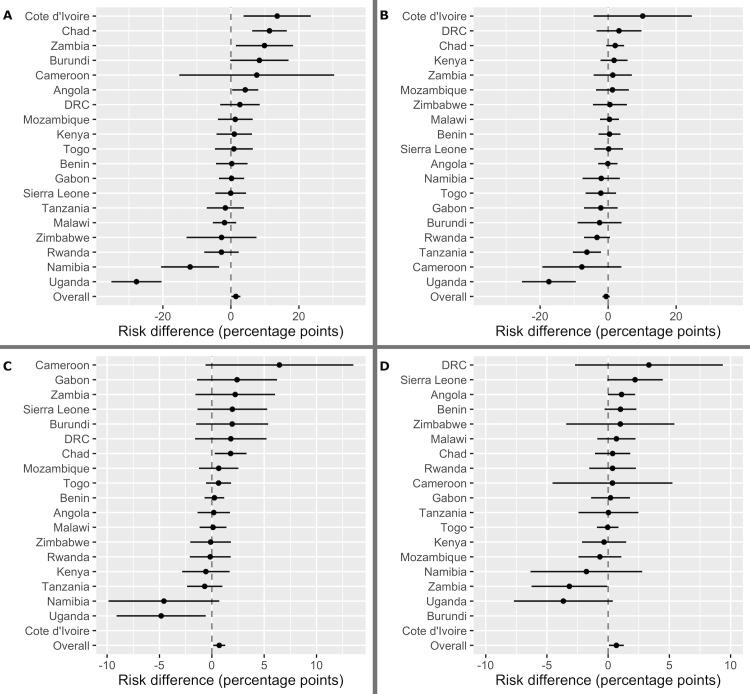
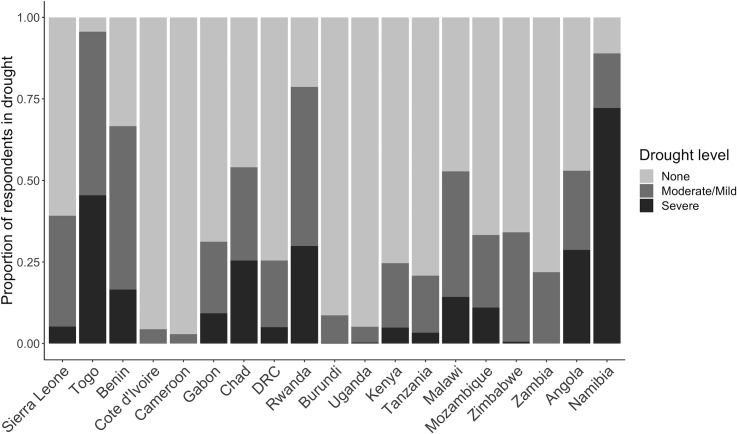
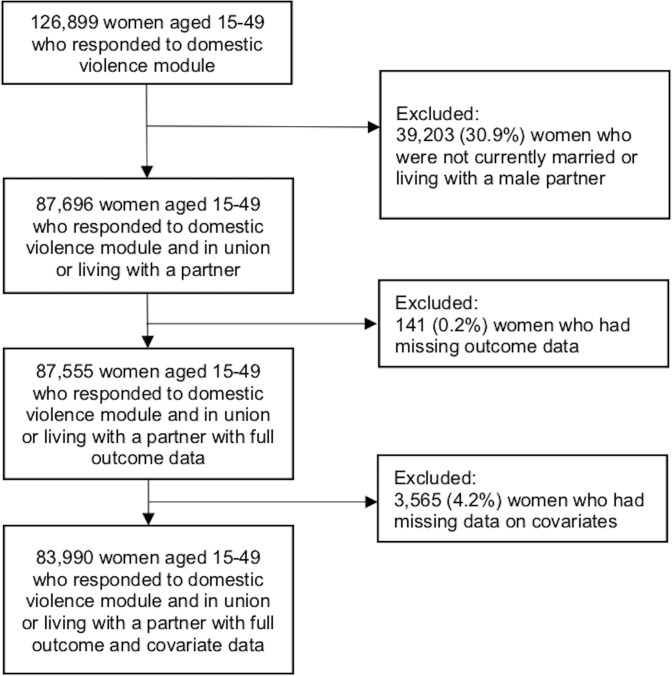
We used data from 19 Demographic and Health Surveys from 2011 to 2018 including 83,990 partnered women aged 15-49 years. Deviations in rainfall in the year before the survey date were measured relative to the 29 previous years using Climate Hazards Group InfraRed Precipitation with Station data, with recent drought classified as ordinal categorical variable (severe: ≤10th percentile; mild/moderate: >10th percentile to ≤30th percentile; none: >30th percentile). We considered 4 IPV-related outcomes: reporting a controlling partner (a risk factor for IPV) and experiencing emotional violence, physical violence, or sexual violence in the 12 months prior to survey. Logistic regression was used to estimate marginal risk differences (RDs). We evaluated the presence of effect heterogeneity by age group and employment status. Of the 83,990 women included in the analytic sample, 10.7% (9,019) experienced severe drought and 23.4% (19,639) experienced mild/moderate drought in the year prior to the survey, with substantial heterogeneity across countries. The mean age of respondents was 30.8 years (standard deviation 8.2). The majority of women lived in rural areas (66.3%) and were married (73.3%), while less than half (42.6%) were literate. Women living in severe drought had higher risk of reporting a controlling partner (marginal RD in percentage points = 3.0, 95% CI 1.3, 4.6; p < 0.001), experiencing physical violence (marginal RD = 0.8, 95% CI 0.1, 1.5; p = 0.019), and experiencing sexual violence (marginal RD = 1.2, 95% CI 0.4, 2.0; p = 0.001) compared with women not experiencing drought. Women living in mild/moderate drought had higher risk of reporting physical (marginal RD = 0.7, 95% CI 0.2, 1.1; p = 0.003) and sexual violence (marginal RD = 0.7, 95% CI 0.3, 1.2; p = 0.001) compared with those not living in drought. We did not find evidence for an association between drought and emotional violence. In analyses stratified by country, we found 3 settings where drought was protective for at least 1 measure of IPV: Namibia, Tanzania, and Uganda. We found evidence for effect heterogeneity (additive interaction) for the association between drought and younger age and between drought and employment status, with stronger associations between drought and IPV among adolescent girls and unemployed women. This study is limited by its lack of measured hypothesized mediating variables linking drought and IPV, prohibiting a formal mediation analysis. Additional limitations include the potential for bias due to residual confounding and potential non-differential misclassification of the outcome measures leading to an attenuation of observed associations.
Our findings indicate that drought was associated with measures of IPV towards women, with larger positive associations among adolescent girls and unemployed women. There was heterogeneity in these associations across countries. Weather shocks may exacerbate vulnerabilities among women in sub-Saharan Africa. Future work should further evaluate potential mechanisms driving these relationships.
干旱对人类健康有许多已知的不利影响,但人们对干旱与亲密伴侣暴力(IPV)之间的关系知之甚少。我们旨在评估这种关系,并评估撒哈拉以南非洲 19 个国家妇女中人口亚组之间的效应异质性。
我们使用了 2011 年至 2018 年 19 次人口与健康调查的数据,包括 83990 名年龄在 15-49 岁之间的有伴侣女性。使用气候危害组红外降水与台站数据,将调查日期前一年的降雨量与前 29 年的降雨量进行比较,衡量降雨量的偏差,将近期干旱分为有序分类变量(严重:≤第 10 百分位;轻度/中度:>第 10 百分位至≤第 30 百分位;无:>第 30 百分位)。我们考虑了 4 个与 IPV 相关的结果:报告有控制欲的伴侣(IPV 的一个风险因素)以及在调查前 12 个月经历情绪暴力、身体暴力或性暴力。使用逻辑回归估计边际风险差异(RD)。我们通过年龄组和就业状况评估了效应异质性的存在。在分析样本中的 83990 名女性中,10.7%(9019 人)经历了严重干旱,23.4%(19639 人)经历了轻度/中度干旱,各国之间存在很大的差异。受访者的平均年龄为 30.8 岁(标准差为 8.2)。大多数女性居住在农村地区(66.3%)和已婚(73.3%),而不到一半(42.6%)识字。生活在严重干旱地区的妇女报告有控制欲的伴侣的风险更高(百分比点的边际 RD=3.0,95%CI 1.3,4.6;p<0.001)、经历身体暴力(边际 RD=0.8,95%CI 0.1,1.5;p=0.019)和性暴力(边际 RD=1.2,95%CI 0.4,2.0;p=0.001)的风险高于未经历干旱的妇女。生活在轻度/中度干旱地区的妇女报告身体暴力(边际 RD=0.7,95%CI 0.2,1.1;p=0.003)和性暴力(边际 RD=0.7,95%CI 0.3,1.2;p=0.001)的风险高于未经历干旱的妇女。我们没有发现干旱与情绪暴力之间存在关联的证据。在按国家划分的分析中,我们发现有 3 个国家存在干旱对至少 1 项 IPV 措施具有保护作用:纳米比亚、坦桑尼亚和乌干达。我们发现,干旱与年龄较小和就业状况之间的关联存在效应异质性(附加交互作用),干旱与 IPV 之间的关联在少女和失业妇女中更强。本研究存在一些局限性,例如缺乏测量干旱和 IPV 之间假设中介变量的关联,限制了正式的中介分析。其他限制因素包括由于残留混杂而导致的偏倚的可能性和对结果测量的潜在非差异错误分类,这可能会削弱观察到的关联。
我们的研究结果表明,干旱与针对妇女的 IPV 测量指标有关,青少年女孩和失业妇女的关联更大。这些关联在国家之间存在异质性。天气冲击可能会加剧撒哈拉以南非洲妇女的脆弱性。未来的工作应进一步评估潜在的潜在机制,推动这些关系。