Hertzog Lucas, Makate Marshall, Chipanta David, Banougnin Boladé, Mchenga Martina, Pereira Gavin, Nyadanu Sylvester Dodzi, Dunne Jennifer, Tallman Paula S, Collins Shalean, Alene Kefyalew Addis, Rousseau-Gueutin Pauline, Mavisakalyan Astghik, Hanigan Ivan C
Curtin School of Population Health, Faculty of Health Sciences, Curtin University, Perth, Australia.
WHO Collaborating Centre for Climate Change and Health Impact Assessment, Perth, Australia.
PLOS Glob Public Health. 2025 Jun 26;5(6):e0004752. doi: 10.1371/journal.pgph.0004752. eCollection 2025.
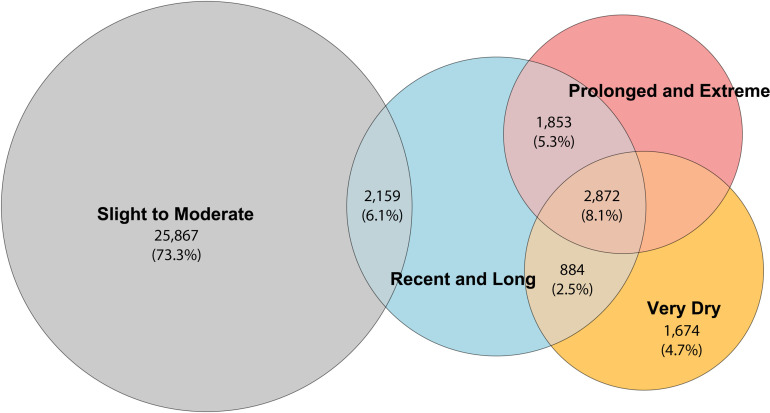
Droughts have profound and far-reaching impacts on human health and well-being, but their influence on sexual violence among adolescent girls in low- and middle-income countries (LMICs) is underexamined.This study examines the association between drought and sexual violence against adolescent girls and young women globally, using cross-sectional, nationally representative data from the Violence Against Children and Youth Surveys (VACS) from 2013 and 2019. The sample includes 35,309 females aged 13-24 from 14 countries in Central and South America, sub-Saharan Africa, Southeast Asia, and Eastern Europe. Sexual violence was defined based on unwanted sexual contact, completed or attempted forced penetration, and pressured sexual activity within the past 12 months. Drought exposure captured intensity and duration of drought conditions measured using the Global Standardized Precipitation-Evapotranspiration Index (SPEI) over a 48-month period before surveys. Bayesian Generalized Linear Models were employed to estimate the association between drought exposure and reported experiences of sexual violence, controlling for age, relationship status, school attendance, and wealth. The analysis revealed that exposure to prolonged and extreme drought, lasting 8-43 months in a 48-month period, was associated with higher odds of sexual violence (OR 1.21, 95% CI 1.21 to 1.22). Very dry periods are also associated with increased odds of experiencing sexual violence (OR 1.04, 95% CI 1.04 to 1.05). In contrast with extreme conditions, exposure to slight to moderate drought and recent and long periods suggested potential protective effects.This study provides novel evidence of an association between extreme drought and an increased likelihood of sexual violence against adolescent girls and young women in LMICs. The findings emphasise how climate change can exacerbate social vulnerabilities through its indirect effects, highlighting the need for comprehensive assessments of its impact on vulnerable populations.
干旱对人类健康和福祉有着深远的影响,但在低收入和中等收入国家(LMICs),干旱对少女遭受性暴力的影响却未得到充分研究。本研究利用2013年和2019年《暴力侵害儿童和青年调查》(VACS)中的横断面、具有全国代表性的数据,考察了全球范围内干旱与针对少女和年轻女性的性暴力之间的关联。样本包括来自中美洲、南美洲、撒哈拉以南非洲、东南亚和东欧14个国家的35309名年龄在13 - 24岁的女性。性暴力的定义基于过去12个月内不想要的性接触、已完成或未遂的强迫性侵犯以及被迫的性活动。干旱暴露情况通过在调查前48个月期间使用全球标准化降水 - 蒸散指数(SPEI)测量的干旱状况的强度和持续时间来体现。采用贝叶斯广义线性模型来估计干旱暴露与报告的性暴力经历之间的关联,并控制年龄、恋爱状况、上学情况和财富等因素。分析表明,在48个月期间持续8 - 43个月的长期极端干旱暴露与性暴力发生几率较高相关(比值比1.21,95%置信区间1.21至1.22)。非常干燥的时期也与遭受性暴力的几率增加相关(比值比1.04,95%置信区间1.04至1.05)。与极端情况相反,轻度至中度干旱以及近期和长期的暴露显示出潜在的保护作用。本研究提供了新的证据,证明在低收入和中等收入国家,极端干旱与少女和年轻女性遭受性暴力的可能性增加之间存在关联。研究结果强调了气候变化如何通过其间接影响加剧社会脆弱性,凸显了全面评估其对弱势群体影响的必要性。