Warnell School of Forestry and Natural Resources, University of Georgia, Athens, Georgia, United States of America.
Southeastern Cooperative Wildlife Disease Study, College of Veterinary Medicine, University of Georgia, Athens, Georgia, United States of America.
PLoS One. 2020 Mar 19;15(3):e0230158. doi: 10.1371/journal.pone.0230158. eCollection 2020.
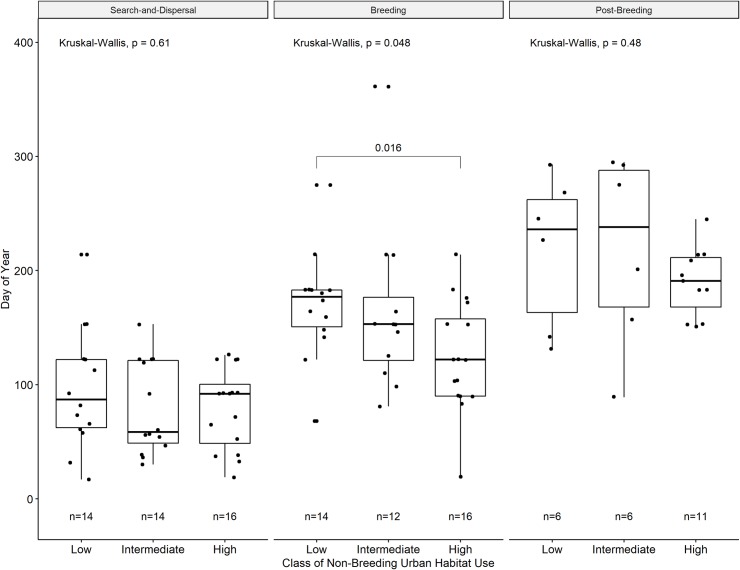
The American White Ibis (Eudocimus albus) is a nomadic wading bird that is increasing the amount of time spent foraging in urban areas, relying on artificial wetlands and other anthropogenic resources year-round. In this study, we explore whether and how American White Ibis association with urban environments is predictive of variation in the timing and length of behavioral seasons. Other urbanized species exhibit altered annual cycles such as loss of migratory behavior and year-round breeding related to consistent resource abundance, often related to intentional and unintentional provisioning. To determine if these same patterns of behavior were also present in White Ibis, we used behavioral change point analysis to segment the tracks of 41 ibis equipped with GPS backpacks to identify the initiation and duration of four behavioral seasons (non-breeding, pre-breeding, breeding, post-breeding) the degree of urban association. We found that intraspecific variation in urban habitat use had strong carryover effects on the timing and duration of behavioral seasons. This study revealed ibis with higher use of urban habitats in non-breeding seasons had longer non-breeding seasons and shorter breeding seasons that began earlier in the year compared to ibis that primarily use wetland habitats. The timing and duration of seasons also varied with ibis age, such that ibis spent more time engaged in breeding-related seasons as they aged. Juvenile and subadult ibis, though considered to be reproductively immature, also exhibit behavioral shifts in relation to breeding seasons. The behavioral patterns found in this study provide evidence that ibis are adapting their annual cycles and seasonal behaviors to exploit urban resources. Future research is needed to identify the effect of interactions between ibis urban association and age on behavioral season expression.
美洲白鹮(Eudocimus albus)是一种迁徙性涉禽,它越来越多地在城市地区觅食,全年依赖人工湿地和其他人为资源。在这项研究中,我们探讨了美洲白鹮与城市环境的联系是否以及如何预测行为季节的时间和长度的变化。其他城市化物种表现出改变的年周期,例如由于一致的资源丰富度而失去迁徙行为和全年繁殖,这通常与有意和无意的供应有关。为了确定这些相同的行为模式是否也存在于白鹮中,我们使用行为变化点分析来分割 41 只携带 GPS 背包的鹮的轨迹,以确定四个行为季节(非繁殖、繁殖前、繁殖、繁殖后)的开始和持续时间以及城市联系的程度。我们发现,同种内对城市生境的利用变化具有强烈的持续效应,对行为季节的时间和持续时间有影响。这项研究表明,在非繁殖季节更多地利用城市生境的白鹮,其非繁殖季节更长,繁殖季节开始得更早,与主要利用湿地生境的白鹮相比,繁殖季节更短。季节的时间和持续时间也随白鹮年龄的变化而变化,随着年龄的增长,白鹮更多地参与与繁殖相关的季节。尽管被认为是繁殖不成熟的幼鸟和亚成体鹮,也表现出与繁殖季节有关的行为转变。本研究中发现的行为模式为白鹮正在适应其年周期和季节性行为以利用城市资源提供了证据。需要进一步的研究来确定白鹮与城市的联系和年龄对行为季节表达的相互作用的影响。