Yabsley Michael J, Coker Sarah M, Welch Catharine N, Garrett Kayla B, Murray Maureen, Grunert Ryan, Seixas Julia S, Kistler Whitney M, Curry Shannon E, Adams Henry C, Nakatsu Charlie S, Swanepoel Liandrie, Wyckoff Seth T, Koser Troy M, Kurimo-Beechuk Elizabeth, Haynes Ellen, Hernandez Sonia M
Warnell School of Forestry and Natural Resources, University of Georgia, Athens, GA, USA.
Southeastern Cooperative Wildlife Disease Study, University of Georgia, Athens, GA, USA.
Int J Parasitol Parasites Wildl. 2023 Jun 29;21:269-276. doi: 10.1016/j.ijppaw.2023.06.010. eCollection 2023 Aug.
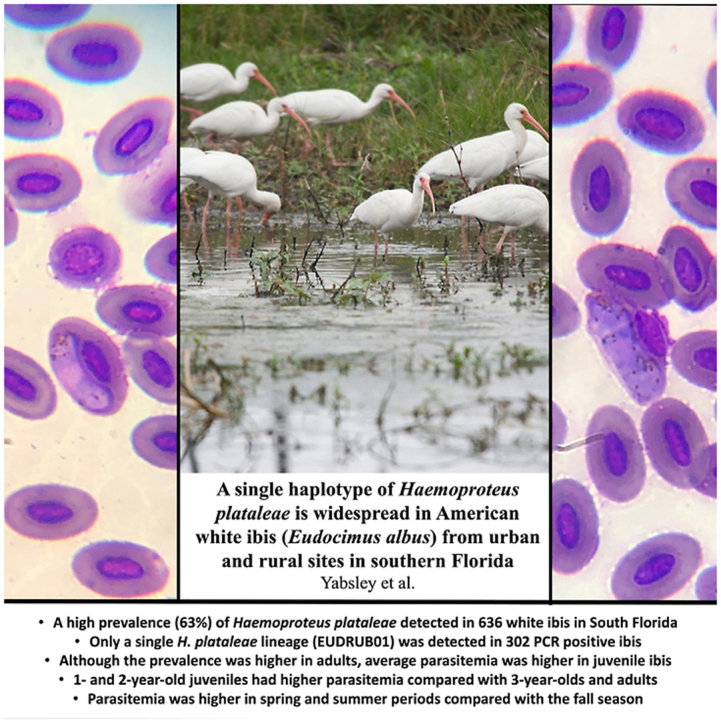
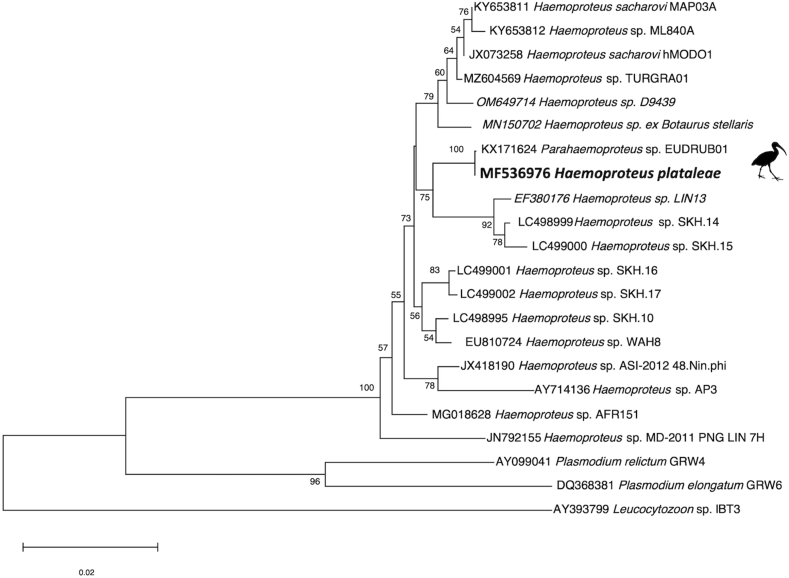
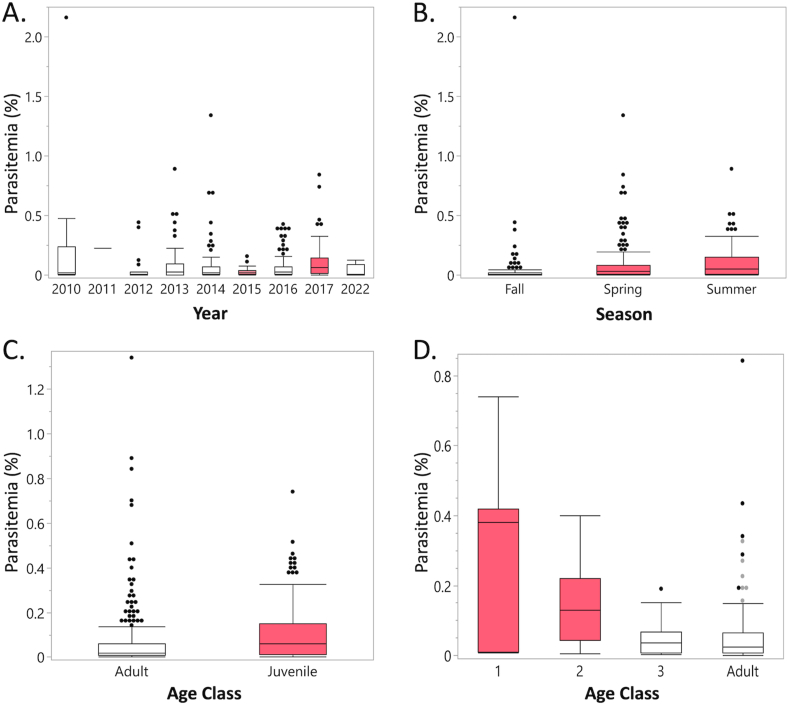
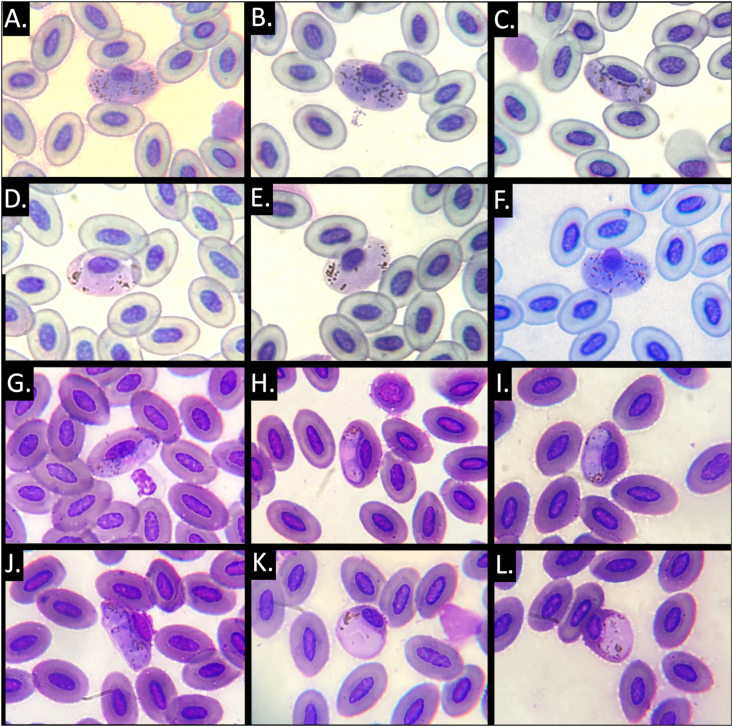
The American white ibis (), a common bird species in Florida, has become increasingly urban, with many populations relying heavily on urban and suburban habitats, which may alter parasite transmission. Parasites of ibis, especially haemosporidians, are understudied. Avian haemosporidia can have a wide range of impacts on birds, including decreased reproductive success or increased mortality. Because southern Florida is subtropical and has a high diversity of potential vectors for haemosporidia, we hypothesized that there will be a high prevalence and genetic diversity of haemosporidia in white ibis. A total of 636 ibis from South Florida were sampled from 2010 to 2022, and blood samples were tested for haemosporidia by examination of Giemsa-stained thin blood smears and/or nested PCRs targeting the cytochrome gene. A total of 400 (62.9%, 95% CI 59-66.7%) ibis were positive for parasites that were morphologically identified as . Sequences of 302 positives revealed a single haplotype of (EUDRUB01), which was previously reported from white ibis in South Florida and captive scarlet ibis () in Brazil. No or infections were detected. Parasitemias of the 400 positive birds were very low (average 0.084%, range 0.001%-2.16% [although only 2 birds had parasitemias >1%]). Prevalence and parasitemias were similar for males and females (68% vs. 61.6% and 0.081% vs. 0.071%, respectively). Prevalence in juveniles was lower compared with adults (52% vs. 67.4%) but parasitemias were higher in juveniles (0.117% vs. 0.065%). This data shows that is common in ibis in South Florida. Although parasitemias were generally low, additional research is needed to determine if this parasite has subclinical effects on ibis, if additional haplotypes or parasite species infect ibis in other regions of their range, or if is pathogenic for other sympatric avian species.
美洲白鹮是佛罗里达州常见的鸟类物种,其越来越多地出现在城市环境中,许多种群严重依赖城市和郊区栖息地,这可能会改变寄生虫的传播。对白鹮的寄生虫,尤其是血孢子虫的研究较少。鸟类血孢子虫可对鸟类产生广泛影响,包括繁殖成功率降低或死亡率增加。由于佛罗里达州南部是亚热带地区,且有多种可能传播血孢子虫的媒介,我们推测白鹮中血孢子虫的感染率和遗传多样性会很高。2010年至2022年期间,共采集了来自南佛罗里达州的636只白鹮样本,并通过检查吉姆萨染色的薄血涂片和/或针对细胞色素b基因的巢式PCR检测血孢子虫。共有400只(62.9%,95%置信区间59 - 66.7%)白鹮的寄生虫检测呈阳性,这些寄生虫在形态上被鉴定为疟原虫。302个阳性样本的序列显示为单一的疟原虫单倍型(EUDRUB01),此前在南佛罗里达州的白鹮和巴西圈养的美洲红鹮中已有报道。未检测到巴贝斯虫或泰勒虫感染。400只阳性鸟类的血虫血症水平非常低(平均0.084%,范围为0.001% - 2.16%[尽管只有2只鸟的血虫血症>1%])。雄性和雌性的感染率和血虫血症水平相似(分别为68%对61.6%和0.081%对0.071%)。幼鸟的感染率低于成年鸟(52%对67.4%),但幼鸟的血虫血症水平更高(0.117%对0.065%)。这些数据表明疟原虫在南佛罗里达州的白鹮中很常见。尽管血虫血症水平通常较低,但仍需要进一步研究以确定这种寄生虫是否对白鹮有亚临床影响,在其分布范围的其他地区是否有其他单倍型或寄生虫物种感染白鹮,或者该疟原虫对其他同域鸟类物种是否具有致病性。