Kim Tae Jin, Park Jeong Gon, Ahn Soon Kil, Kim Kil Won, Choi Jaehyuk, Kim Hyun Young, Ha Sun-Hwa, Seo Woo Duck, Kim Jae Kwang
Division of Life Sciences, College of Life Sciences and Bioengineering, Incheon National University, Incheon 22012, Korea.
Division of Crop Foundation, National Institute of Crop Science, Rural Development Administration, Wanju, Jeonbuk 55365, Korea.
Metabolites. 2020 Mar 17;10(3):112. doi: 10.3390/metabo10030112.
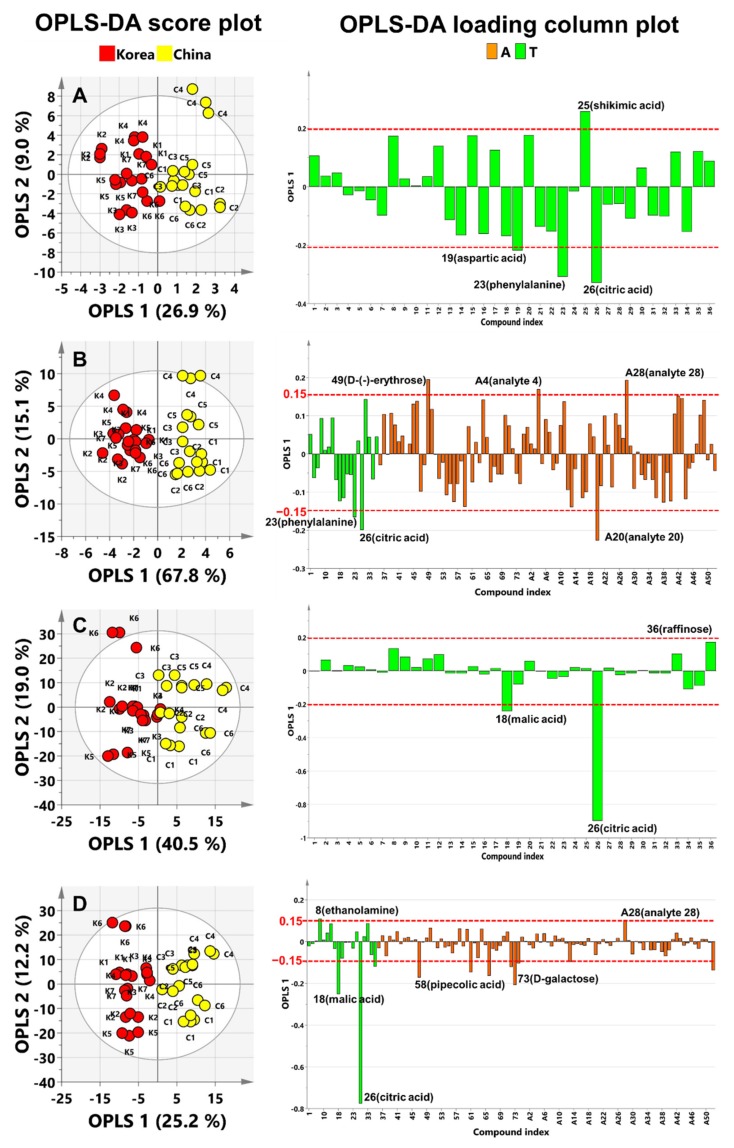
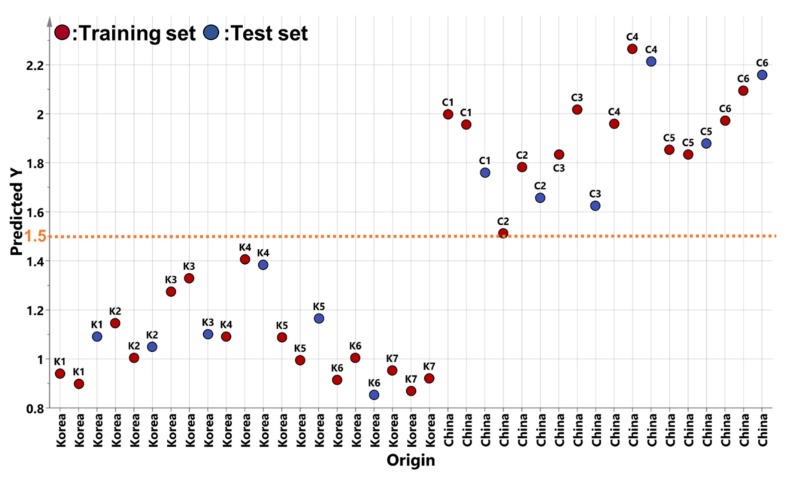
As international food trade increases, consumers are becoming increasingly interested in food safety and authenticity, which are linked to geographical origin. Adzuki beans () are cultivated worldwide, but there are no tools for accurately discriminating their geographical origin. Thus, our study aims to develop a method for discriminating the geographical origin of adzuki beans through targeted and non-targeted metabolite profiling with gas chromatography time-of-flight mass spectrometry combined with multivariate analysis. Orthogonal partial least squares discriminant analysis showed clear discrimination between adzuki beans cultivated in Korea and China. Non-targeted metabolite profiling showed better separation than targeted profiling. Furthermore, citric acid and malic acid were the most notable metabolites for discriminating adzuki beans cultivated in Korea and China. The geographical discrimination method combining non-targeted metabolite profiling and pareto-scaling showed excellent predictability ( = 0.812). Therefore, it is a suitable prediction tool for the discrimination of geographical origin and is expected to be applicable to the geographical authentication of adzuki beans.
随着国际食品贸易的增加,消费者对与地理来源相关的食品安全和真实性越来越感兴趣。小豆在全球范围内种植,但目前尚无准确鉴别其地理来源的工具。因此,我们的研究旨在通过气相色谱-飞行时间质谱结合多变量分析的靶向和非靶向代谢物谱分析,开发一种鉴别小豆地理来源的方法。正交偏最小二乘判别分析显示,韩国和中国种植的小豆之间有明显的区分。非靶向代谢物谱分析比靶向谱分析显示出更好的分离效果。此外,柠檬酸和苹果酸是区分韩国和中国种植的小豆的最显著代谢物。结合非靶向代谢物谱分析和帕累托缩放的地理鉴别方法显示出优异的预测能力( = 0.812)。因此,它是一种适用于鉴别地理来源的预测工具,有望应用于小豆的地理认证。