Institute of Urology, Department of Urology, First Affiliated Hospital, Army Medical University (Third Military Medical University), Chongqing, 400038, China.
Department of Cell Biology, College of Basic Medical Sciences, Army Medical University (Third Military Medical University), Chongqing, 400038, China.
BMC Urol. 2020 Mar 19;20(1):31. doi: 10.1186/s12894-020-00602-9.
A routine blood examination is one of the most rapid, convenient and inexpensive clinical examinations that can reflect a patient's inflammatory status and other blood conditions, and the prognostic value of routine preoperative blood parameters in MIBC patients is still unclear, so we evaluated the prognostic value of routine preoperative blood parameters in muscle-invasive bladder cancer (MIBC) following radical cystectomy (RC).
Data on 202 patients with MIBC who underwent RC at our institution were retrospectively collected between October 2007 and August 2018. The median preoperative neutrophil-lymphocyte ratio (NLR), platelet-lymphocyte ratio (PLR) and hemoglobin (HGB) values were used as cutoffs to form the low and high NLR, low and high PLR, and low and high HGB groups, respectively. The clinicopathologic characteristics of each group were compared by chi-square and t tests. Kaplan-Meier survival and multivariate Cox regression analyses were used to analyze prognosis.
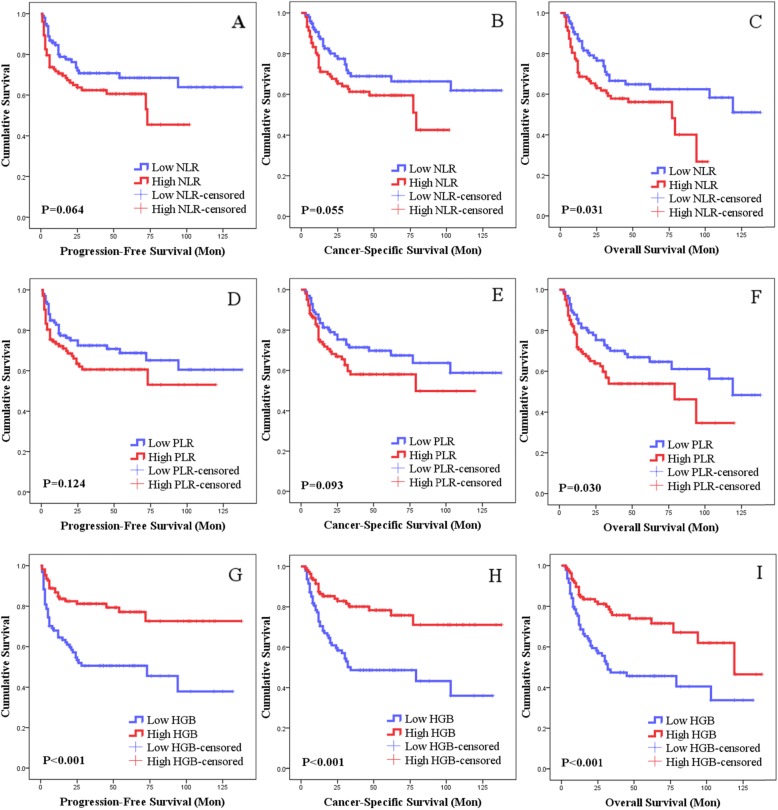
The median NLR, PLR and HGB values were 2.42, 112 and 125 g/L, respectively. Kaplan-Meier results showed that the low HGB group had poor progression-free survival (PFS), cancer-specific survival (CSS) and overall survival (OS). A high NLR and high PLR groups correlated only with poor OS. Multivariate Cox analyses showed that pathological T3/4 stage, positive lymph node status and low HGB were independent risk factors for PFS, CSS and OS, and age was the only independent risk factor for OS.
Preoperative peripheral blood HGB is an independent risk factor for the prognosis of MIBC patients. These data suggest that HGB may be a useful prognostic marker for MIBC patients undergoing RC.
常规血液检查是最快速、方便和廉价的临床检查之一,可以反映患者的炎症状态和其他血液状况,而常规术前血液参数在肌层浸润性膀胱癌(MIBC)患者中的预后价值尚不清楚,因此我们评估了常规术前血液参数在根治性膀胱切除术(RC)后 MIBC 患者中的预后价值。
回顾性收集了 2007 年 10 月至 2018 年 8 月在我院接受 RC 的 202 例 MIBC 患者的数据。中位数术前中性粒细胞-淋巴细胞比值(NLR)、血小板-淋巴细胞比值(PLR)和血红蛋白(HGB)值作为截断值,分别形成低和高 NLR、低和高 PLR 以及低和高 HGB 组。通过卡方检验和 t 检验比较各组的临床病理特征。采用 Kaplan-Meier 生存分析和多因素 Cox 回归分析评估预后。
中位数 NLR、PLR 和 HGB 值分别为 2.42、112 和 125g/L。Kaplan-Meier 结果表明,低 HGB 组的无进展生存期(PFS)、癌症特异性生存期(CSS)和总生存期(OS)较差。高 NLR 和高 PLR 组仅与 OS 不良相关。多因素 Cox 分析表明,病理 T3/4 期、阳性淋巴结状态和低 HGB 是 PFS、CSS 和 OS 的独立危险因素,而年龄是 OS 的唯一独立危险因素。
术前外周血 HGB 是 MIBC 患者预后的独立危险因素。这些数据表明,HGB 可能是 MIBC 患者接受 RC 的有用预后标志物。