School of Engineering, Swiss Federal Institute of Technology in Lausanne (EPFL), Station 17, 1015, Lausanne, Switzerland.
Sci Rep. 2020 Mar 19;10(1):5067. doi: 10.1038/s41598-020-61924-0.
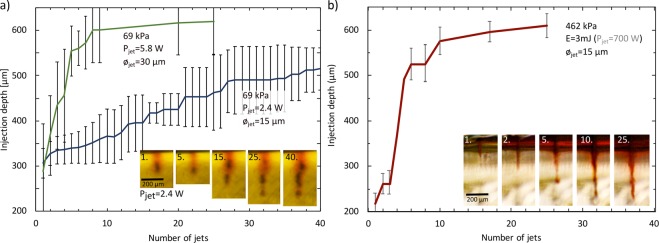
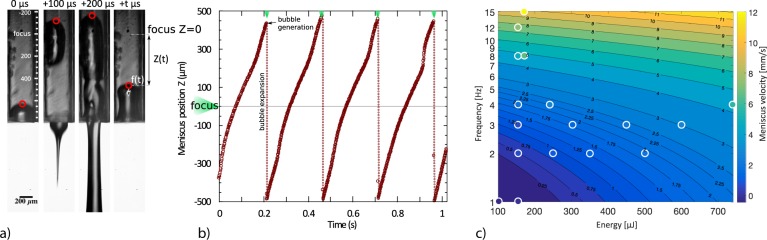
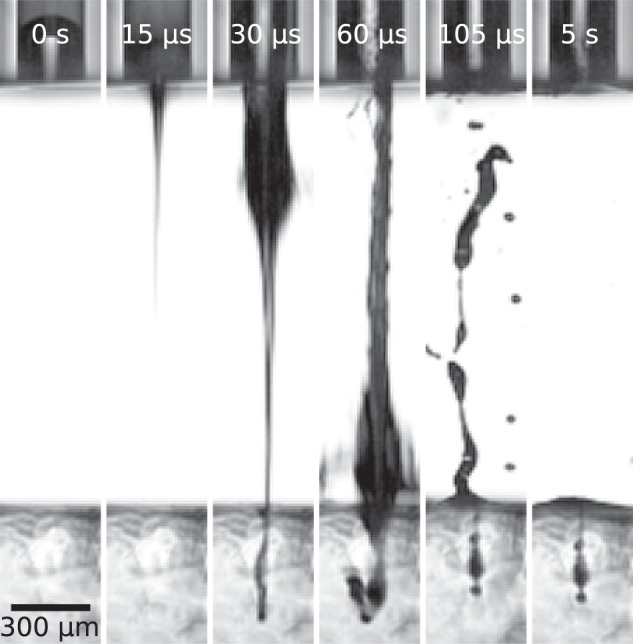
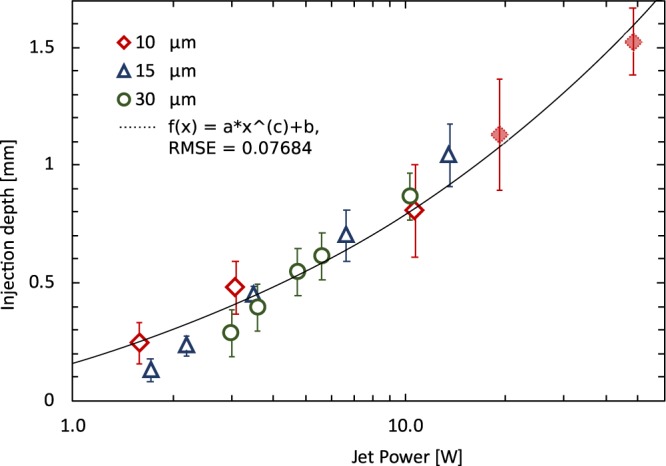
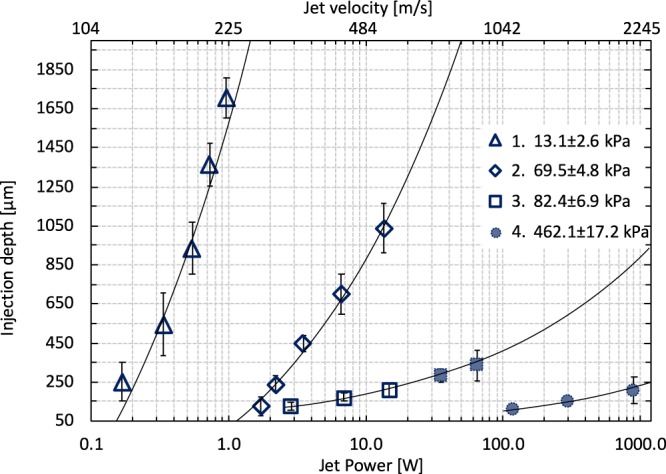
Fast liquid jets are investigated for use as a needle-free drug delivery system into an elastic tissue such as skin. Using smaller jet diameters in a repetitive regime can mitigate bruising and pain associated with current injectors. In this study, we aim to unravel the potential of the method to deliver liquids into biological tissues having higher elasticity than healthy skin (i.e >60 kPa). To address this challenge, we have implemented a laser-based jetting system capable of generating supersonic liquid microjets in a repetitive regime. We provide insights on the penetration of microjets into hydrogel samples with elastic modulus ranging from 16 kPa to 0.5 MPa. The unprecedented speeds of injection (>680 m/s) together with a newly introduced repetitive regime opens possibilities for usage in needle-free drug administration into materials with elasticity covering the wide spectrum of biological soft tissues like blood vessels, all skin layers, scarred or dried skin or tumors.
高速液体射流被研究用作一种无针药物输送系统,将药物注入弹性组织,如皮肤。在重复模式下使用更小的射流直径可以减轻与当前注射器相关的瘀伤和疼痛。在这项研究中,我们旨在揭示该方法将液体输送到比健康皮肤(即 >60 kPa)具有更高弹性的生物组织中的潜力。为了应对这一挑战,我们已经实施了一种基于激光的射流系统,能够在重复模式下产生超音速液体微射流。我们提供了有关微射流进入弹性模量范围从 16 kPa 到 0.5 MPa 的水凝胶样本中的穿透情况的见解。前所未有的注射速度(>680 m/s)以及新引入的重复模式为在弹性覆盖从血管、所有皮肤层、疤痕或干燥皮肤或肿瘤等生物软组织的广泛范围的材料中进行无针药物给药开辟了可能性。