Institute for General Kinesiology and Exercise Science, Faculty of Sports Science, University of Leipzig, D-04109, Leipzig, Germany.
Max Planck Institute for Human Cognitive and Brain Sciences, Department of Neurology, D-04103, Leipzig, Germany.
Sci Rep. 2020 Mar 19;10(1):5021. doi: 10.1038/s41598-020-61909-z.
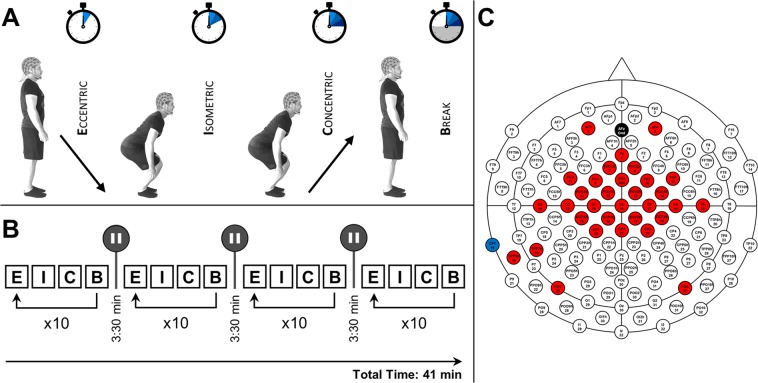
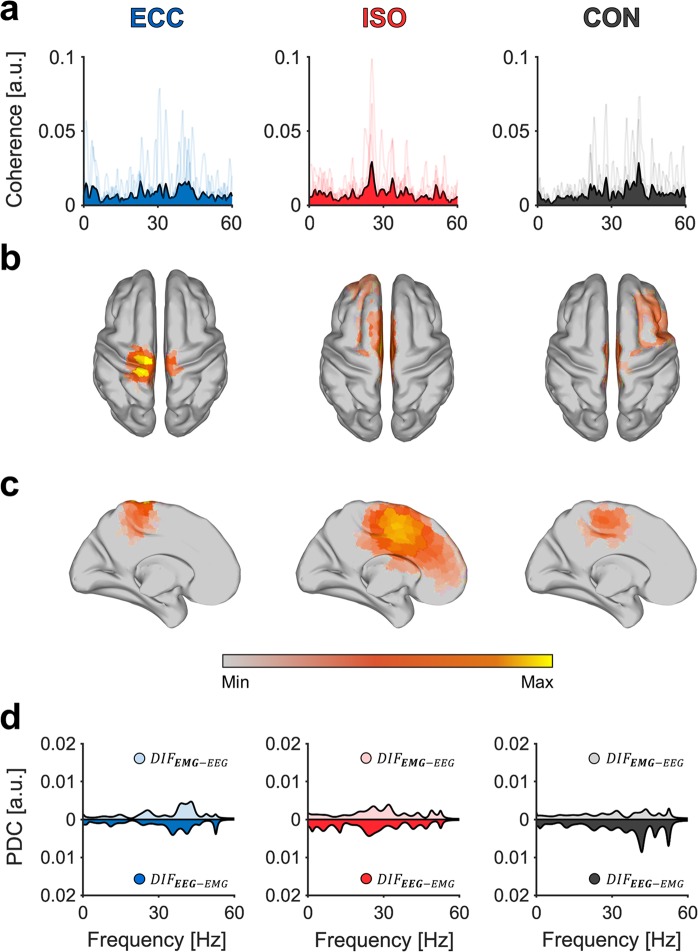
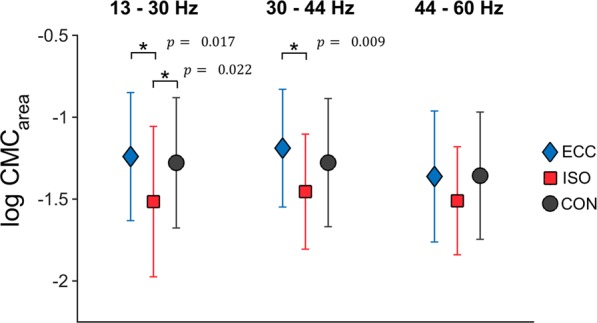
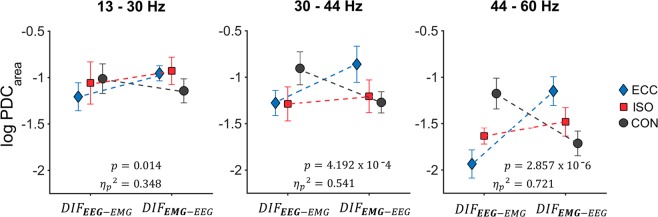
While much is known about motor control during simple movements, corticomuscular communication profiles during compound movement control remain largely unexplored. Here, we aimed at examining frequency band related interactions between brain and muscles during different movement periods of a bipedal squat (BpS) task utilizing regression corticomuscular coherence (rCMC), as well as partial directed coherence (PDC) analyses. Participants performed 40 squats, divided into three successive movement periods (Eccentric (ECC), Isometric (ISO) and Concentric (CON)) in a standardized manner. EEG was recorded from 32 channels specifically-tailored to cover bilateral sensorimotor areas while bilateral EMG was recorded from four main muscles of BpS. We found both significant CMC and PDC (in beta and gamma bands) during BpS execution, where CMC was significantly elevated during ECC and CON when compared to ISO. Further, the dominant direction of information flow (DIF) was most prominent in EEG-EMG direction for CON and EMG-EEG direction for ECC. Collectively, we provide novel evidence that motor control during BpS is potentially achieved through central motor commands driven by a combination of directed inputs spanning across multiple frequency bands. These results serve as an important step toward a better understanding of brain-muscle relationships during multi joint compound movements.
虽然人们对简单运动中的运动控制有了很多了解,但在复合运动控制中,皮质肌肉通讯特征在很大程度上仍未得到探索。在这里,我们旨在利用回归皮质肌肉相干性(rCMC)和偏部分相干性(PDC)分析,检查在双足深蹲(BpS)任务的不同运动期间,大脑和肌肉之间与频带相关的相互作用。参与者以标准化的方式进行了 40 次深蹲,分为三个连续的运动阶段(离心(ECC)、等长(ISO)和向心(CON))。EEG 从 32 个通道记录,这些通道专门设计用于覆盖双侧感觉运动区,而 BpS 的四个主要肌肉则记录双侧 EMG。我们发现 BpS 执行期间存在显著的 CMC 和 PDC(在 beta 和 gamma 频段),与 ISO 相比,ECC 和 CON 期间 CMC 显著升高。此外,信息流的主导方向(DIF)在 CON 时在 EEG-EMG 方向上最为突出,在 ECC 时在 EMG-EEG 方向上最为突出。总之,我们提供了新的证据,表明 BpS 期间的运动控制可能是通过跨越多个频带的定向输入组合驱动的中央运动命令来实现的。这些结果是朝着更好地理解多关节复合运动期间的脑-肌肉关系迈出的重要一步。