Institute for General Kinesiology and Exercise Science, Faculty of Sports Science, University of Leipzig, Leipzig, Germany.
Max Planck Institute for Human Cognitive and Brain Sciences, Department of Neurology, Leipzig, Germany.
J Neurophysiol. 2020 Oct 1;124(4):1045-1055. doi: 10.1152/jn.00231.2020. Epub 2020 Aug 20.
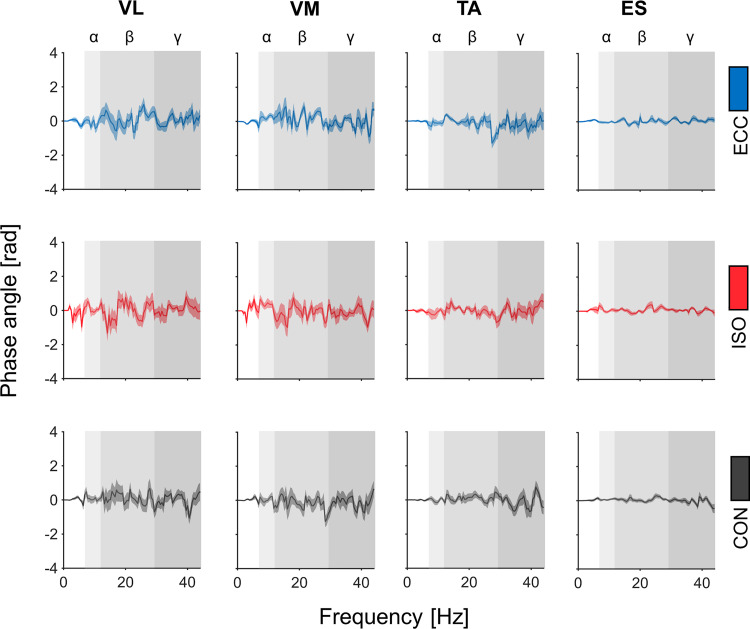
Coordination of functionally coupled muscles is a key aspect of movement execution. Demands on coordinative control increase with the number of involved muscles and joints, as well as with differing movement periods within a given motor sequence. While previous research has provided evidence concerning inter- and intramuscular synchrony in isolated movements, compound movements remain largely unexplored. With this study, we aimed to uncover neural mechanisms of bilateral coordination through intermuscular coherence (IMC) analyses between principal homologous muscles during bipedal squatting (BpS) at multiple frequency bands (alpha, beta, and gamma). For this purpose, participants performed bipedal squats without additional load, which were divided into three distinct movement periods (eccentric, isometric, and concentric). Surface electromyography (EMG) was recorded from four homologous muscle pairs representing prime movers during bipedal squatting. We provide novel evidence that IMC magnitudes differ between movement periods in beta and gamma bands, as well as between homologous muscle pairs across all frequency bands. IMC was greater in the muscle pairs involved in postural and bipedal stability compared with those involved in muscular force during BpS. Furthermore, beta and gamma IMC magnitudes were highest during eccentric movement periods, whereas we did not find movement-related modulations for alpha IMC magnitudes. This finding thus indicates increased integration of afferent information during eccentric movement periods. Collectively, our results shed light on intermuscular synchronization during bipedal squatting, as we provide evidence that central nervous processing of bilateral intermuscular functioning is achieved through task-dependent modulations of common neural input to homologous muscles. It is largely unexplored how the central nervous system achieves coordination of homologous muscles of the upper and lower body within a compound whole body movement, and to what extent this neural drive is modulated between different movement periods and muscles. Using intermuscular coherence analysis, we show that homologous muscle functions are mediated through common oscillatory input that extends over alpha, beta, and gamma frequencies with different synchronization patterns at different movement periods.
功能耦合肌肉的协调是运动执行的一个关键方面。协调控制的需求随着涉及的肌肉和关节数量的增加而增加,以及在给定运动序列内不同的运动周期。虽然以前的研究已经提供了关于孤立运动中肌肉间和肌肉内同步性的证据,但复合运动仍然在很大程度上未被探索。通过这项研究,我们旨在通过双足深蹲(BpS)期间主要同源肌肉之间的肌肉间相干性(IMC)分析,在多个频带(alpha、beta 和 gamma)中揭示双侧协调的神经机制。为此,参与者在没有额外负载的情况下进行双足深蹲,这些深蹲被分为三个不同的运动周期(离心、等长和向心)。表面肌电图(EMG)从代表双足深蹲时主动肌的四个同源肌肉对中记录。我们提供了新的证据,证明在 beta 和 gamma 频段以及在所有频段的同源肌肉对之间,运动周期之间的 IMC 幅度不同。在 BpS 期间,与参与肌肉力量的肌肉对相比,参与姿势和双足稳定性的肌肉对的 IMC 幅度更大。此外,在离心运动期间,beta 和 gamma IMC 幅度最高,而我们没有发现 alpha IMC 幅度与运动相关的调制。因此,这一发现表明在离心运动期间感觉信息的整合增加。总的来说,我们的结果揭示了双足深蹲过程中的肌肉间同步性,因为我们提供的证据表明,通过对同源肌肉共同神经输入的任务相关调制,中枢神经系统实现了双侧肌肉间功能的整合。中枢神经系统如何在复合全身运动中实现上下半身同源肌肉的协调,以及这种神经驱动在不同运动周期和肌肉之间的调制程度,在很大程度上仍未被探索。通过肌肉间相干性分析,我们表明同源肌肉功能是通过共同的振荡输入介导的,该输入在不同的运动周期中以不同的同步模式延伸到 alpha、beta 和 gamma 频率。