Departments of Genetics, Perelman School of Medicine, University of Pennsylvania, Philadelphia, PA, 19104, USA.
Penn Epigenetics Institute, Perelman School of Medicine, University of Pennsylvania, Philadelphia, PA, 19104, USA.
Protein Cell. 2020 Aug;11(8):565-583. doi: 10.1007/s13238-020-00705-x. Epub 2020 Mar 19.
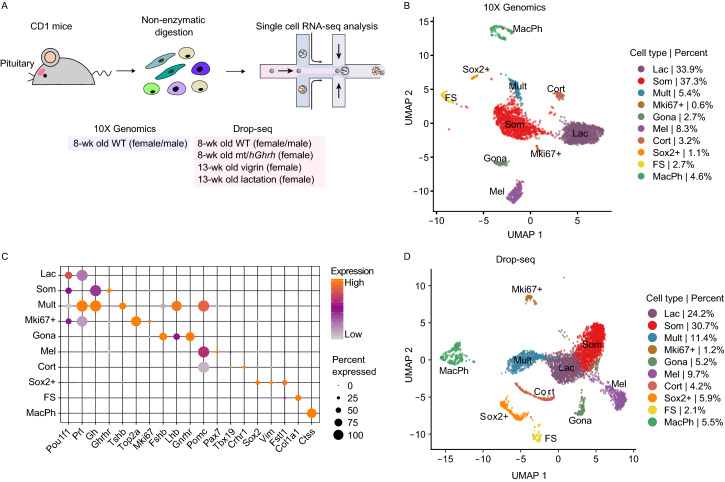
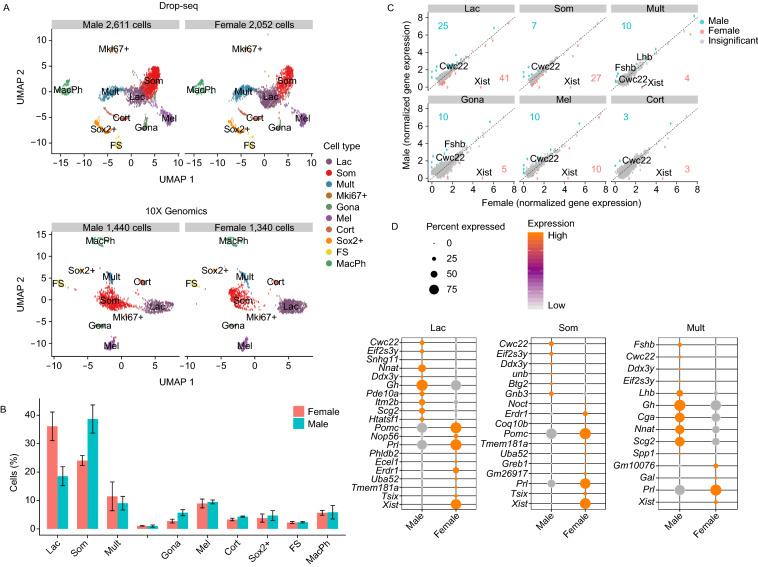
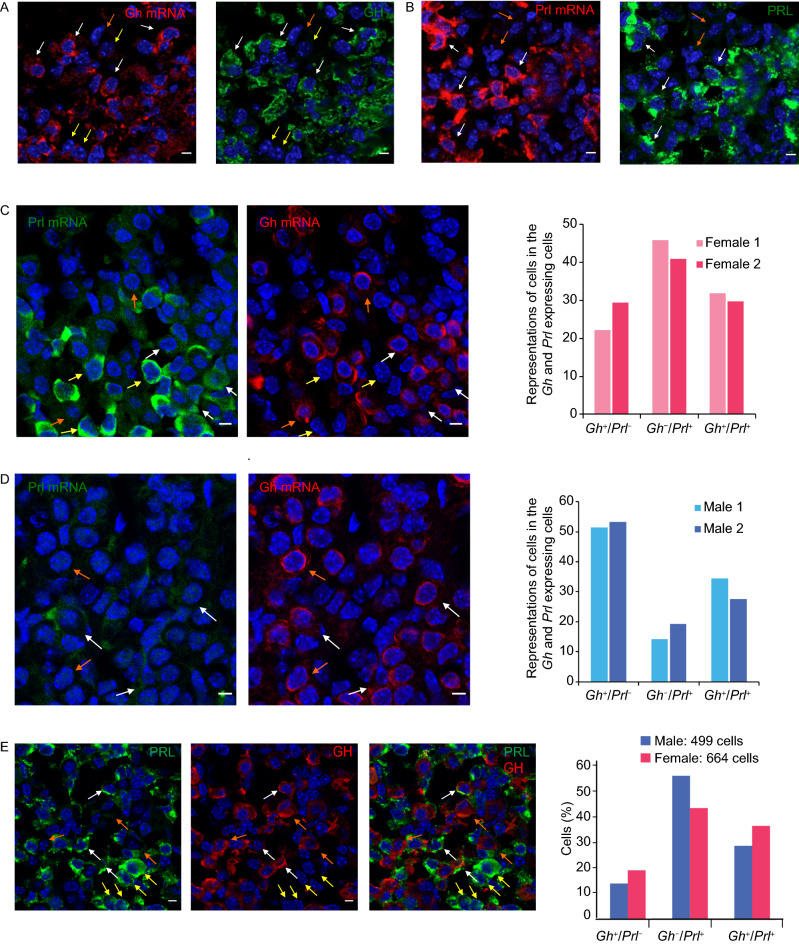
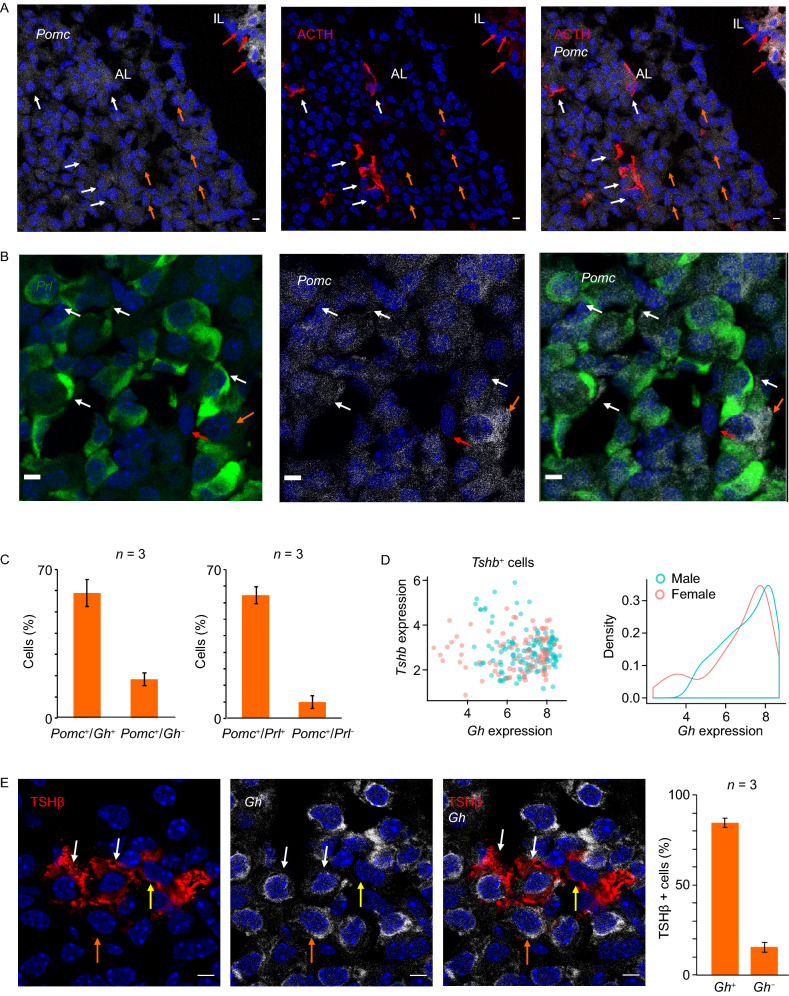
The anterior pituitary gland drives highly conserved physiologic processes in mammalian species. These hormonally controlled processes are central to somatic growth, pubertal transformation, fertility, lactation, and metabolism. Current cellular models of mammalian anteiror pituitary, largely built on candidate gene based immuno-histochemical and mRNA analyses, suggest that each of the seven hormones synthesized by the pituitary is produced by a specific and exclusive cell lineage. However, emerging evidence suggests more complex relationship between hormone specificity and cell plasticity. Here we have applied massively parallel single-cell RNA sequencing (scRNA-seq), in conjunction with complementary imaging-based single-cell analyses of mRNAs and proteins, to systematically map both cell-type diversity and functional state heterogeneity in adult male and female mouse pituitaries at single-cell resolution and in the context of major physiologic demands. These quantitative single-cell analyses reveal sex-specific cell-type composition under normal pituitary homeostasis, identify an array of cells associated with complex complements of hormone-enrichment, and undercover non-hormone producing interstitial and supporting cell-types. Interestingly, we also identified a Pou1f1-expressing cell population that is characterized by a unique multi-hormone gene expression profile. In response to two well-defined physiologic stresses, dynamic shifts in cellular diversity and transcriptome profiles were observed for major hormone producing and the putative multi-hormone cells. These studies reveal unanticipated cellular complexity and plasticity in adult pituitary, and provide a rich resource for further validating and expanding our molecular understanding of pituitary gene expression programs and hormone production.
垂体前叶驱动哺乳动物物种中高度保守的生理过程。这些受激素控制的过程是躯体生长、青春期转化、生育、哺乳和代谢的核心。目前基于候选基因的免疫组织化学和 mRNA 分析的哺乳动物前垂体细胞模型表明,垂体合成的七种激素中的每一种都是由特定的、排他性的细胞谱系产生的。然而,新出现的证据表明激素特异性和细胞可塑性之间存在更复杂的关系。在这里,我们应用大规模平行单细胞 RNA 测序 (scRNA-seq),结合基于互补成像的单个细胞 mRNA 和蛋白质分析,以系统地绘制成年雄性和雌性小鼠垂体在单细胞分辨率下的细胞多样性和功能状态异质性,以及在主要生理需求的背景下。这些定量单细胞分析揭示了正常垂体内稳态下的性别特异性细胞类型组成,确定了一系列与复杂激素富集相关的细胞,并揭示了非激素产生的间质和支持细胞类型。有趣的是,我们还鉴定了一个 Pou1f1 表达细胞群,其特征是独特的多激素基因表达谱。对两种明确的生理应激反应,主要激素产生细胞和假定的多激素细胞的细胞多样性和转录组谱发生了动态变化。这些研究揭示了成年垂体中出人意料的细胞复杂性和可塑性,并为进一步验证和扩展我们对垂体基因表达程序和激素产生的分子理解提供了丰富的资源。