Pathology Department, CARIM School for Cardiovascular Diseases, MUMC Maastricht, P. Debyelaan 25, Maastricht, the Netherlands.
Biochemistry Department, RWTH Aachen, Aachen, Germany.
Cardiovasc Res. 2019 Oct 1;115(12):1705-1715. doi: 10.1093/cvr/cvz185.
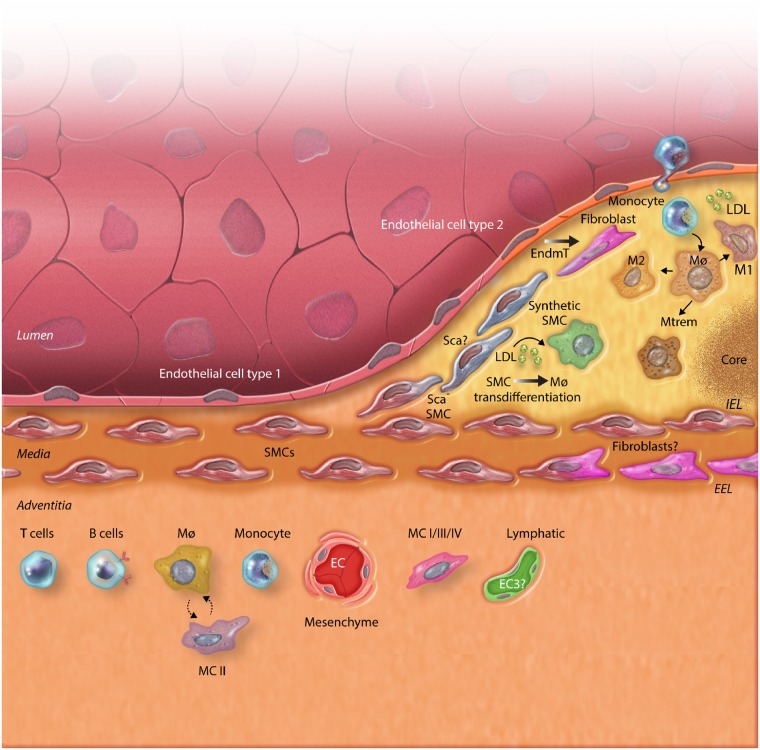
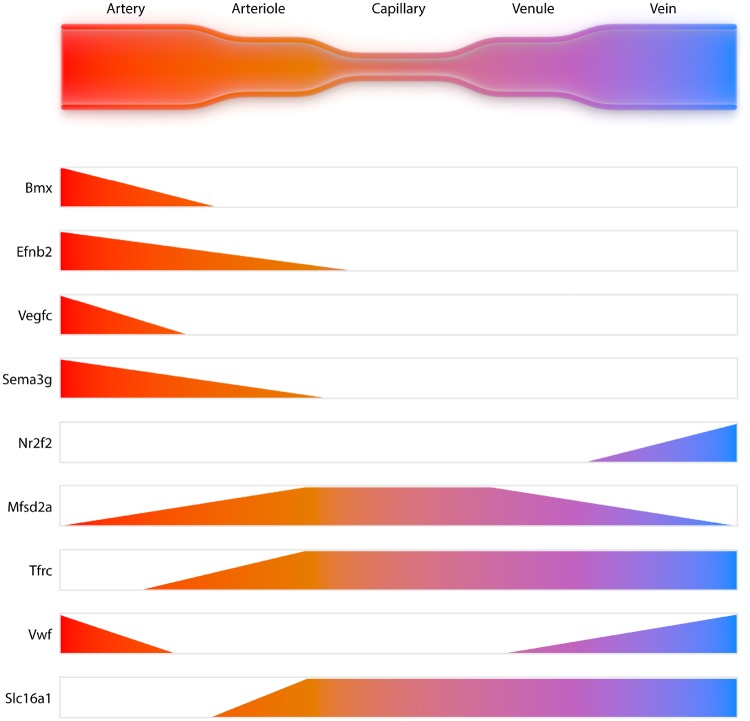
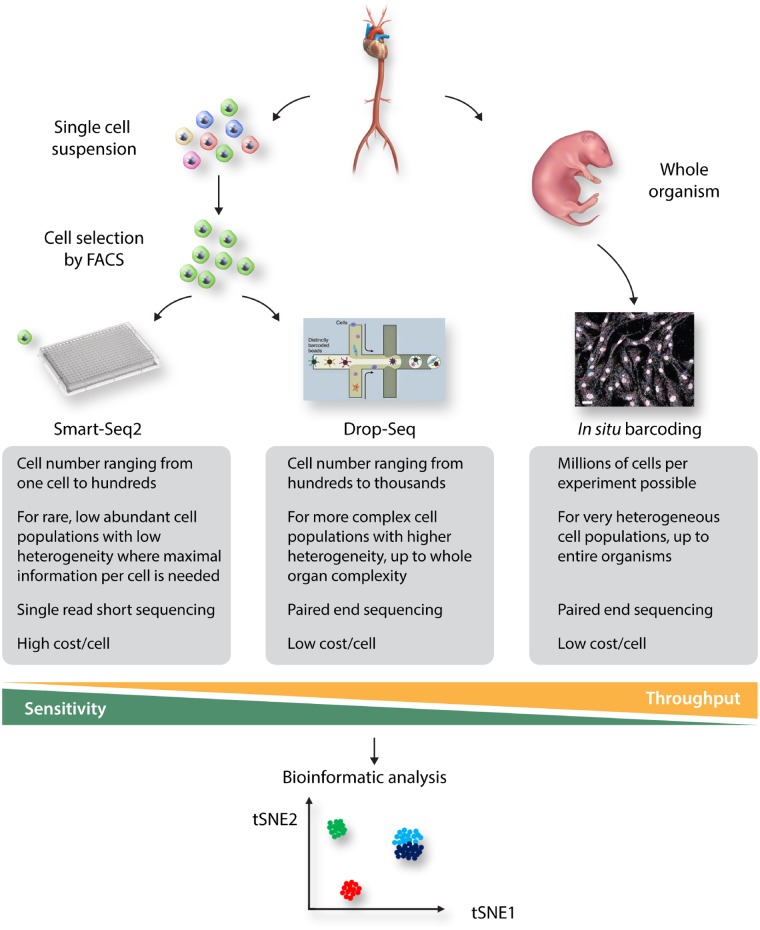
Cellular characteristics and their adjustment to a state of disease have become more evident due to recent advances in imaging, fluorescent reporter mice, and whole genome RNA sequencing. The uncovered cellular heterogeneity and/or plasticity potentially complicates experimental studies and clinical applications, as markers derived from whole tissue 'bulk' sequencing is unable to yield a subtype transcriptome and specific markers. Here, we propose definitions on heterogeneity and plasticity, discuss current knowledge thereof in the vasculature and how this may be improved by single-cell sequencing (SCS). SCS is emerging as an emerging technique, enabling researchers to investigate different cell populations in more depth than ever before. Cell selection methods, e.g. flow assisted cell sorting, and the quantity of cells can influence the choice of SCS method. Smart-Seq2 offers sequencing of the complete mRNA molecule on a low quantity of cells, while Drop-seq is possible on large numbers of cells on a more superficial level. SCS has given more insight in heterogeneity in healthy vasculature, where it revealed that zonation is crucial in gene expression profiles among the anatomical axis. In diseased vasculature, this heterogeneity seems even more prominent with discovery of new immune subsets in atherosclerosis as proof. Vascular smooth muscle cells and mesenchymal cells also share these plastic characteristics with the ability to up-regulate markers linked to stem cells, such as Sca-1 or CD34. Current SCS studies show some limitations to the number of replicates, quantity of cells used, or the loss of spatial information. Bioinformatical tools could give some more insight in current datasets, making use of pseudo-time analysis or RNA velocity to investigate cell differentiation or polarization. In this review, we discuss the use of SCS in unravelling heterogeneity in the vasculature, its current limitations and promising future applications.
由于成像、荧光报告小鼠和全基因组 RNA 测序等方面的最新进展,细胞的特征及其对疾病状态的调节变得更加明显。未被发现的细胞异质性和/或可塑性可能会使实验研究和临床应用复杂化,因为源自整个组织“整体”测序的标记无法产生亚型转录组和特定标记。在这里,我们提出了关于异质性和可塑性的定义,讨论了血管中目前对此的认识,以及单细胞测序 (SCS) 如何改善这一点。SCS 作为一种新兴技术正在出现,使研究人员能够比以往任何时候都更深入地研究不同的细胞群体。细胞选择方法,例如流式辅助细胞分选,以及细胞数量会影响 SCS 方法的选择。Smart-Seq2 可对少量细胞进行完整 mRNA 分子的测序,而 Drop-seq 则可在更浅层水平上对数以千计的细胞进行测序。SCS 使人们对健康血管中的异质性有了更深入的了解,它揭示了在解剖轴上的基因表达谱中,分区是至关重要的。在患病的血管中,这种异质性似乎更加明显,动脉粥样硬化中发现的新免疫亚群就是证明。血管平滑肌细胞和间充质细胞也具有这种可塑性特征,能够上调与干细胞相关的标记物,如 Sca-1 或 CD34。目前的 SCS 研究显示,在复制数量、使用的细胞数量或空间信息的丢失方面存在一些限制。生物信息学工具可以对当前数据集进行一些更深入的分析,利用伪时间分析或 RNA 速度来研究细胞分化或极化。在这篇综述中,我们讨论了 SCS 在揭示血管中异质性方面的应用、其当前的局限性和有前途的未来应用。