Department of Respiration, Xuanwu Hospital, Capital Medical University, Beijing, China (mainland).
College of Humanities and Social Sciences, Harbin Engineering University, Harbin, Heilongjiang, China (mainland).
Med Sci Monit. 2020 Mar 20;26:e923921. doi: 10.12659/MSM.923921.
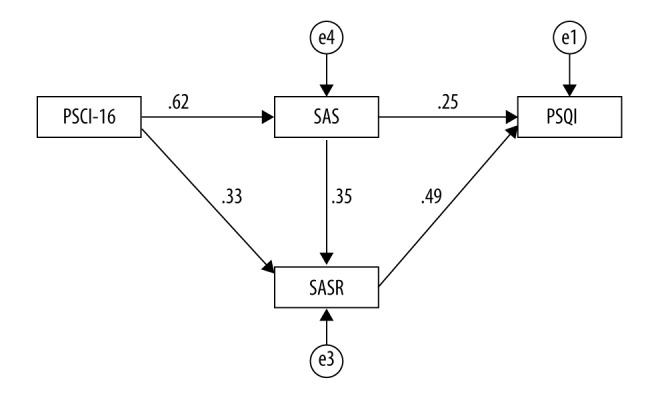
BACKGROUND From the end of December 2019, coronavirus disease 2019 (COVID-19) began to spread in central China. Social capital is a measure of social trust, belonging, and participation. This study aimed to investigate the effects of social capital on sleep quality and the mechanisms involved in people who self-isolated at home for 14 days in January 2020 during the COVID-19 epidemic in central China. MATERIAL AND METHODS Individuals (n=170) who self-isolated at home for 14 days in central China, completed self-reported questionnaires on the third day of isolation. Individual social capital was assessed using the Personal Social Capital Scale 16 (PSCI-16) questionnaire. Anxiety was assessed using the Self-Rating Anxiety Scale (SAS) questionnaire, stress was assessed using the Stanford Acute Stress Reaction (SASR) questionnaire, and sleep was assessed using the Pittsburgh Sleep Quality Index (PSQI) questionnaire. Path analysis was performed to evaluate the relationships between a dependent variable (social capital) and two or more independent variables, using Pearson's correlation analysis and structural equation modeling (SEM). RESULTS Low levels of social capital were associated with increased levels of anxiety and stress, but increased levels of social capital were positively associated with increased quality of sleep. Anxiety was associated with stress and reduced sleep quality, and the combination of anxiety and stress reduced the positive effects of social capital on sleep quality. CONCLUSIONS During a period of individual self-isolation during the COVID-19 virus epidemic in central China, increased social capital improved sleep quality by reducing anxiety and stress.
自 2019 年 12 月底以来,2019 年冠状病毒病(COVID-19)开始在中国中部地区传播。社会资本是衡量社会信任、归属感和参与度的指标。本研究旨在探讨社会资本对睡眠质量的影响,以及在中国中部 COVID-19 疫情期间,2020 年 1 月在家中自我隔离 14 天的人群中涉及的机制。
170 名在家中自我隔离 14 天的个体于隔离的第三天完成了自我报告问卷。个体社会资本采用个人社会资本量表 16(PSCI-16)问卷进行评估。焦虑采用自评焦虑量表(SAS)问卷评估,压力采用斯坦福急性应激反应(SASR)问卷评估,睡眠采用匹兹堡睡眠质量指数(PSQI)问卷评估。采用 Pearson 相关分析和结构方程模型(SEM)对因变量(社会资本)与两个或多个自变量之间的关系进行路径分析。
低水平的社会资本与焦虑和压力水平升高有关,但高水平的社会资本与睡眠质量的提高呈正相关。焦虑与压力和睡眠质量下降有关,焦虑和压力的组合降低了社会资本对睡眠质量的积极影响。
在中国中部 COVID-19 病毒流行期间,个体自我隔离期间,增加社会资本可以通过减轻焦虑和压力来改善睡眠质量。