Alacreu-Crespo Adrián, Olié Emilie, Guillaume Sebastien, Girod Chloé, Cazals Aurélie, Chaudieu Isabelle, Courtet Philippe
PSNREC, Univ. Montpellier, INSERM, CHU de Montpellier, Montpellier, France.
Department of Emergency Psychiatry and Acute Care, Lapeyronie Hospital, CHU Montpellier, Montpellier, France.
Front Psychiatry. 2020 Mar 4;11:97. doi: 10.3389/fpsyt.2020.00097. eCollection 2020.
Several studies demonstrated that the hypothalamic-pituitary-adrenal (HPA) axis is dysregulated in suicide attempters. Prospective studies found that people with an abnormal response at the dexamethasone suppression test (DST) are more likely to commit suicide. However, whether DST may predict suicide attempts remains less clear. A possible strategy to address this question is to consider the suicide attempt lethality.
(1) To compare the pre- and post-DST cortisol levels in serious/violent suicide attempters and in non-serious/non-violent suicide attempters, and (2) to investigate whether cortisol level can predict new suicide attempts or their lethality.
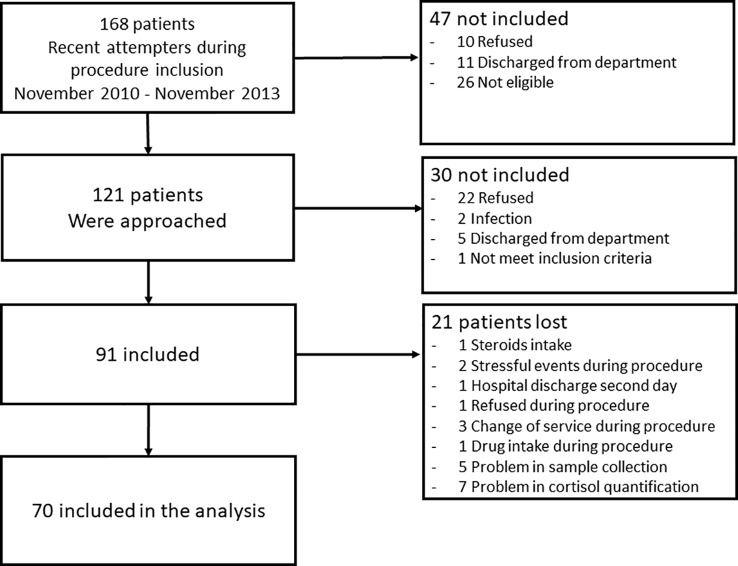
The study included 70 recent suicide attempters (25 with a serious or violent attempt) who were followed for two years. Three saliva samples for cortisol measurement were obtained at 8a.m., 3p.m., and 9p.m. before the DST (pre-DST). Then, at 11 p.m., 1 mg of dexamethasone was given orally. The following day (post-DST), three saliva samples were collected at the same hours as before. The post-DST-pre-DST salivary cortisol Δ index was calculated for each collection time. The Risk-Rescue Ratio Scale (RRRS) and the Suicidal Intent Scale (SIS) were used to characterize the suicide attempt at inclusion and those occurring during the follow-up.
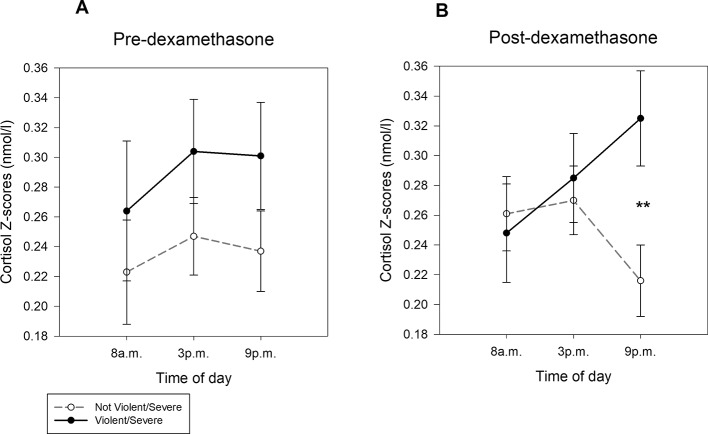
Post-DST cortisol level at 9 p.m. was higher in patients with an initial violent or serious suicide attempt than in non-violent/non-serious attempters (p < .010). Higher post-DST cortisol at 9p.m. was associated with lower RRRS rescue score and higher clinical impression of suicide severity at inclusion. Among the 66 patients who completed the follow-up, 26 attempted suicide again at least once. Higher pre-DST cortisol at 8a.m. predicted new suicide attempts during the follow-up (OR = 2.15 [1.11, 4.15]), and higher cortisol Δ index at 9p.m. was associated with higher suicide intent during the follow-up.
Our results suggest that HPA axis hyper-reactivity monitored with the DST is a marker of violent/serious suicide attempt with lower rescue possibility. Furthermore, higher changes between pre-DST and post-DST cortisol levels may predict higher suicide intent. These findings might help to characterize the biological features of nearest suicide phenotypes.
多项研究表明,自杀未遂者的下丘脑 - 垂体 - 肾上腺(HPA)轴功能失调。前瞻性研究发现,地塞米松抑制试验(DST)反应异常的人更有可能自杀。然而,DST是否可以预测自杀未遂仍不太清楚。解决这个问题的一个可能策略是考虑自杀未遂的致死性。
(1)比较严重/暴力自杀未遂者和非严重/非暴力自杀未遂者在DST前后的皮质醇水平,以及(2)调查皮质醇水平是否可以预测新的自杀未遂或其致死性。
该研究纳入了70名近期自杀未遂者(25名有严重或暴力自杀未遂行为),并对他们进行了为期两年的随访。在DST前(DST前)的上午8点、下午3点和晚上9点采集三份唾液样本用于测量皮质醇。然后,在晚上11点口服1毫克地塞米松。第二天(DST后),在与之前相同的时间采集三份唾液样本。计算每个采集时间的DST后 - DST前唾液皮质醇Δ指数。使用风险 - 救援比量表(RRRS)和自杀意图量表(SIS)来描述纳入时及随访期间发生的自杀未遂情况。
初始有暴力或严重自杀未遂行为的患者在晚上9点的DST后皮质醇水平高于非暴力/非严重自杀未遂者(p <.010)。晚上9点较高的DST后皮质醇与较低的RRRS救援评分以及纳入时较高的自杀严重程度临床印象相关。在完成随访的66名患者中,26人至少再次尝试自杀一次。上午8点较高的DST前皮质醇可预测随访期间的新自杀未遂(OR = 2.15 [1.11, 4.15]),晚上9点较高的皮质醇Δ指数与随访期间较高的自杀意图相关。
我们的结果表明,用DST监测的HPA轴高反应性是暴力/严重自杀未遂且救援可能性较低的一个标志。此外,DST前和DST后皮质醇水平之间的较大变化可能预测较高的自杀意图。这些发现可能有助于描述近期自杀表型的生物学特征。