Ishikawa Mitsuhiko, Senju Atsushi, Itakura Shoji
Department of Psychology, Graduate School of Letters, Kyoto University, Kyoto, Japan.
Japan Society for the Promotion of Science, Tokyo, Japan.
Front Psychol. 2020 Mar 3;11:213. doi: 10.3389/fpsyg.2020.00213. eCollection 2020.
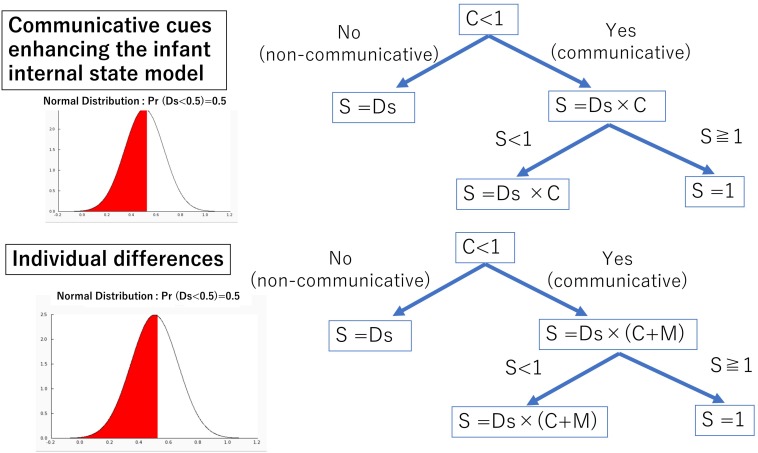
Many studies have explored factors which influence gaze-following behavior of young infants. However, the results of empirical studies were inconsistent, and the mechanism underlying the contextual modulation of gaze following remains unclear. In order to provide valuable insight into the mechanisms underlying gaze following, we conducted computational modeling using Q-learning algorithm and simulated the learning process of infant gaze following to suggest a feasible model. In Experiment 1, we simulated how communicative cues and infant internal states affect the learning process of gaze following. The simulation indicated that the model in which communicative cues enhance infant internal states is the most feasible to explain the infant learning process. In Experiment 2, we simulated how individual differences in motivation for communication affect the learning process. The results showed that low motivation for communication can delay the learning process and decrease the frequency of gaze following. These simulations suggest that communicative cues may enhance infants' internal states and promote the development of gaze following. Also, initial social motivation may affect the learning process of social behaviors in the long term.
许多研究探讨了影响幼儿视线追随行为的因素。然而,实证研究结果并不一致,视线追随情境调节的潜在机制仍不明确。为了深入了解视线追随的潜在机制,我们使用Q学习算法进行了计算建模,并模拟了婴儿视线追随的学习过程,以提出一个可行的模型。在实验1中,我们模拟了交流线索和婴儿内部状态如何影响视线追随的学习过程。模拟结果表明,交流线索增强婴儿内部状态的模型最能解释婴儿的学习过程。在实验2中,我们模拟了交流动机的个体差异如何影响学习过程。结果表明,交流动机低会延迟学习过程并降低视线追随的频率。这些模拟表明,交流线索可能增强婴儿的内部状态并促进视线追随的发展。此外,最初的社会动机可能长期影响社会行为的学习过程。