Tikhonov Gleb, Opedal Øystein H, Abrego Nerea, Lehikoinen Aleksi, de Jonge Melinda M J, Oksanen Jari, Ovaskainen Otso
Department of Computer Science Aalto University Espoo Finland.
Organismal and Evolutionary Biology Research Programme University of Helsinki Helsinki Finland.
Methods Ecol Evol. 2020 Mar;11(3):442-447. doi: 10.1111/2041-210X.13345. Epub 2020 Jan 23.
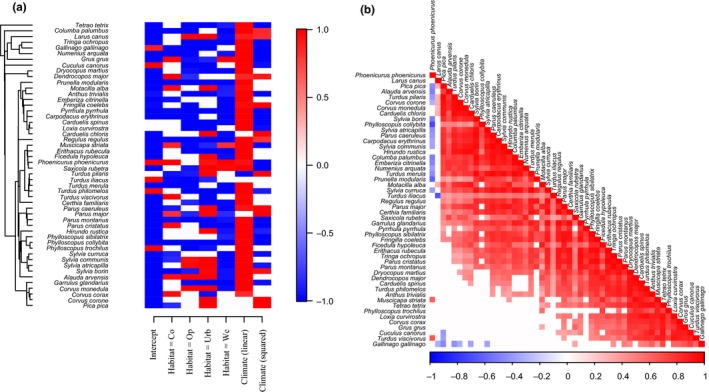
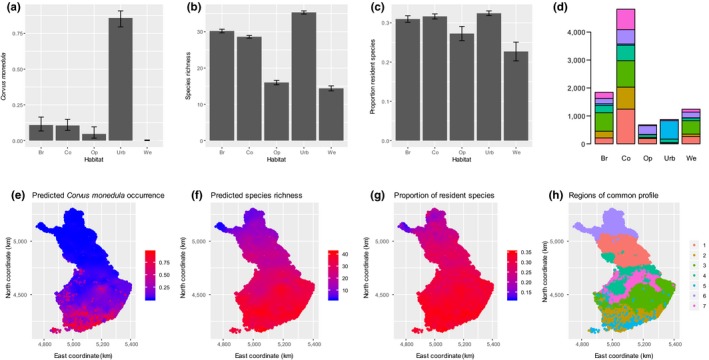
Joint Species Distribution Modelling (JSDM) is becoming an increasingly popular statistical method for analysing data in community ecology. Hierarchical Modelling of Species Communities (HMSC) is a general and flexible framework for fitting JSDMs. HMSC allows the integration of community ecology data with data on environmental covariates, species traits, phylogenetic relationships and the spatio-temporal context of the study, providing predictive insights into community assembly processes from non-manipulative observational data of species communities.The full range of functionality of HMSC has remained restricted to Matlab users only. To make HMSC accessible to the wider community of ecologists, we introduce Hmsc 3.0, a user-friendly r implementation.We illustrate the use of the package by applying Hmsc 3.0 to a range of case studies on real and simulated data. The real data consist of bird counts in a spatio-temporally structured dataset, environmental covariates, species traits and phylogenetic relationships. Vignettes on simulated data involve single-species models, models of small communities, models of large species communities and models for large spatial data. We demonstrate the estimation of species responses to environmental covariates and how these depend on species traits, as well as the estimation of residual species associations. We demonstrate how to construct and fit models with different types of random effects, how to examine MCMC convergence, how to examine the explanatory and predictive powers of the models, how to assess parameter estimates and how to make predictions. We further demonstrate how Hmsc 3.0 can be applied to normally distributed data, count data and presence-absence data.The package, along with the extended vignettes, makes JSDM fitting and post-processing easily accessible to ecologists familiar with r.
联合物种分布建模(JSDM)正日益成为群落生态学中用于分析数据的一种流行统计方法。物种群落层次建模(HMSC)是用于拟合JSDM的一个通用且灵活的框架。HMSC允许将群落生态学数据与环境协变量、物种性状、系统发育关系以及研究的时空背景数据相结合,从而从物种群落的非操纵性观测数据中提供对群落组装过程的预测性见解。HMSC的全部功能一直仅限于Matlab用户使用。为了让更广泛的生态学家群体能够使用HMSC,我们推出了Hmsc 3.0,这是一个用户友好的R语言实现版本。我们通过将Hmsc 3.0应用于一系列关于真实数据和模拟数据的案例研究来说明该软件包的使用方法。真实数据包括一个时空结构数据集中的鸟类计数、环境协变量、物种性状和系统发育关系。关于模拟数据的 vignettes 涉及单物种模型、小群落模型、大物种群落模型和大空间数据模型。我们展示了对物种对环境协变量的响应估计以及这些响应如何依赖于物种性状,以及对残余物种关联的估计。我们展示了如何构建和拟合具有不同类型随机效应的模型,如何检查MCMC收敛情况,如何检查模型的解释力和预测力,如何评估参数估计以及如何进行预测。我们进一步展示了Hmsc 3.0如何应用于正态分布数据、计数数据和存在 - 缺失数据。该软件包以及扩展的 vignettes 使熟悉R语言的生态学家能够轻松进行JSDM拟合和后处理。