Organismal and Evolutionary Biology Research Programme, University of Helsinki, P.O. Box 65, FI-00014, Helsinki, Finland.
Computational Systems Biology Group, Department of Computer Science, Aalto University, P.O. Box 11000, FI-00076, Espoo, Finland.
Ecology. 2020 Feb;101(2):e02929. doi: 10.1002/ecy.2929. Epub 2019 Dec 20.
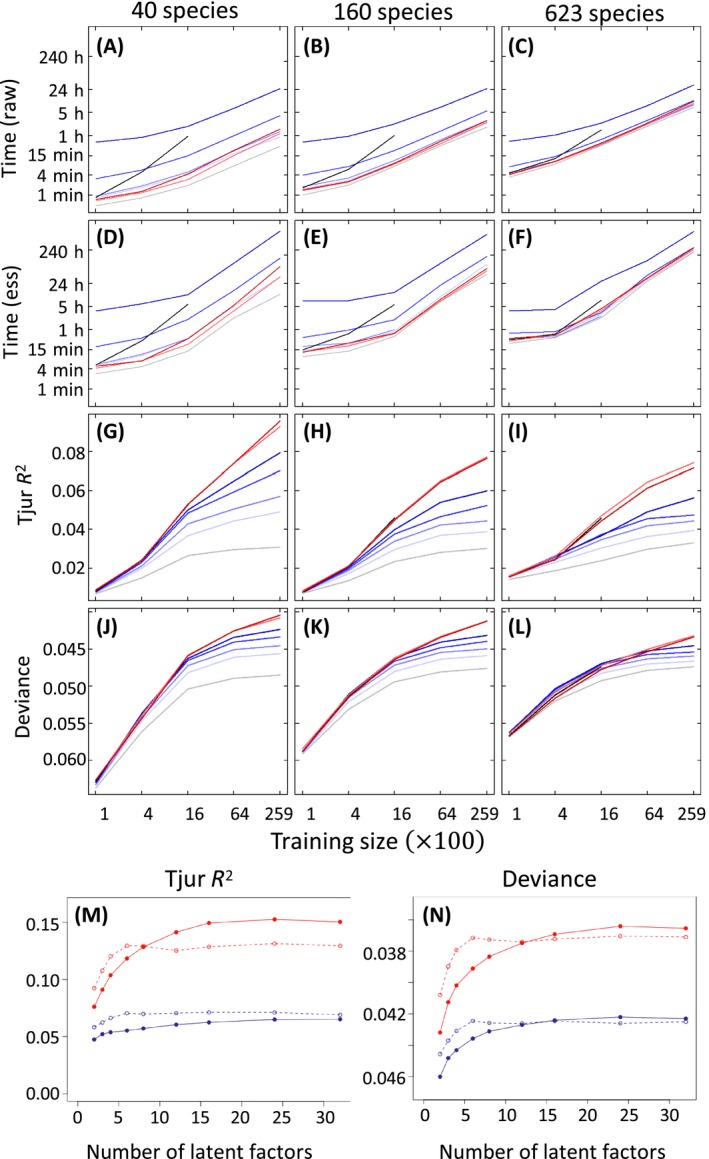
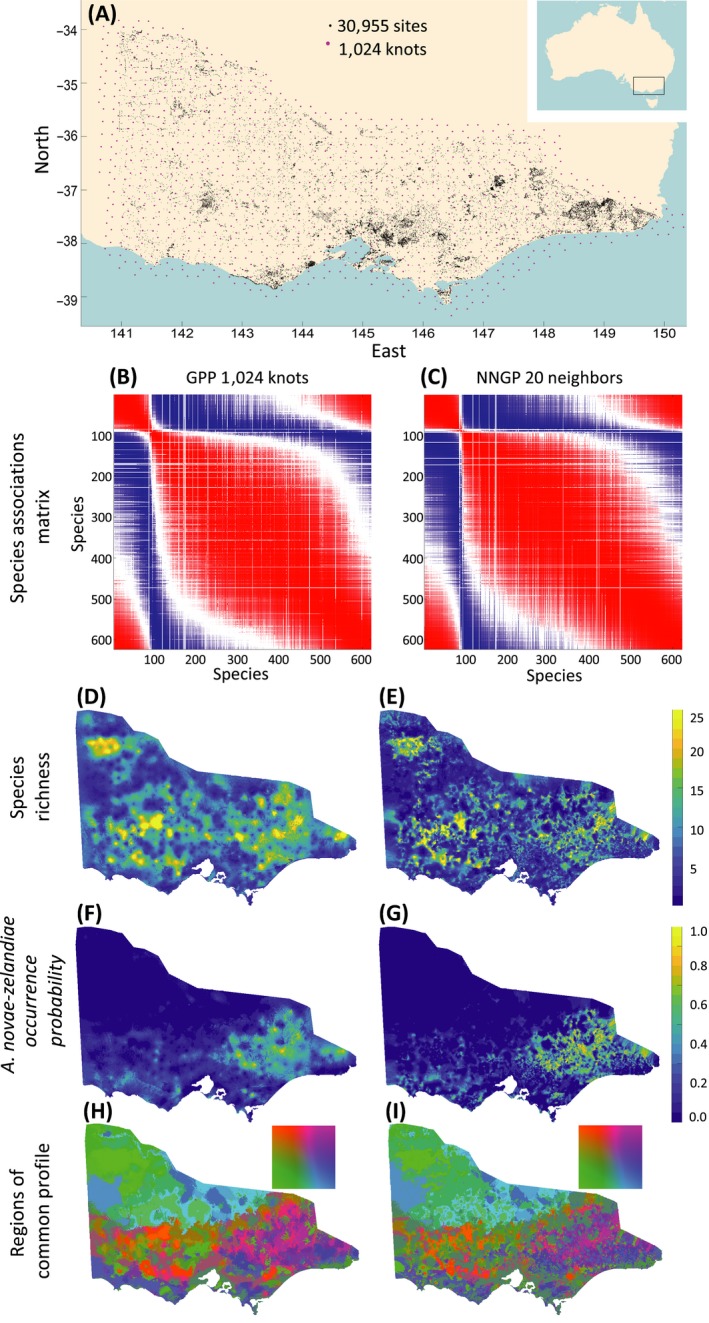
The ongoing global change and the increased interest in macroecological processes call for the analysis of spatially extensive data on species communities to understand and forecast distributional changes of biodiversity. Recently developed joint species distribution models can deal with numerous species efficiently, while explicitly accounting for spatial structure in the data. However, their applicability is generally limited to relatively small spatial data sets because of their severe computational scaling as the number of spatial locations increases. In this work, we propose a practical alleviation of this scalability constraint for joint species modeling by exploiting two spatial-statistics techniques that facilitate the analysis of large spatial data sets: Gaussian predictive process and nearest-neighbor Gaussian process. We devised an efficient Gibbs posterior sampling algorithm for Bayesian model fitting that allows us to analyze community data sets consisting of hundreds of species sampled from up to hundreds of thousands of spatial units. The performance of these methods is demonstrated using an extensive plant data set of 30,955 spatial units as a case study. We provide an implementation of the presented methods as an extension to the hierarchical modeling of species communities framework.
全球变化的持续和对宏观生态过程的日益关注,要求对物种群落的空间广泛数据进行分析,以了解和预测生物多样性的分布变化。最近开发的联合物种分布模型可以有效地处理大量物种,同时明确考虑数据中的空间结构。然而,由于其在空间位置数量增加时的严重计算规模限制,它们的适用性通常仅限于相对较小的空间数据集。在这项工作中,我们通过利用两种空间统计技术来缓解联合物种建模的这种可扩展性约束,这两种技术可以促进大型空间数据集的分析:高斯预测过程和最近邻高斯过程。我们设计了一种用于贝叶斯模型拟合的高效吉布斯后验采样算法,允许我们分析由数百个物种组成的群落数据集,这些物种是从多达数十万的空间单元中采样得到的。这些方法的性能通过一个广泛的植物数据集进行了验证,该数据集包含 30955 个空间单元作为案例研究。我们提供了所提出方法的实现,作为对物种群落层次建模框架的扩展。