Montoya-Rodríguez Diana M, Ávila-Torres Yenny, Serna-Galvis Efraím A, Torres-Palma Ricardo A
Grupo de Investigación en Remediación Ambiental y Biocatálisis (GIRAB), Instituto de Química, Facultad de Ciencias Exactas y Naturales, Universidad de Antioquia UdeA, Calle 70 No. 52-21, Medellín, Colombia.
Grupo de Investigación QUIBIO, Facultad de Ciencias Básicas, Universidad Santiago de Cali, Santiago de Cali, Pampalinda, Colombia.
Data Brief. 2020 Mar 2;29:105361. doi: 10.1016/j.dib.2020.105361. eCollection 2020 Apr.
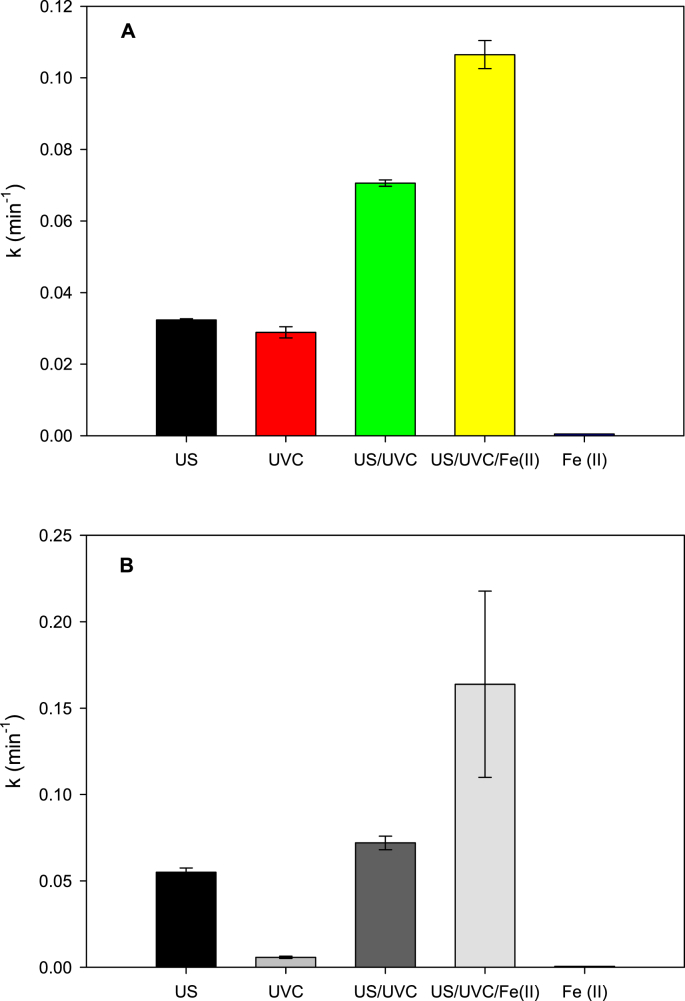
Ampicillin and nafcillin antibiotics were treated by high frequency ultrasound (at 375 kHz and 24.4 W). Degradations followed pseudo-first order kinetics, which constants were k: 0.0323 min for AMP and k: 0.0550 min for NAF. Accumulation of sonogenerated hydrogen peroxide and inhibition degree of sonochemical removal (IDS) in presence of a radical scavenger were also stablished. Afterwards, ultrasound was combined with UVC light (sono-photolysis), with ferrous ion (sono-Fenton), and with ferrous ion plus UVC light (sono-photo-Fenton) to degrade the antibiotics. Furthermore, treatment of the pollutants in a complex matrix and removal of antimicrobial activity (AA) were considered. The antibiotics evolution was followed by HPLC-DAD technique and the accumulation of sonogenerated HO was measured by an iodometry-spectrophotometry methodology (77.6 and 57.3 μmol L of HO after 30 min of sonication were accumulated in presence of AMP and NAF, respectively). IDS was analyzed through treatment of the antibiotics in presence of 2-propanol (87.1% for AMP and 56 % for NAF) and considering the hydrophobic character of pollutants (i.e., Log P values). Antimicrobial activity evolution was assessed by the Kirby-Bauer method using as indicator microorganism (sono-photo-Fenton process removed 100% of AA after 60 and 20 min for AMP and NAF, respectively). Finally, for degradations in the complex matrix, a simulated effluent of municipal wastewater treatment plant was utilized (sono-photo-Fenton led to degradations higher than 90 % at 60 min of treatment for both antibiotics). The data from the present work can be valuable for people researching on treatment of wastewaters containing antibiotics, application of advanced oxidation technologies and combination of sonochemical process with photochemical systems.
氨苄西林和萘夫西林抗生素采用高频超声(频率为375kHz,功率为24.4W)进行处理。降解过程符合准一级动力学,其速率常数分别为:氨苄西林的k为0.0323min⁻¹,萘夫西林的k为0.0550min⁻¹。还测定了超声产生的过氧化氢的积累以及在自由基清除剂存在下的声化学去除抑制率(IDS)。随后,将超声与紫外线C光(超声光解)、亚铁离子(超声芬顿)以及亚铁离子加紫外线C光(超声光芬顿)相结合来降解抗生素。此外,还考虑了在复杂基质中对污染物的处理以及抗菌活性(AA)的去除。通过高效液相色谱 - 二极管阵列检测技术(HPLC - DAD)跟踪抗生素的降解过程,并采用碘量法 - 分光光度法测定超声产生的羟基自由基(·OH)的积累量(超声处理30min后,在氨苄西林和萘夫西林存在下分别积累了77.6和57.3μmol·L⁻¹的·OH)。通过在2 - 丙醇存在下处理抗生素来分析IDS(氨苄西林的IDS为87.1%,萘夫西林的IDS为56%),并考虑污染物的疏水特性(即Log P值)。采用柯氏 - 鲍尔法,以[指示微生物]作为指示微生物评估抗菌活性的变化(超声光芬顿法在分别处理60min和20min后,对氨苄西林和萘夫西林的抗菌活性去除率均达到100%)。最后,对于复杂基质中的降解,使用了城市污水处理厂的模拟废水(超声光芬顿法在处理60min时,两种抗生素的降解率均高于90%)。本研究的数据对于研究含抗生素废水处理、高级氧化技术的应用以及声化学过程与光化学系统结合的人员具有重要价值。