Équipe Pathogènes Hydriques Santé Environnements, UMR 5569 HSM, University of Montpellier, France.
Laboratoire de Bactériologie, Hôpitaux universitaires de Strasbourg, France.
Genome Biol Evol. 2020 May 1;12(5):535-552. doi: 10.1093/gbe/evaa055.
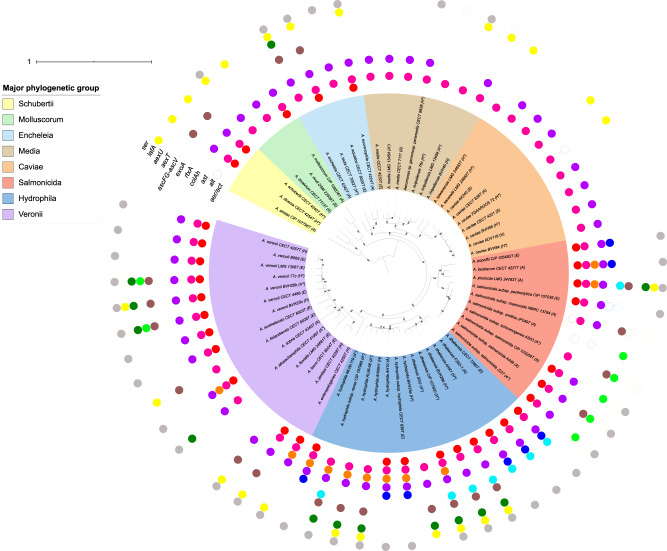
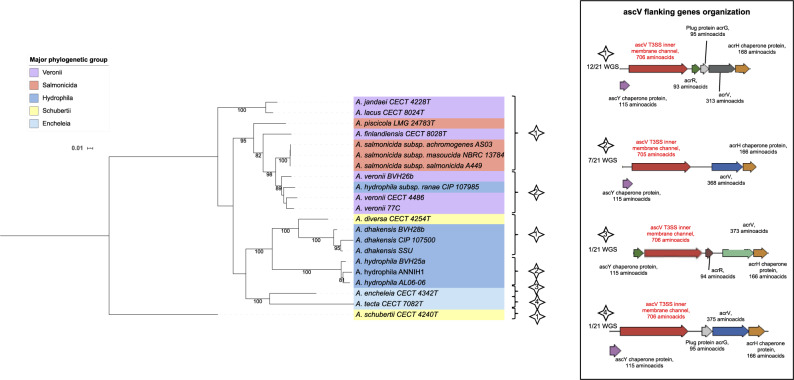
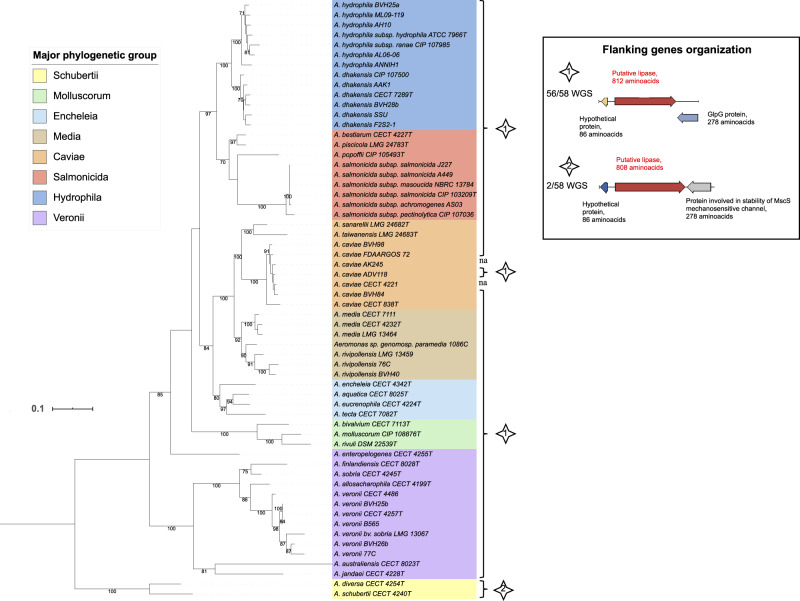
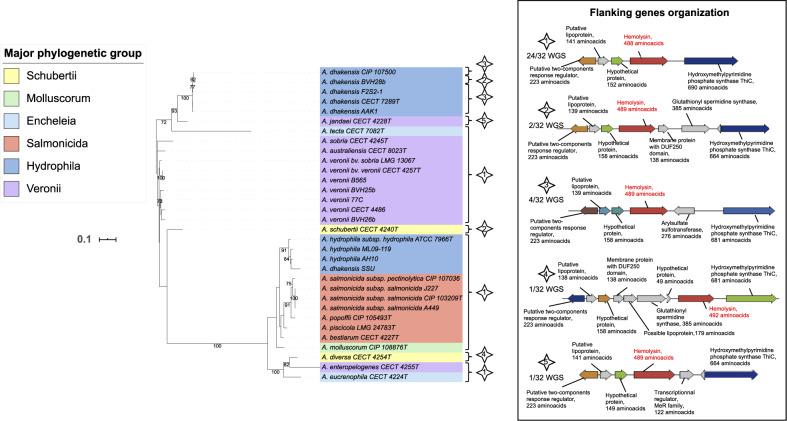
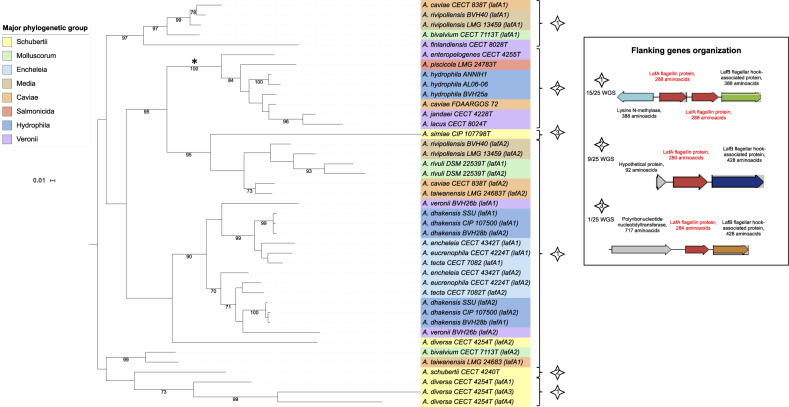
Aeromonads are ubiquitous aquatic bacteria that cause opportunistic infections in humans, but their pathogenesis remains poorly understood. A pathogenomic approach was undertaken to provide insights into the emergence and evolution of pathogenic traits in aeromonads. The genomes of 64 Aeromonas strains representative of the whole genus were analyzed to study the distribution, phylogeny, and synteny of the flanking sequences of 13 virulence-associated genes. The reconstructed evolutionary histories varied markedly depending on the gene analyzed and ranged from vertical evolution, which followed the core genome evolution (alt and colAh), to complex evolution, involving gene loss by insertion sequence-driven gene disruption, horizontal gene transfer, and paraphyly with some virulence genes associated with a phylogroup (aer, ser, and type 3 secretion system components) or no phylogroup (type 3 secretion system effectors, Ast, ExoA, and RtxA toxins). The general pathogenomic overview of aeromonads showed great complexity with diverse evolution modes and gene organization and uneven distribution of virulence genes in the genus; the results provided insights into aeromonad pathoadaptation or the ability of members of this group to emerge as pathogens. Finally, these findings suggest that aeromonad virulence-associated genes should be examined at the population level and that studies performed on type or model strains at the species level cannot be generalized to the whole species.
气单胞菌是普遍存在于水生环境中的细菌,能引起人类机会性感染,但它们的发病机制仍不清楚。本研究采用病原体组学方法深入了解气单胞菌中致病特征的出现和进化。对 64 株气单胞菌代表全属的基因组进行分析,研究 13 种与毒力相关基因侧翼序列的分布、系统发育和基因同线性。分析结果表明,不同基因的重建进化历史差异显著,从垂直进化(遵循核心基因组进化,如 alt 和 colAh)到复杂进化(涉及由插入序列驱动的基因中断导致的基因缺失、水平基因转移和系统发育分歧,一些与谱系相关的毒力基因(aer、ser 和 III 型分泌系统成分)或没有谱系(III 型分泌系统效应子、Ast、ExoA 和 RtxA 毒素))。气单胞菌的总体病原体组学概述显示出极大的复杂性,具有多种进化模式和基因组织,以及属内毒力基因分布不均;这些结果为气单胞菌的病理适应或该菌成员作为病原体出现的能力提供了深入了解。最后,这些发现表明,气单胞菌相关毒力基因应在群体水平上进行检查,而在种水平上对特定或模式菌株进行的研究不能推广到整个种。