Bartkova Simona, Leekitcharoenphon Pimlapas, Aarestrup Frank M, Dalsgaard Inger
Section for Bacteriology and Pathology, National Veterinary Institute, Technical University of Denmark, Lyngby, Denmark.
Research Group for Genomic Epidemiology, National Food Institute, Technical University of Denmark, Lyngby, Denmark.
Front Microbiol. 2017 Dec 5;8:2411. doi: 10.3389/fmicb.2017.02411. eCollection 2017.
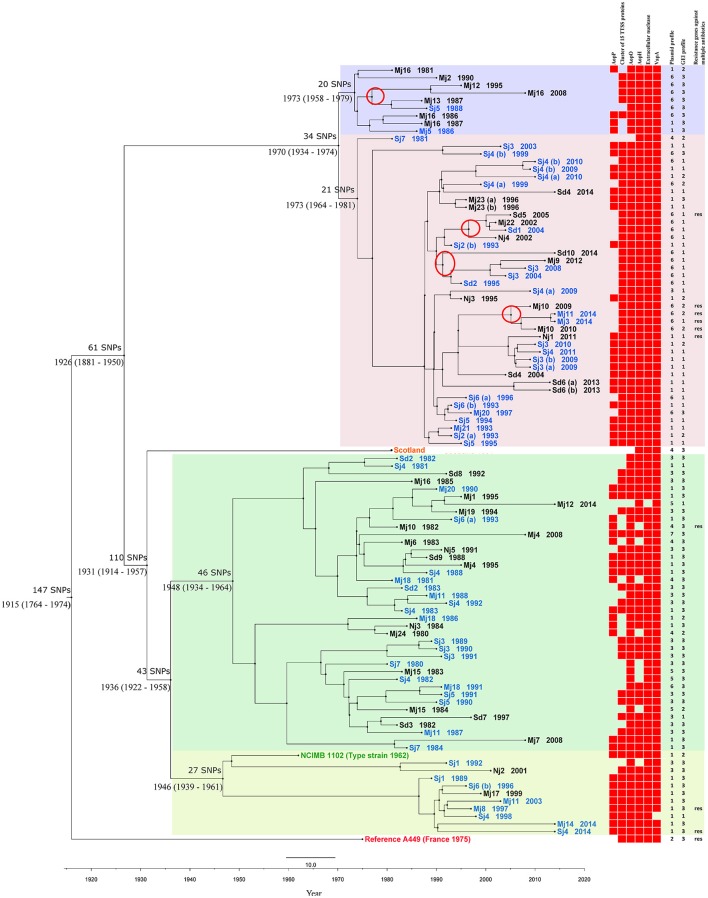
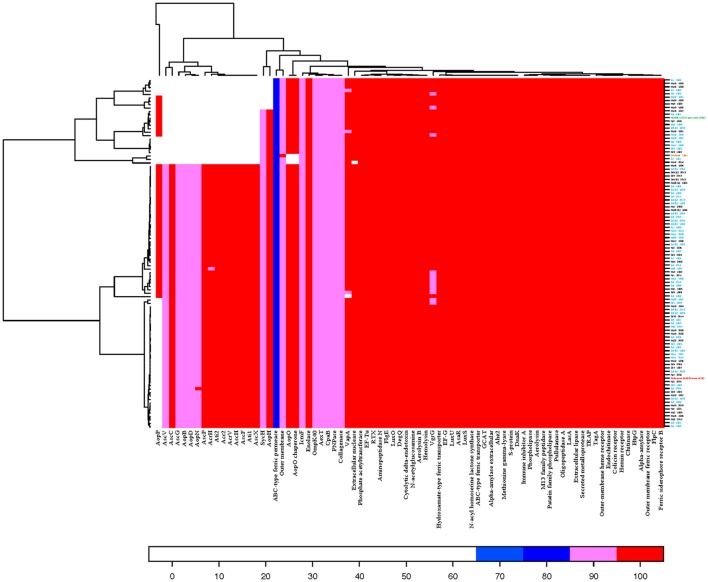
Furunculosis, a serious infection caused by the bacterium subsp. is common in sea-reared rainbow trout production in Denmark. Developing an effective control strategy requires knowledge of the epidemiology, as well as the genomic and virulent variability of the Danish subsp. isolates. To obtain this, the genomes of 101 subsp. , including 99 Danish isolates, one Scottish strain and the type strain NCIMB 1102, were sequenced using the Illumina HiSeq platform. Isolates were assembled, examined for presence of plasmids, virulence and iron acquisition proteins, genomic islands, and antibiotic resistance genes. Single Nucleotide Polymorphisms were aligned and subjected to Bayesian temporal phylogenetic and maximum likelihood tree reconstruction using the published genome of subsp. A449 as reference. Bayesian temporal phylogenetic reconstruction suggests that four major introductions of subsp. into Denmark have occurred. The introductions correlate with the freshwater and subsequent seawater expansion of rainbow trout production. Initial transmission of the bacterium could have been from seawater to freshwater or vice versa, and most minor clades include a mixture of strains from different fresh- and seawater farms. Genomic variation of subsp. mostly appeared to be associated with their plasmids and plasmid encoded virulence factors. Nine subsp. isolates harbored worldwide known antibiotic resistance genes against several antibiotics and there is an indication that 33% of the isolates contained the genomic island AsaGEI1b. These findings not only support the usefulness of whole genome sequencing for genetic studies of homogeneous bacteria in general, but provide novel information about the Danish subsp. population, with implications for vaccine development in efforts to better protect Danish rainbow trout in the future.
疖病是由 亚种细菌引起的一种严重感染,在丹麦海水养殖虹鳟鱼生产中很常见。制定有效的控制策略需要了解丹麦 亚种分离株的流行病学、基因组和毒力变异性。为了获得这些信息,使用Illumina HiSeq平台对101株 亚种的基因组进行了测序,其中包括99株丹麦分离株、1株苏格兰菌株和模式菌株NCIMB 1102。对分离株进行了组装,检查了质粒、毒力和铁获取蛋白、基因组岛和抗生素抗性基因的存在情况。单核苷酸多态性进行了比对,并以已发表的 亚种A449基因组为参考,进行了贝叶斯时间系统发育和最大似然树重建。贝叶斯时间系统发育重建表明, 亚种已四次主要传入丹麦。这些传入与虹鳟鱼生产的淡水和随后的海水养殖扩张相关。细菌的最初传播可能是从海水到淡水,反之亦然,大多数小分支包括来自不同淡水和海水养殖场菌株的混合物。 亚种的基因组变异似乎主要与其质粒和质粒编码的毒力因子有关。9株 亚种分离株含有全球已知的针对多种抗生素的抗生素抗性基因,并且有迹象表明33%的分离株含有基因组岛AsaGEI1b。这些发现不仅总体上支持了全基因组测序在同源细菌遗传研究中的有用性,还提供了有关丹麦 亚种群体的新信息,对未来更好地保护丹麦虹鳟鱼的疫苗开发具有启示意义。