National Institute for Nutrition and Health, Chinese Center for Disease Control and Prevention, Beijing, China.
BMC Psychiatry. 2020 Mar 20;20(1):130. doi: 10.1186/s12888-020-02520-4.
The Perceived Stress Scale (PSS) is a globally used and self-report scale measuring perceived stress. Three versions of PSS (PSS-14, PSS-10 and PSS-4) are available which comprise 14, 10 and 4 items respectively. However, the Chinese version of the PSS has not yet been validated in a large community-based general population. The aims of this study were to evaluate the psychometric properties of the Chinese PSS in a large community-based general population and to compare the appropriateness of the three versions of PSS.
A total of 9507 adults with at least a junior high school education and completed PSS-14 from the China Health and Nutrition Survey were involved in this study. The internal consistency reliability of PSS was assessed using Cronbach's alpha coefficient and confirmatory factor analysis was employed to test the construct validity. Modification index was used for model extension and the critical ratio was used for model restriction.
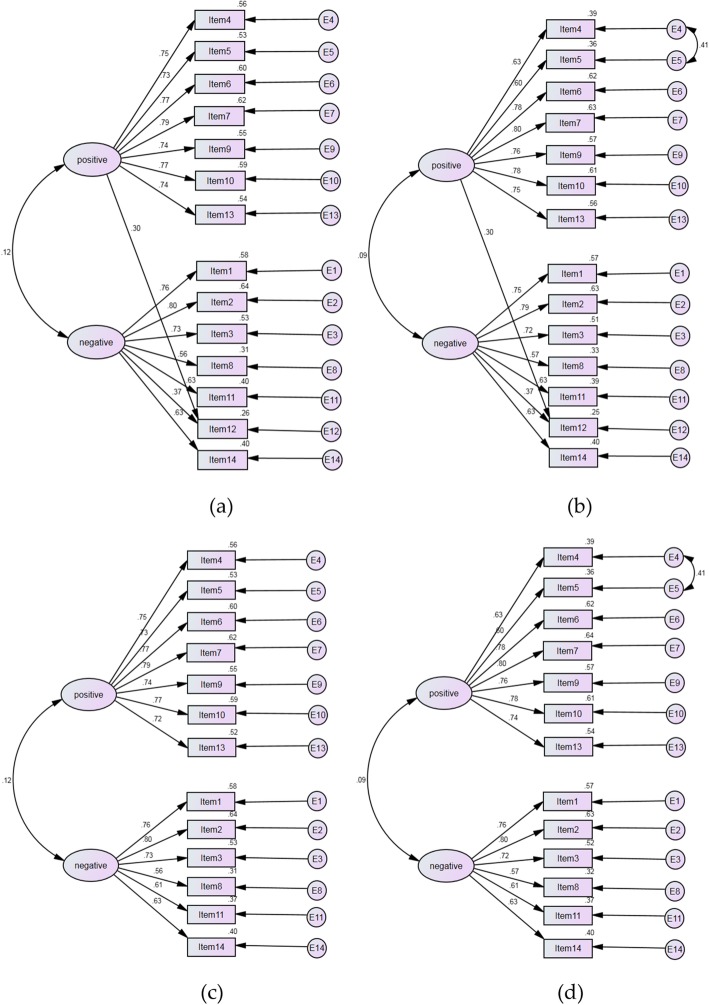
The internal consistency coefficients were satisfactory for PSS-14 and PSS-10, but not for PSS-4. The corresponding Cronbach's alpha were 0.830, 0.754 and 0.473 respectively. A 2-factor structure was confirmed for the PSS-14 and PSS-10, and all items' standardized factor loadings exceeded 0.4 for either negative or positive factors. Given that item 12 loaded on both negative and positive factors for PSS-14 and the goodness of fit for PSS-14 was not acceptable, PSS-13 (PSS-14 excluding item 12) was studied. The construct validities of PSS-13 and PSS-10 were satisfactory, but the goodness of fit for PSS-10 were better than that for PSS-13.
PSS-13 (PSS-14 excluding item 12) and PSS-10 have satisfactory psychometric properties. PSS-10 are more applicable to measure the perceived stress than PSS-13 in a large community-based general population in China.
感知压力量表(PSS)是一种全球通用的自我报告量表,用于测量感知压力。目前有三个版本的 PSS(PSS-14、PSS-10 和 PSS-4),分别包含 14、10 和 4 个项目。然而,PSS 的中文版本尚未在大型基于社区的一般人群中得到验证。本研究的目的是评估 PSS 的中文版本在大型基于社区的一般人群中的心理测量特性,并比较三个版本的 PSS 的适用性。
共有 9507 名至少受过初中教育并完成了中国健康与营养调查中的 PSS-14 的成年人参与了本研究。使用 Cronbach's alpha 系数评估 PSS 的内部一致性信度,采用验证性因素分析检验结构效度。使用修正指数进行模型扩展,使用临界比进行模型限制。
PSS-14 和 PSS-10 的内部一致性系数令人满意,但 PSS-4 的则不然。相应的 Cronbach's alpha 分别为 0.830、0.754 和 0.473。PSS-14 和 PSS-10 均证实存在 2 个因子结构,并且无论是负因子还是正因子,所有项目的标准化因子负荷均超过 0.4。鉴于 PSS-14 的第 12 项同时加载在负因子和正因子上,且 PSS-14 的拟合优度不可接受,因此研究了 PSS-13(PSS-14 中不包含第 12 项的版本)。PSS-13 和 PSS-10 的结构效度令人满意,但 PSS-10 的拟合优度优于 PSS-13。
PSS-13(PSS-14 中不包含第 12 项的版本)和 PSS-10 具有令人满意的心理测量特性。在我国基于社区的一般人群中,PSS-10 比 PSS-13 更适用于测量感知压力。