Academic Unit of General Practice, Australian National University, Canberra, Australian Capital Territory, Australia kathleen.o'
Academic Unit of General Practice, Australian National University, Canberra, Australian Capital Territory, Australia.
BMJ Open. 2020 Mar 19;10(3):e034847. doi: 10.1136/bmjopen-2019-034847.
There is mixed evidence on the relationship between physical activity and behavioural and mental health. We aimed to estimate the association between physical activity and risk of behavioural and mental health disorders in early school-aged children.
A series of cross-sectional complete enumeration (census) surveys.
All primary schools in the Australian Capital Territory, 2014-2016.
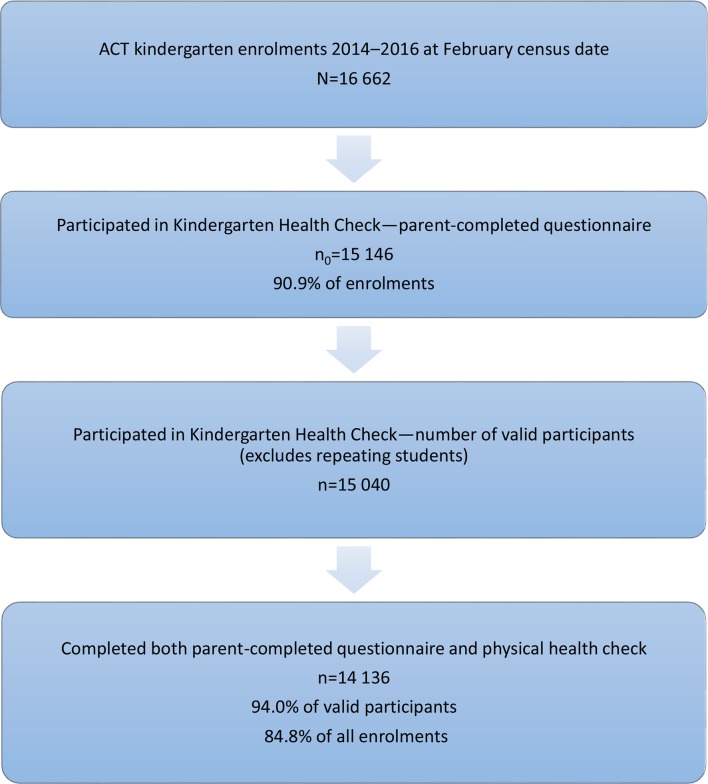
All children enrolled in their first year of full-time primary education (kindergarten) were invited to participate. Of the 16 662 eligible kindergarten children, 15 040 completed the survey for the first time.
Average daily physical activity participation and prevalence of risk of behavioural and mental health disorders derived from parent-reported data and the Strengths and Difficulties Questionnaire (SDQ). Characteristics associated with SDQ and subscales were estimated using logistic regression.
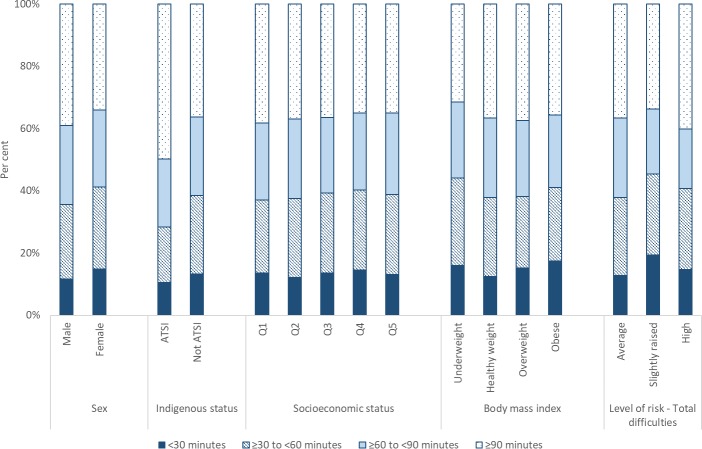
8340 (61.7%) children met physical activity targets (60 min or more daily) and 709 (4.8%) were at clinically significant risk of behavioural and mental health disorders ().Known sociodemographic correlates were also those variables associated with high risk of behavioural and mental health disorders (): Aboriginal and Torres Strait Islander status (OR 2.72, 95% CI 1.78-4.16), relative socioeconomic disadvantage (most disadvantaged vs least disadvantaged, OR 1.86, 95% CI 1.38-2.50) and male sex (OR 1.80, 95% CI 1.49-2.17). Average daily physical activity was not significant, despite the highest levels of physical activity (90 min or more daily) being reported in boys, Aboriginal and Torres Strait Islander children and those from more disadvantaged areas.
Our study provides comprehensive cross-sectional data on the relationship between physical activity participation and the risk of behavioural and mental health disorders in a large cohort of early school-aged Australian children. Aboriginal and Torres Strait Islander children, boys and those from the most disadvantaged socioeconomic group were at greatest risk of clinically significant behavioural and mental health disorders.
体力活动与行为和心理健康之间的关系证据不一。本研究旨在评估 6 岁以下儿童体力活动与行为和心理健康障碍风险之间的关联。
一系列横断面完全枚举(普查)调查。
2014-2016 年澳大利亚首都地区所有小学。
邀请所有入读全日制小学一年级(幼儿园)的儿童参加。在 16626 名符合条件的幼儿园儿童中,有 15040 名首次完成了调查。
来自家长报告数据和长处和困难问卷(SDQ)的平均每日体力活动参与度和行为与心理健康障碍风险的患病率。使用逻辑回归估计与 SDQ 和子量表相关的特征。
8340 名(61.7%)儿童达到体力活动目标(每天 60 分钟或更多),709 名(4.8%)存在行为与心理健康障碍高风险()。已知的社会人口统计学相关性也是与行为和心理健康障碍高风险相关的变量():原住民和托雷斯海峡岛民身份(OR 2.72,95%CI 1.78-4.16)、相对社会经济劣势(最不利与最不利,OR 1.86,95%CI 1.38-2.50)和男性(OR 1.80,95%CI 1.49-2.17)。尽管报告的男孩、原住民和托雷斯海峡岛民儿童以及来自较不利地区的儿童的日常体力活动水平最高(每天 90 分钟或更多),但平均每日体力活动并不显著。
本研究提供了澳大利亚 6 岁以下儿童大规模队列中体力活动参与度与行为和心理健康障碍风险之间关系的全面横断面数据。原住民和托雷斯海峡岛民儿童、男孩和来自最不利社会经济群体的儿童患行为和心理健康障碍的风险最高。