Department of Biochemistry and Molecular Biology, University of Chicago, Chicago, IL, 60637, USA.
Grossman Institute for Neuroscience, Quantitative Biology and Human Behavior, University of Chicago, Chicago, IL, 60637, USA.
Nat Commun. 2020 Mar 20;11(1):1489. doi: 10.1038/s41467-020-15211-1.
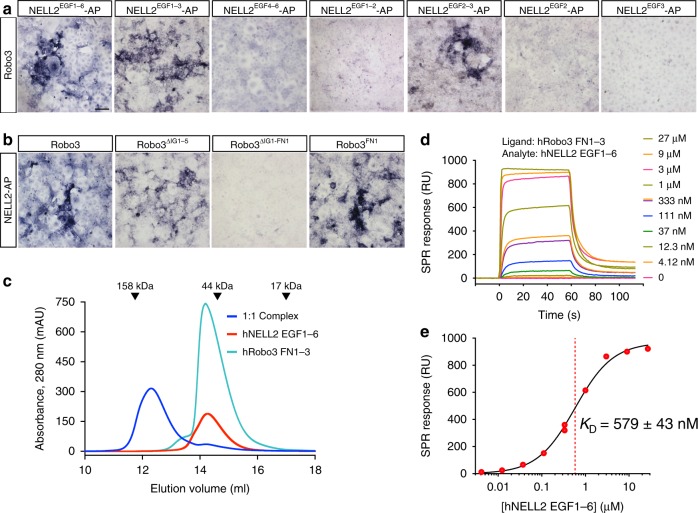
Axon pathfinding is critical for nervous system development, and it is orchestrated by molecular cues that activate receptors on the axonal growth cone. Robo family receptors bind Slit guidance cues to mediate axon repulsion. In mammals, the divergent family member Robo3 does not bind Slits, but instead signals axon repulsion from its own ligand, NELL2. Conversely, canonical Robos do not mediate NELL2 signaling. Here, we present the structures of NELL-Robo3 complexes, identifying a mode of ligand engagement for Robos that is orthogonal to Slit binding. We elucidate the structural basis for differential binding between NELL and Robo family members and show that NELL2 repulsive activity is a function of its Robo3 affinity and is enhanced by ligand trimerization. Our results reveal a mechanism of oligomerization-induced Robo activation for axon guidance and shed light on Robo family member ligand binding specificity, conformational variability, divergent modes of signaling, and evolution.
轴突导向对神经系统的发育至关重要,它由分子线索来调控,这些线索能激活轴突生长锥上的受体。Robo 家族受体结合 Slit 导向线索来介导轴突排斥。在哺乳动物中,分歧的家族成员 Robo3 不结合 Slits,而是通过其自身配体 NELL2 发出轴突排斥信号。相反,典型的 Robos 不能介导 NELL2 信号。在这里,我们呈现了 NELL-Robo3 复合物的结构,确定了 Robos 与配体结合的一种模式,与 Slit 结合不同。我们阐明了 NELL 和 Robo 家族成员之间不同结合的结构基础,并表明 NELL2 的排斥活性是其与 Robo3 亲和力的功能,并且通过配体三聚体化得到增强。我们的结果揭示了轴突导向中寡聚诱导的 Robo 激活的机制,并阐明了 Robo 家族成员配体结合特异性、构象变异性、不同的信号转导模式和进化。