Department of Surgery and Cancer, Institute of Reproductive and Developmental Biology, Imperial College London, London, UK.
Mechanistic Biology and Profiling, Discovery Sciences, R&D, AstraZeneca, Cambridge, UK.
Cancer Immunol Immunother. 2020 Aug;69(8):1391-1401. doi: 10.1007/s00262-020-02544-5. Epub 2020 Mar 21.
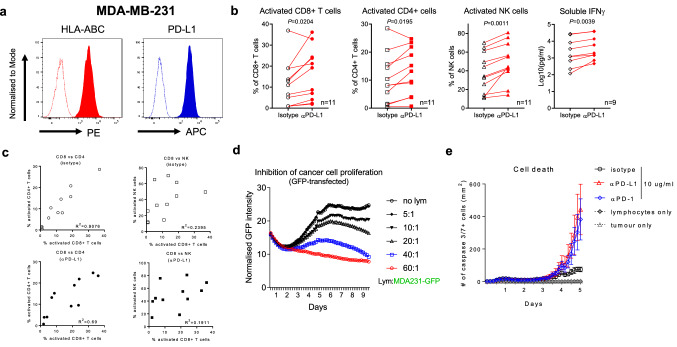
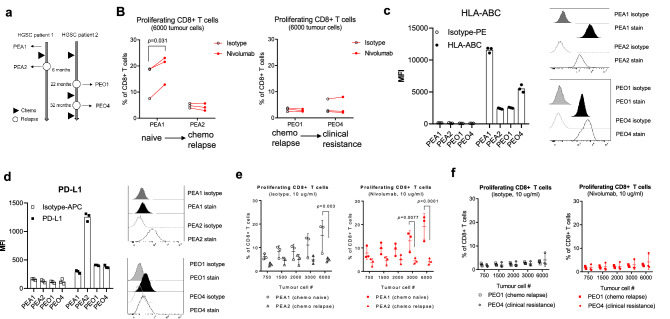
Immune checkpoint blocking antibodies are currently being tested in ovarian cancer (OC) patients and have shown some responses in early clinical trials. However, it remains unclear how human OC cancer cells regulate lymphocyte activation in response to therapy. In this study, we have established and optimised an in vitro tumour-immune co-culture system (TICS), which is specifically designed to quantify the activation of multiple primary human lymphocyte subsets and human cancer cell killing in response to PD-1/L1 blockade. Human OC cell lines and treatment naïve patient ascites show differential effects on lymphocyte activation and respond differently to PD-1 blocking antibody nivolumab in TICS. Using paired OC cell lines established prior to and after chemotherapy relapse, our data reveal that the resistant cells express low levels of HLA and respond poorly to nivolumab, relative to the treatment naïve cells. In accordance, knockdown of IFNγ receptor expression compromises response to nivolumab in the treatment naïve OC cell line, while enhanced HLA expression induced by a DNA methyltransferase inhibitor promotes lymphocyte activation in TICS. Altogether, our results suggest a 'cross resistance' model, where the acquired chemotherapy resistance in cancer cells may confer resistance to immune checkpoint blockade therapy through down-regulation of antigen presentation machinery. As such, agents that can restore HLA expression may be a suitable combination partner for immunotherapy in chemotherapy-relapsed human ovarian cancer patients.
免疫检查点阻断抗体目前正在卵巢癌(OC)患者中进行测试,并在早期临床试验中显示出一些反应。然而,目前尚不清楚人类 OC 癌细胞如何调节淋巴细胞的激活以响应治疗。在这项研究中,我们建立并优化了一种体外肿瘤免疫共培养系统(TICS),该系统专门用于定量测定多种原发性人淋巴细胞亚群的激活和人类癌细胞对 PD-1/L1 阻断的杀伤作用。人类 OC 细胞系和未经治疗的患者腹水对淋巴细胞激活有不同的影响,并在 TICS 中对 PD-1 阻断抗体nivolumab 有不同的反应。使用在化疗复发前后建立的配对 OC 细胞系,我们的数据表明,耐药细胞表达低水平的 HLA,并且对 nivolumab 的反应不如治疗初治细胞。相应地,IFNγ受体表达的敲低会损害治疗初治 OC 细胞系对 nivolumab 的反应,而 DNA 甲基转移酶抑制剂诱导的 HLA 表达增强会促进 TICS 中的淋巴细胞激活。总之,我们的结果表明了一种“交叉耐药”模型,其中癌细胞获得的化疗耐药性可能通过下调抗原呈递机制而对免疫检查点阻断治疗产生耐药性。因此,能够恢复 HLA 表达的药物可能是化疗复发的人类卵巢癌患者免疫治疗的合适联合治疗伙伴。