Research Department of Child Nutrition, University Children's Hospital, Ruhr University, Bochum, Germany.
University of Education, Freiburg, Germany.
Eur J Clin Nutr. 2020 May;74(5):757-764. doi: 10.1038/s41430-020-0600-0. Epub 2020 Mar 12.
Intervention studies suggest an influence of breakfast dietary glycemic index (GI) on children's cognition. The Cognition Intervention Study Dortmund-GI-I study examined whether lunch dietary GI might have short-term effects on selected cognitive parameters.
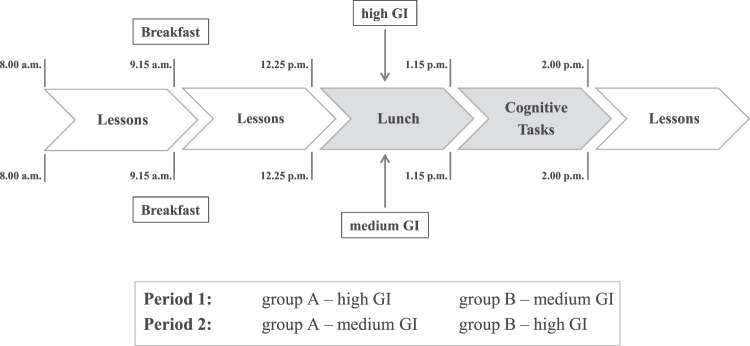
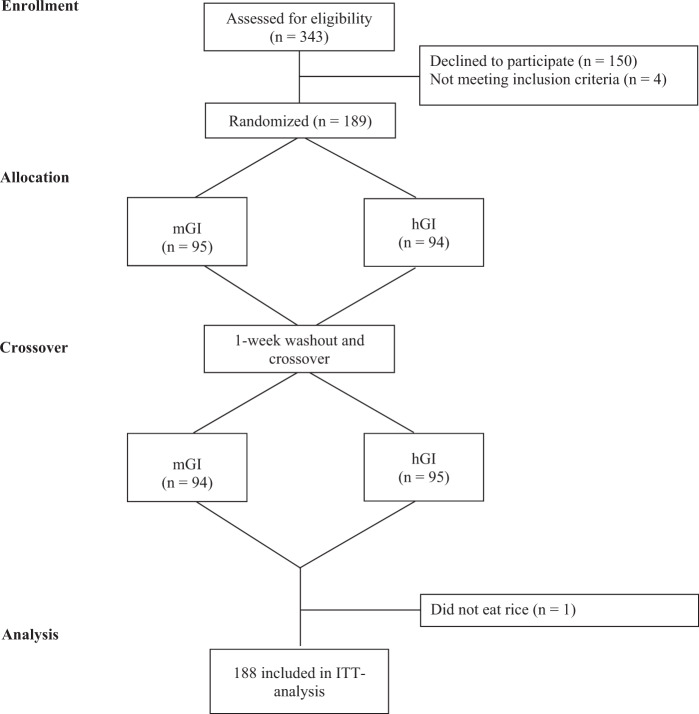
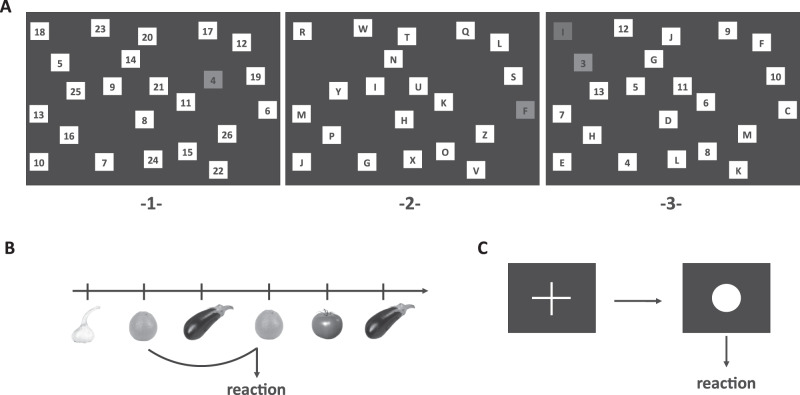
A randomized crossover study was performed at a comprehensive school on 2 test days. One hundred and eighty-nine participants (5th and 6th grade) were randomly assigned to one of the two sequences, medium-high GI (m-hGI) or high-medium GI (h-mGI), following block randomization. In the first period, one group received a dish containing hGI rice (GI: 86) ad libitum, the other mGI rice (GI: 62)-1 week later, in the second period, vice versa. Tonic alertness, task switching, and working memory updating were tested with a computerized test battery 45 min after beginning of lunch break. Treatment effects were estimated using the t test for normally distributed data or the Wilcoxon rank-sum test for non-normally distributed data.
The crossover approach revealed no effects of lunch dietary GI on the tested cognitive parameters in the early afternoon. However, we determined carryover effects for two parameters, and therefore analyzed only data of the first period. The reaction time of the two-back task (working memory updating) was faster (p = 0.001) and the count of commission errors in the alertness task was lower (p = 0.04) in the hGI group.
No evidence of short-term effects of lunch dietary GI on cognition of schoolchildren was found. Potential positive effects on single parameters of working memory updating and tonic alertness favoring hGI rice need to be verified.
干预研究表明,早餐的膳食血糖生成指数(GI)会影响儿童的认知能力。多特蒙德 GI-I 认知干预研究探讨了午餐的膳食 GI 是否会对某些认知参数产生短期影响。
在一所综合学校的 2 个测试日进行了一项随机交叉研究。189 名参与者(五年级和六年级)按照区组随机化分为两种序列中的一种:高-中 GI(h-mGI)或中-高 GI(m-hGI)。在第一阶段,一组参与者随意食用高 GI 米饭(GI:86),另一组食用中 GI 米饭(GI:62)——1 周后,在第二阶段,顺序相反。在午餐休息开始后 45 分钟,使用计算机化测试电池测试神经紧张度、任务转换和工作记忆更新。使用正态分布数据的 t 检验或非正态分布数据的 Wilcoxon 秩和检验估计处理效果。
交叉方法没有发现午餐膳食 GI 对下午早些时候测试认知参数的影响。然而,我们确定了两个参数的滞后效应,因此仅分析了第一阶段的数据。双回任务(工作记忆更新)的反应时间更快(p=0.001),警觉任务的错误计数更低(p=0.04),在 hGI 组。
没有发现午餐膳食 GI 对学龄儿童认知的短期影响的证据。需要验证 hGI 米饭对工作记忆更新和神经紧张度的单个参数的潜在积极影响。