Department of Clinical Chemistry and Biochemistry, Medical University of Lodz, 90-419 Lodz, Poland.
Department of Biochemistry and Molecular Biology, Hollings Cancer Center, Medical University of South Carolina, Charleston, SC 29425, USA.
Int J Mol Sci. 2020 Mar 19;21(6):2108. doi: 10.3390/ijms21062108.
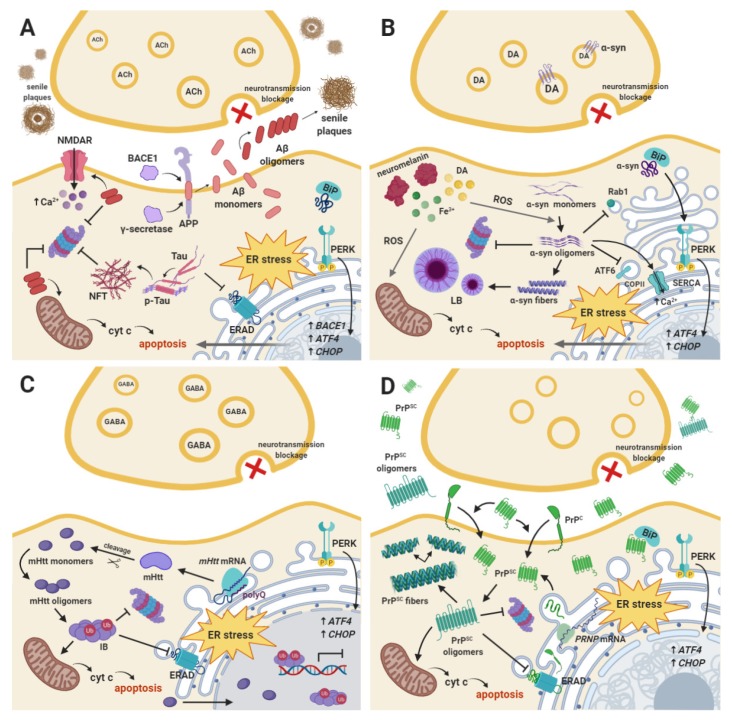
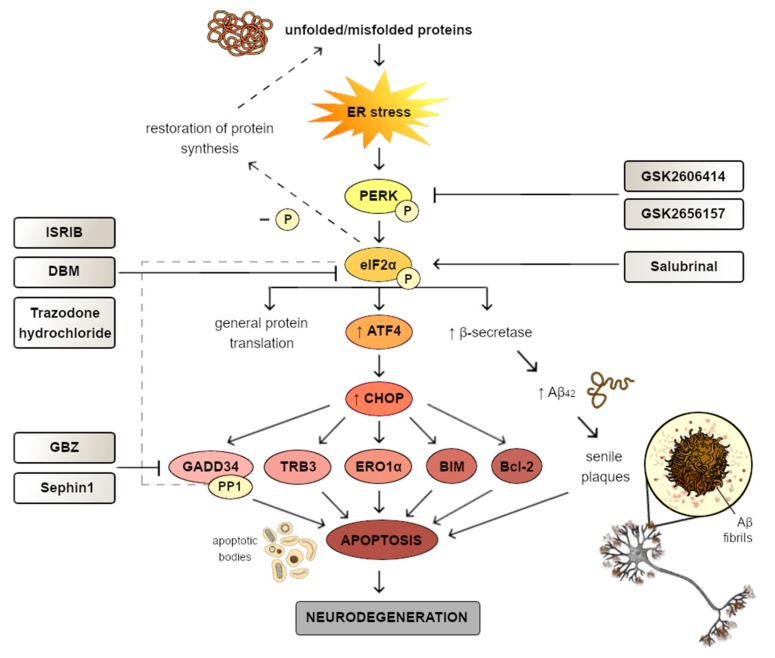
Higher prevalence of neurodegenerative diseases is strictly connected with progressive aging of the world population. Interestingly, a broad range of age-related, neurodegenerative diseases is characterized by a common pathological mechanism-accumulation of misfolded and unfolded proteins within the cells. Under certain circumstances, such protein aggregates may evoke endoplasmic reticulum (ER) stress conditions and subsequent activation of the unfolded protein response (UPR) signaling pathways via the protein kinase RNA-like endoplasmic reticulum kinase (PERK)-dependent manner. Under mild to moderate ER stress, UPR has a pro-adaptive role. However, severe or long-termed ER stress conditions directly evoke shift of the UPR toward its pro-apoptotic branch, which is considered to be a possible cause of neurodegeneration. To this day, there is no effective cure for Alzheimer's disease (AD), Parkinson's disease (PD), Huntington's disease (HD), or prion disease. Currently available treatment approaches for these diseases are only symptomatic and cannot affect the disease progression. Treatment strategies, currently under detailed research, include inhibition of the PERK-dependent UPR signaling branches. The newest data have reported that the use of small-molecule inhibitors of the PERK-mediated signaling branches may contribute to the development of a novel, ground-breaking therapeutic approach for neurodegeneration. In this review, we critically describe all the aspects associated with such targeted therapy against neurodegenerative proteopathies.
神经退行性疾病的患病率较高与世界人口的老龄化密切相关。有趣的是,广泛的与年龄相关的神经退行性疾病的特征是一个共同的病理机制-细胞内错误折叠和未折叠蛋白质的积累。在某些情况下,这些蛋白质聚集体可能会引发内质网(ER)应激条件,并通过蛋白激酶 RNA 样内质网激酶(PERK)依赖性方式随后激活未折叠蛋白反应(UPR)信号通路。在轻度至中度 ER 应激下,UPR 具有促适应作用。然而,严重或长期的 ER 应激条件直接引发 UPR 向其促凋亡分支转移,这被认为是神经退行性变的可能原因。迄今为止,尚无有效的阿尔茨海默病(AD)、帕金森病(PD)、亨廷顿病(HD)或朊病毒病的治疗方法。目前针对这些疾病的治疗方法仅为对症治疗,无法影响疾病进展。目前正在详细研究的治疗策略包括抑制 PERK 依赖性 UPR 信号分支。最新数据表明,使用 PERK 介导的信号分支的小分子抑制剂可能有助于开发针对神经退行性变的新型突破性治疗方法。在这篇综述中,我们批判性地描述了针对神经退行性蛋白病的这种靶向治疗的所有方面。