Fast and Chronic Programmes, Alexandra Hospital , 378 Alexandra Road, 159964, Singapore; Division of Nephrology, National University Health System, 1E Kent Ridge Rd, 119228, Singapore.
Saw Swee Hock School of Public Health, National University of Singapore, 21 Lower Kent Ridge Rd, 119077, Singapore.
Travel Med Infect Dis. 2020 May-Jun;35:101636. doi: 10.1016/j.tmaid.2020.101636. Epub 2020 Mar 20.
The current 2019 novel coronavirus outbreak is rapidly evolving. YouTube has been recognized as a popular source of information in previous disease outbreaks. We analyzed the content on YouTube about n-CoV in English and Mandarin languages.
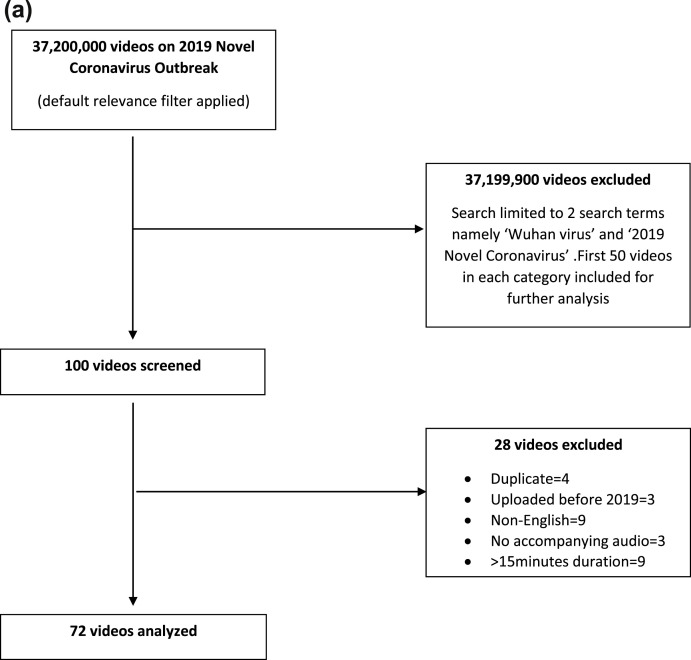
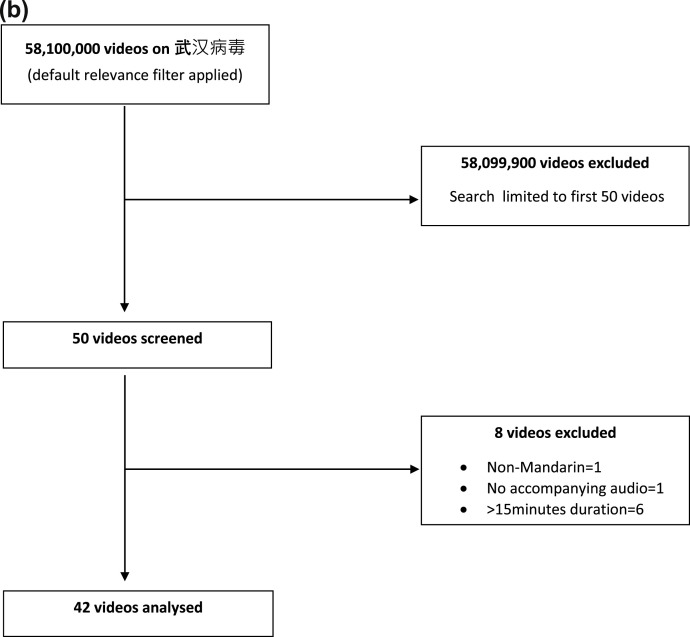
YouTube was searched using the terms '2019 novel coronavirus', 'Wuhan virus' and '' (Mandarin for Wuhan virus) on 1st and 2nd February 2020. First 50 videos in each group were analyzed. Videos in other languages, duplicate videos, those without an audio and duration >15 min were excluded .72 videos in English and 42 in Mandarin were reviewed. 2 reviewers classified the videos as useful, misleading or news based on pre specified criterion. Inter-observer agreement was evaluated with kappa coefficient. Modified DISCERN index for reliability and medical information and content index (MICI) score were used for content analysis.
These videos attracted cumulative 21,288,856 views. 67% of English and 50% Mandarin videos had useful information. The viewership of misleading Mandarin videos was higher than the useful ones. WHO accounted for only 4% of useful videos. Mean DISCERN score for reliability was 3.12/5 and 3.25/5 for English and Mandarin videos respectively. Mean cumulative MICI score of useful videos was low (6.71/25 for English and 6.28/25 for Mandarin).
YouTube viewership during 2019 n-CoV outbreak is higher than previous outbreaks. The medical content of videos is suboptimal International health agencies are underrepresented. Given its popularity, YouTube should be considered as important platform for information dissemination.
当前的 2019 年新型冠状病毒爆发正在迅速演变。在之前的疾病爆发中,YouTube 已被公认为是一个受欢迎的信息来源。我们分析了英语和简体中文的 YouTube 上有关 n-CoV 的内容。
我们于 2020 年 2 月 1 日和 2 日在 YouTube 上使用“2019 年新型冠状病毒”、“武汉病毒”和“武汉病毒”(简体中文)等术语进行搜索。分析每组的前 50 个视频。排除其他语言的视频、重复视频、无音频且时长超过 15 分钟的视频。共审查了 72 个英语视频和 42 个简体中文视频。两位审阅者根据预设标准将视频归类为有用、误导或新闻。使用 Kappa 系数评估观察者间一致性。使用可靠性和医学信息内容指数(MICI)评分的修改后的 DISCERN 指数进行内容分析。
这些视频共吸引了 21288866 次观看。67%的英语视频和 50%的简体中文视频具有有用的信息。误导性的简体中文视频的观看量高于有用的视频。在有用的视频中,世界卫生组织(WHO)仅占 4%。可靠性的平均 DISCERN 得分为 3.12/5,英语和简体中文视频分别为 3.25/5。有用视频的平均累积 MICI 得分为 6.71/25(英语)和 6.28/25(简体中文)。
在 2019 年 n-CoV 爆发期间,YouTube 的浏览量高于以往爆发。视频的医学内容不理想,国际卫生机构代表性不足。鉴于其受欢迎程度,YouTube 应被视为信息传播的重要平台。