Indian Institute of Advanced Study, Shimla, India.
Indian Institute of Technology, Kharagpur, India.
BMC Med Inform Decis Mak. 2021 Aug 30;21(1):255. doi: 10.1186/s12911-021-01613-8.
Institutions, government departments, and healthcare professionals engage in social media because it facilitates reaching a large number of people simultaneously. YouTube provides a platform whereby anyone can upload videos and gain feedback on their content from other users. Many YouTube videos are related to health and science, and many people search YouTube for health-related information. YouTube has been acknowledged as a key public information source in recent crises caused by Zika, H1N1, swine flu, and most recently, COVID-19.
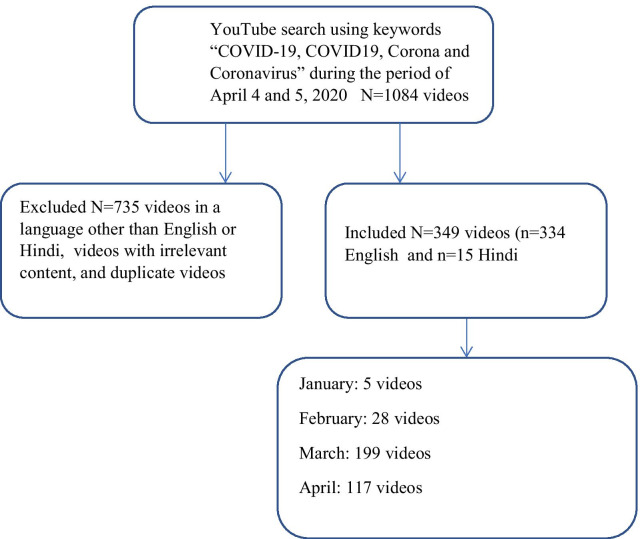
YouTube videos were collected from the YouTube Application Programming Interface (API) using the search terms COVID-19, coronavirus, COVID19, and corona. The search was conducted on April 4 and 5, 2020. The initial investigation found a total of 1084 videos. The second step involved identifying and verifying the videos for their relationship to COVID-19 information and excluding videos that did not relate to COVID-19 or were in a language other than English and Hindi.
An analysis of YouTube videos covering COVID-19, uploaded in early 2020, in English and Hindi. The sample comprised 349 videos (n = 334 English). Videos were characterized by contributor, duration, content, and reception (views/likes/dislikes/comments). The majority contained general information, with only 4.01% focusing on symptoms and 11.17% on treatment and outcomes. Further, the majority (n = 229) were short videos of under 10 min duration. Videos provided by government and health care professionals comprised 6.87% and 5.74% % of the sample, respectively. News channels uploaded 71.63% of videos.
YouTube may provide a significant resource for disseminating of information on public health issues like outbreaks of viral infections and should be utilized by healthcare agencies for this purpose. However, there is currently no way to determine whether a video has been produced or verified by authorized healthcare professionals. This limitation needs to be addressed so that the vital distribution services offered by platforms like YouTube can be fully utilized for increasing public understanding of healthcare science, particularly during a crisis such as a pandemic.
机构、政府部门和医疗保健专业人员使用社交媒体是因为它可以同时接触到大量的人。YouTube 提供了一个平台,任何人都可以在这个平台上上传视频,并从其他用户那里获得对其内容的反馈。许多 YouTube 视频与健康和科学有关,许多人在 YouTube 上搜索与健康相关的信息。在最近由寨卡病毒、H1N1 流感、猪流感以及最近的 COVID-19 引发的危机中,YouTube 已被公认为一个关键的公共信息来源。
使用 COVID-19、冠状病毒、COVID19 和 corona 等关键词从 YouTube 应用程序接口 (API) 中收集 YouTube 视频。搜索于 2020 年 4 月 4 日和 5 日进行。初步调查共发现 1084 个视频。第二步涉及识别和验证与 COVID-19 信息相关的视频,并排除与 COVID-19 无关或语言不是英语和印地语的视频。
对 2020 年初上传的关于 COVID-19 的英语和印地语 YouTube 视频进行了分析。样本包括 349 个视频(n=334 个英语视频)。视频的特征包括上传者、时长、内容和反馈(浏览量/点赞/不喜欢/评论)。大多数视频包含一般信息,只有 4.01%的视频关注症状,11.17%的视频关注治疗和结果。此外,大多数视频(n=229)时长不到 10 分钟。政府和医疗保健专业人员提供的视频分别占样本的 6.87%和 5.74%。新闻频道上传了 71.63%的视频。
YouTube 可能是传播病毒性传染病等突发公共卫生事件信息的重要资源,医疗保健机构应利用这一资源。然而,目前无法确定视频是否由授权的医疗保健专业人员制作或验证。需要解决这一限制,以便充分利用像 YouTube 这样的平台提供的重要分发服务,提高公众对医疗保健科学的理解,特别是在像大流行这样的危机期间。