Backman Helena, Lindberg Anne, Hedman Linnea, Stridsman Caroline, Jansson Sven-Arne, Sandström Thomas, Lundbäck Bo, Rönmark Eva
Dept of Public Health and Clinical Medicine, Section of Sustainable Health/the OLIN Unit, Umeå University, Umeå, Sweden.
Dept of Health Sciences, Luleå University of Technology, Luleå, Sweden.
World Allergy Organ J. 2020 Mar 17;13(3):100110. doi: 10.1016/j.waojou.2020.100110. eCollection 2020 Mar.
The relationship between lung function decline and eosinophils and neutrophils has important therapeutic implications among asthmatics, but it has rarely been studied in large cohort studies.
The aim is to study the relationship between blood eosinophils and neutrophils and FEV decline in a long-term follow-up of a population-based adult asthma cohort.
In 2012-2014, an adult asthma cohort was invited to a follow-up including spirometry, blood sampling, and structured interviews, and n = 892 participated (55% women, mean age 59 y, 32-92 y). Blood eosinophils, neutrophils and FEV decline were analyzed both as continuous variables and divided into categories with different cut-offs. Regression models adjusted for smoking, exposure to vapors, gas, dust, or fumes (VGDF), use of inhaled and oral corticosteroids, and other possible confounders were utilized to analyze the relationship between eosinophils and neutrophils at follow-up and FEV decline.
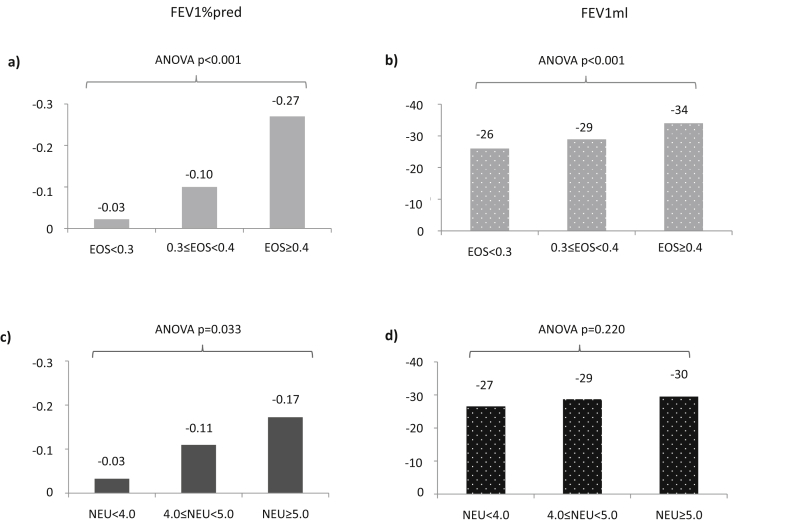
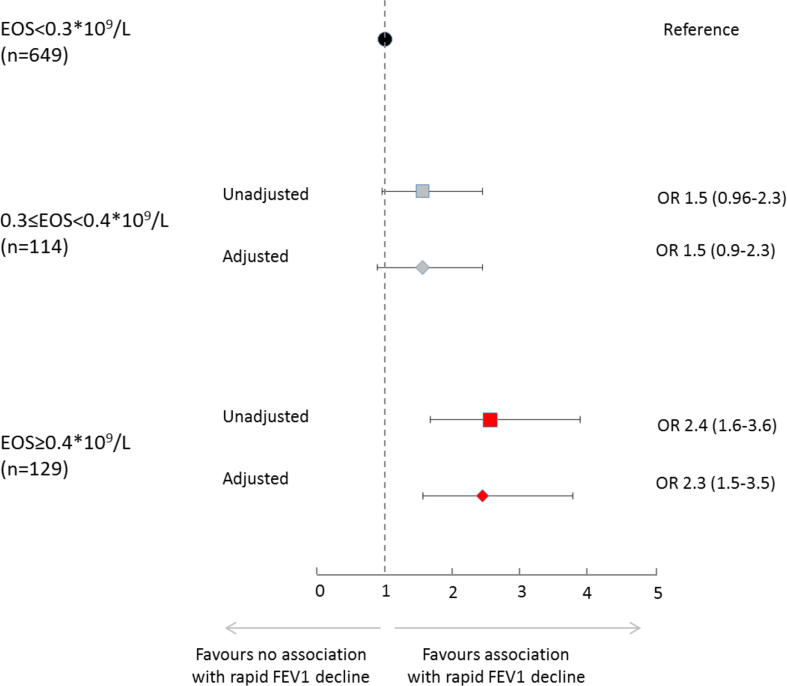
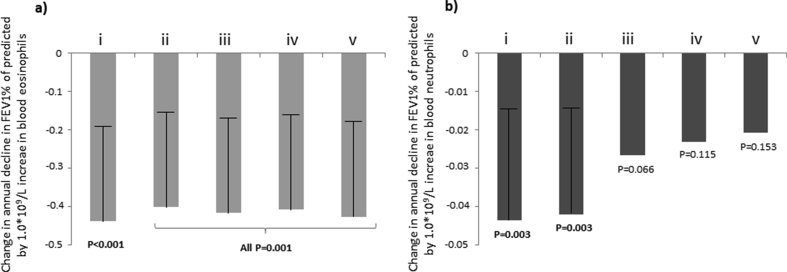
The mean follow-up time was 18 years, and the mean FEV decline was 27 ml/year. The annual FEV decline was related to higher levels of both blood eosinophils and neutrophils at follow-up, but only the association with eosinophils remained when adjusted for confounders. Further, the association between FEV decline and eosinophils was stronger among those using ICS. With EOS <0.3 × 10/L as reference, a more rapid decline in FEV1 was independently related to EOS ≥0.4 × 10/L in adjusted analyses.
Besides emphasizing the importance of smoking cessation and reduction of other harmful exposures, our real-world results indicate that there is an independent relationship between blood eosinophils and FEV decline among adults with asthma.
肺功能下降与嗜酸性粒细胞和中性粒细胞之间的关系在哮喘患者中具有重要的治疗意义,但在大型队列研究中很少被研究。
旨在研究基于人群的成年哮喘队列长期随访中血液嗜酸性粒细胞和中性粒细胞与第一秒用力呼气容积(FEV)下降之间的关系。
在2012年至2014年期间,邀请一个成年哮喘队列进行随访,包括肺功能测定、血液采样和结构化访谈,892人参与(55%为女性,平均年龄59岁,年龄范围32至92岁)。血液嗜酸性粒细胞、中性粒细胞和FEV下降情况既作为连续变量进行分析,也根据不同的临界值分为不同类别。使用针对吸烟、接触蒸汽、气体、灰尘或烟雾(VGDF)、吸入和口服皮质类固醇的使用以及其他可能的混杂因素进行调整的回归模型,来分析随访时嗜酸性粒细胞和中性粒细胞与FEV下降之间的关系。
平均随访时间为18年,平均FEV下降为每年27毫升。随访时每年的FEV下降与血液嗜酸性粒细胞和中性粒细胞水平升高均相关,但在调整混杂因素后,仅与嗜酸性粒细胞的关联仍然存在。此外,在使用吸入性糖皮质激素(ICS)的人群中,FEV下降与嗜酸性粒细胞之间的关联更强。在调整分析中,以嗜酸性粒细胞计数(EOS)<0.3×10⁹/L为参照,EOS≥0.4×10⁹/L与FEV₁下降更快独立相关。
除了强调戒烟和减少其他有害暴露的重要性外,我们的实际研究结果表明,成年哮喘患者血液嗜酸性粒细胞与FEV下降之间存在独立关系。