Bermúdez Barón Nicolás, Kankaanranta Hannu, Hedman Linnea, Andersson Martin, Stridsman Caroline, Lindberg Anne, Rönmark Eva, Backman Helena
Dept of Public Health and Clinical Medicine, Section of Sustainable Health, OLIN unit, Umeå University, Umeå, Sweden.
Dept of Internal Medicine and Clinical Nutrition, Krefting Research Centre, Sahlgrenska Academy, Gothenburg University, Gothenburg, Sweden.
ERJ Open Res. 2022 Oct 24;8(4). doi: 10.1183/23120541.00110-2022. eCollection 2022 Oct.
With increasing prevalence of overweight and obesity, it is important to study how body mass index (BMI) change may affect lung function among subjects with asthma. There are few prospective studies on this topic, especially with separate analyses of those with normal and high BMI. The aim of the present study was to prospectively study the association between annual BMI change and annual lung function decline, separately among those with normal initial BMI and overweight/obesity, in an adult asthma cohort.
A population-based adult asthma cohort was examined at study entry between 1986 and 2001 and at follow-up between 2012 and 2014 (n=945). Annual BMI change was analysed in association with annual decline in forced expiratory volume in 1 s (FEV), forced vital capacity (FVC) and FEV/FVC separately in those with normal weight (BMI 18.5-24.9) and overweight/obese subjects (BMI ≥25) at study entry. Regression models were used to adjust for sex, age, smoking, inhaled corticosteroids use and occupational exposure to gas, dust or fumes.
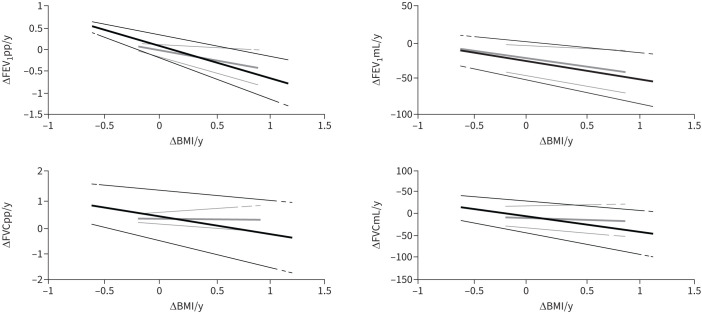
Overweight/obese subjects had lower FEV and FVC but slower annual FEV and FVC decline compared to those with normal weight. After adjustment through regression modelling, the association between BMI change with FEV and FVC decline remained significant for both BMI groups, but with stronger associations among the overweight/obese (FEV B=-25 mL B=-15 mL). However, when including only those with BMI increase during follow-up, the associations remained significant among those with overweight/obesity, but not in the normal-weight group. No associations were seen for FEV/FVC.
BMI increase is associated with faster FEV and FVC decline among overweight and obese adults with asthma in comparison with their normal-weight counterparts.
随着超重和肥胖患病率的增加,研究体重指数(BMI)变化如何影响哮喘患者的肺功能具有重要意义。关于这一主题的前瞻性研究较少,尤其是对BMI正常和较高者进行单独分析的研究。本研究的目的是在一个成人哮喘队列中,前瞻性地研究初始BMI正常者与超重/肥胖者中,年度BMI变化与年度肺功能下降之间的关联。
对一个基于人群的成人哮喘队列进行研究,该队列于1986年至2001年纳入研究对象,并于2012年至2014年进行随访(n = 945)。分别分析了研究入组时体重正常(BMI 18.5 - 24.9)和超重/肥胖受试者(BMI≥25)的年度BMI变化与1秒用力呼气容积(FEV)、用力肺活量(FVC)和FEV/FVC年度下降之间的关联。使用回归模型对性别、年龄、吸烟、吸入性糖皮质激素使用以及职业性接触气体、粉尘或烟雾进行校正。
与体重正常者相比,超重/肥胖受试者的FEV和FVC较低,但FEV和FVC的年度下降较慢。通过回归模型校正后,BMI变化与FEV和FVC下降之间的关联在两个BMI组中均仍然显著,但超重/肥胖组中的关联更强(FEV B = -25 mL,FVC B = -15 mL)。然而,仅纳入随访期间BMI增加者时,超重/肥胖者中的关联仍然显著,但体重正常组中不显著。未发现FEV/FVC有相关性。
与体重正常的哮喘成年人相比,超重和肥胖的哮喘成年人BMI增加与FEV和FVC下降更快有关。