Department of Psychiatry, Psychotherapy, and Psychosomatics, RWTH Aachen University, Aachen, Germany.
Department of Experimental Psychology, University of Oxford, Oxford, UK.
Sci Adv. 2020 Mar 18;6(12):eaaz1170. doi: 10.1126/sciadv.aaz1170. eCollection 2020 Mar.
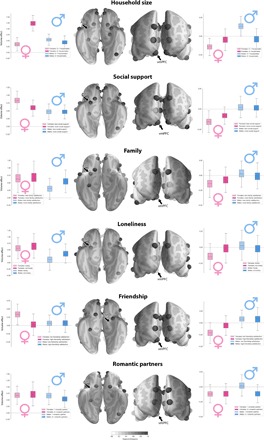
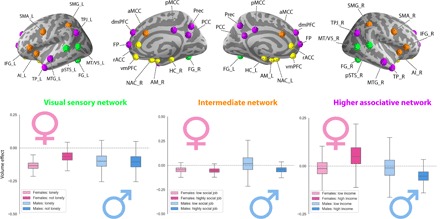
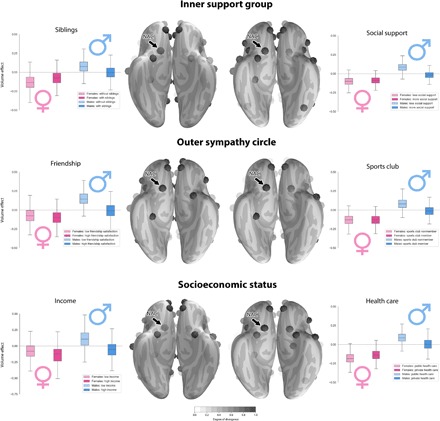
In human and nonhuman primates, sex differences typically explain much interindividual variability. Male and female behaviors may have played unique roles in the likely coevolution of increasing brain volume and more complex social dynamics. To explore possible divergence in social brain morphology between men and women living in different social environments, we applied probabilistic generative modeling to ~10,000 UK Biobank participants. We observed strong volume effects especially in the limbic system but also in regions of the sensory, intermediate, and higher association networks. Sex-specific brain volume effects in the limbic system were linked to the frequency and intensity of social contact, such as indexed by loneliness, household size, and social support. Across the processing hierarchy of neural networks, different conditions for social interplay may resonate in and be influenced by brain anatomy in sex-dependent ways.
在人类和非人类灵长类动物中,性别差异通常可以解释个体间的许多差异。男性和女性的行为可能在大脑体积增加和更复杂的社会动态的共同进化中发挥了独特的作用。为了探索生活在不同社会环境中的男性和女性的社会大脑形态可能存在的差异,我们对约 10000 名英国生物库参与者进行了概率生成建模。我们观察到强烈的体积效应,特别是在边缘系统中,但也在感觉、中间和高级联想网络的区域中观察到。边缘系统中的性别特异性大脑体积效应与社交接触的频率和强度有关,例如孤独感、家庭规模和社会支持。在神经网络的处理层次结构中,不同的社交互动条件可能以性别依赖的方式在大脑解剖结构中产生共鸣并受到影响。