Department of Medicine, Perelman School of Medicine, University of Pennsylvania, Philadelphia, PA.
Department of Pathology and.
Blood. 2020 May 7;135(19):1673-1684. doi: 10.1182/blood.2019002792.
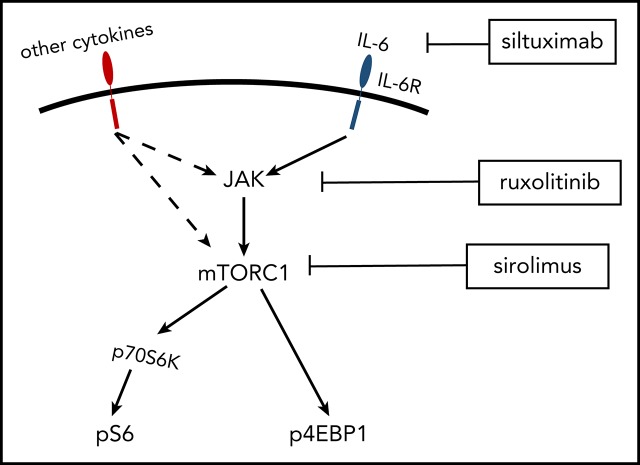
Idiopathic multicentric Castleman disease (iMCD) is a rare and poorly understood hematologic disorder characterized by lymphadenopathy, systemic inflammation, cytopenias, and life-threatening multiorgan dysfunction. Interleukin-6 (IL-6) inhibition effectively treats approximately one-third of patients. Limited options exist for nonresponders, because the etiology, dysregulated cell types, and signaling pathways are unknown. We previously reported 3 anti-IL-6 nonresponders with increased mTOR activation who responded to mTOR inhibition with sirolimus. We investigated mTOR signaling in tissue and serum proteomes from iMCD patients and controls. mTOR activation was increased in the interfollicular space of iMCD lymph nodes (N = 26) compared with control lymph nodes by immunohistochemistry (IHC) for pS6, p4EBP1, and p70S6K, known effectors and readouts of mTORC1 activation. IHC for pS6 also revealed increased mTOR activation in iMCD compared with Hodgkin lymphoma, systemic lupus erythematosus, and reactive lymph nodes, suggesting that the mTOR activation in iMCD is not just a product of lymphoproliferation/inflammatory lymphadenopathy. Further, the degree of mTOR activation in iMCD was comparable to autoimmune lymphoproliferative syndrome, a disease driven by mTOR hyperactivation that responds to sirolimus treatment. Gene set enrichment analysis of serum proteomic data from iMCD patients (n = 88) and controls (n = 42) showed significantly enriched mTORC1 signaling. Finally, functional studies revealed increased baseline mTOR pathway activation in peripheral monocytes and T cells from iMCD remission samples compared with healthy controls. IL-6 stimulation augmented mTOR activation in iMCD patients, which was abrogated with JAK1/2 inhibition. These findings support mTOR activation as a novel therapeutic target for iMCD, which is being investigated through a trial of sirolimus (NCT03933904).
特发性多中心 Castleman 病(iMCD)是一种罕见且尚未被充分认识的血液系统疾病,其特征为淋巴结病、全身炎症、细胞减少症和危及生命的多器官功能障碍。白细胞介素 6(IL-6)抑制对大约三分之一的患者有效。由于病因、失调的细胞类型和信号通路未知,因此对无反应者的治疗选择有限。我们之前报道了 3 例抗 IL-6 无反应者,这些患者的 mTOR 活性增加,用西罗莫司抑制 mTOR 后得到缓解。我们研究了 iMCD 患者和对照者的组织和血清蛋白质组中的 mTOR 信号。通过对 pS6、p4EBP1 和 p70S6K 的免疫组化(IHC),我们发现 iMCD 淋巴结的滤泡间区的 mTOR 激活增加(N=26),这是 mTORC1 激活的已知效应物和读出物。IHC 也显示 pS6 在 iMCD 中的激活增加,与霍奇金淋巴瘤、系统性红斑狼疮和反应性淋巴结相比,这表明 iMCD 中的 mTOR 激活不仅仅是淋巴细胞增殖/炎症性淋巴结病的产物。此外,iMCD 中的 mTOR 激活程度与自身免疫性淋巴增生综合征相当,这是一种由 mTOR 过度激活驱动的疾病,对西罗莫司治疗有反应。iMCD 患者(n=88)和对照者(n=42)的血清蛋白质组数据的基因集富集分析显示 mTORC1 信号显著富集。最后,功能研究显示,与健康对照者相比,iMCD 缓解样本的外周单核细胞和 T 细胞中的 mTOR 通路基线激活增加。IL-6 刺激增强了 iMCD 患者的 mTOR 激活,用 JAK1/2 抑制可阻断这种激活。这些发现支持 mTOR 激活作为 iMCD 的一种新的治疗靶点,正在通过西罗莫司的临床试验进行研究(NCT03933904)。