Department of Gastroenterological Surgery I, Graduate School of Medicine, Hokkaido University, Sapporo.
Department of Surgery, Sapporo-Kosei General Hospital, Sapporo.
BJS Open. 2020 Jun;4(3):486-498. doi: 10.1002/bjs5.50263. Epub 2020 Mar 24.
The Endoscopic Surgical Skill Qualification System (ESSQS) was introduced in Japan to improve the quality of laparoscopic surgery. This cohort study investigated the short- and long-term postoperative outcomes of colorectal cancer laparoscopic procedures performed by or with qualified surgeons compared with outcomes for unqualified surgeons.
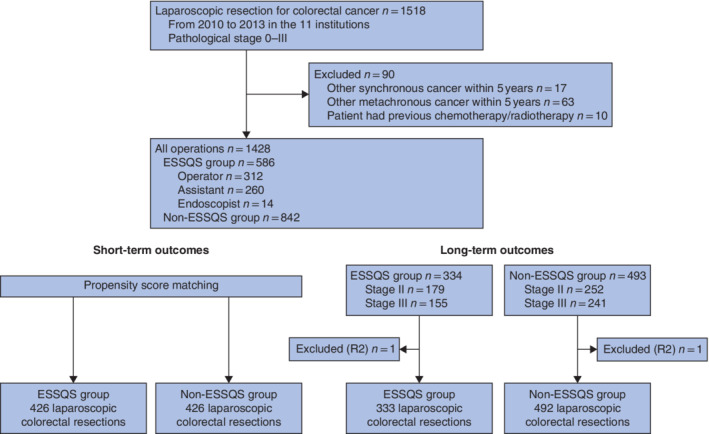
All laparoscopic colorectal resections performed from 2010 to 2013 in 11 Japanese hospitals were reviewed retrospectively. The procedures were categorized as performed by surgeons with or without the ESSQS qualification and patients' clinical, pathological and surgical features were used to match subgroups using propensity scoring. Outcome measures included postoperative and long-term results.
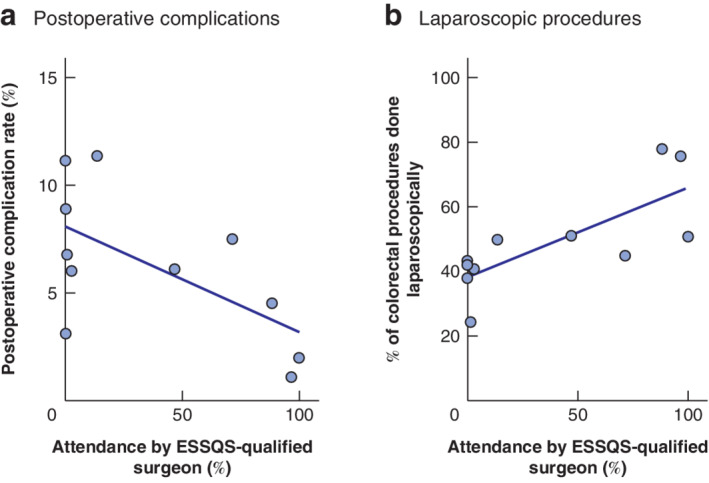
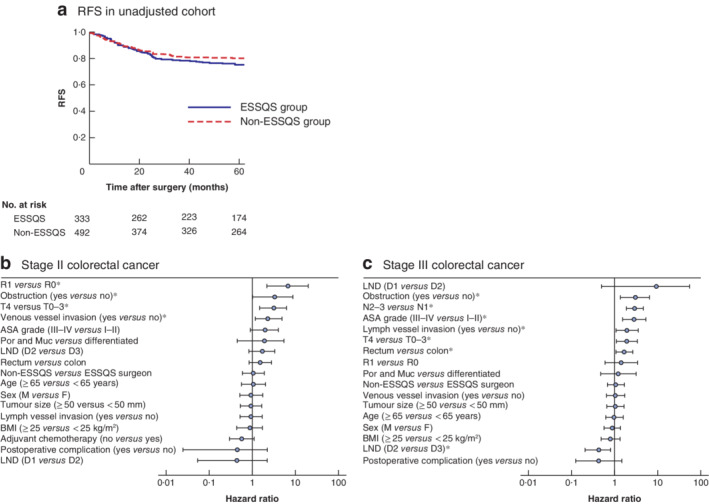
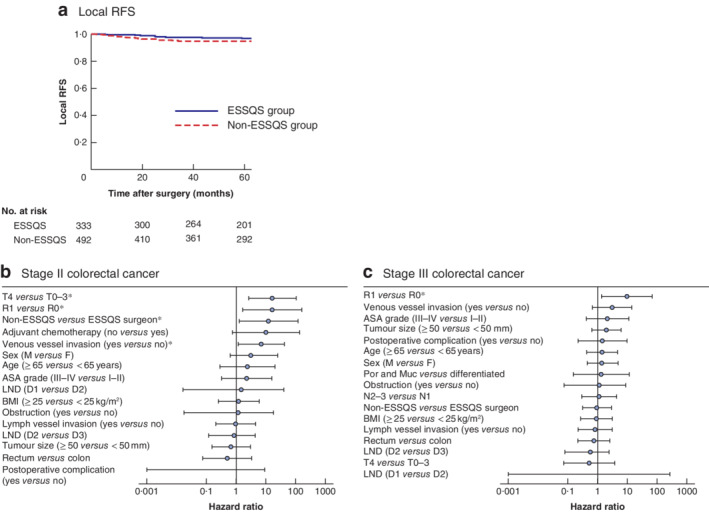
Overall, 1428 procedures were analysed; 586 procedures were performed with ESSQS-qualified surgeons and 842 were done by ESSQS-unqualified surgeons. Upon matching, two cohorts of 426 patients were selected for comparison of short-term results. A prevalence of rectal resection (50·3 versus 40·5 per cent; P < 0·001) and shorter duration of surgery (230 versus 238 min; P = 0·045) was reported for the ESSQS group. Intraoperative and postoperative complication and reoperation rates were significantly lower in the ESSQS group than in the non-ESSQS group (1·2 versus 3·6 per cent, P = 0·014; 4·6 versus 7·5 per cent, P = 0·025; 1·9 versus 3·9 per cent, P = 0·023, respectively). These findings were confirmed after propensity score matching. Cox regression analysis found that non-attendance of ESSQS-qualified surgeons (hazard ratio 12·30, 95 per cent c.i. 1·28 to 119·10; P = 0·038) was independently associated with local recurrence in patients with stage II disease.
Laparoscopic colorectal procedures performed with ESSQS-qualified surgeons showed improved postoperative results. Further studies are needed to investigate the impact of the qualification on long-term oncological outcomes.
内镜手术技能资格认证系统(ESSQS)在日本引入,旨在提高腹腔镜手术的质量。本队列研究调查了由合格外科医生或与合格外科医生合作进行的结直肠腹腔镜手术与不合格外科医生进行的手术的短期和长期术后结果。
回顾性分析了 2010 年至 2013 年在日本 11 家医院进行的所有腹腔镜结直肠切除术。根据外科医生是否具有 ESSQS 资格对手术进行分类,并使用倾向评分匹配患者的临床、病理和手术特征的亚组。观察指标包括术后和长期结果。
共分析了 1428 例手术;586 例手术由具有 ESSQS 资质的外科医生完成,842 例手术由 ESSQS 不合格的外科医生完成。匹配后,选择了两组 426 例患者进行短期结果比较。ESSQS 组直肠切除术(50.3%比 40.5%;P<0.001)和手术时间更短(230 分钟比 238 分钟;P=0.045)。ESSQS 组术中及术后并发症和再次手术率明显低于非 ESSQS 组(1.2%比 3.6%,P=0.014;4.6%比 7.5%,P=0.025;1.9%比 3.9%,P=0.023)。这些发现在倾向评分匹配后得到了证实。Cox 回归分析发现,Ⅱ期疾病患者中,非 ESSQS 合格外科医生(危险比 12.30,95%可信区间 1.28 至 119.10;P=0.038)是局部复发的独立相关因素。
由具有 ESSQS 资质的外科医生进行的腹腔镜结直肠手术术后结果改善。需要进一步研究该资质对长期肿瘤学结果的影响。