National Human Genome Research Institute, National Institutes of Health, 50 South Drive, Bldg 50, Room 5351, Bethesda, MD, 20892, USA.
Department of Veterinary Clinical Sciences, College of Veterinary Medicine, Purdue University, West Lafayette, IN, 47907, USA.
BMC Cancer. 2020 Mar 24;20(1):251. doi: 10.1186/s12885-020-06737-0.
Invasive urothelial carcinoma (iUC) is highly similar between dogs and humans in terms of pathologic presentation, molecular subtypes, response to treatment and age at onset. Thus, the dog is an established and relevant model for testing and development of targeted drugs benefiting both canine and human patients. We sought to identify gene expression patterns associated with two primary types of canine iUC tumors: those that express a common somatic mutation in the BRAF gene, and those that do not.
We performed RNAseq on tumor and normal tissues from pet dogs. Analysis of differential expression and clustering, and positional and individual expression was used to develop gene set enrichment profiles distinguishing iUC tumors with and without BRAFV595E mutations, as well as genomic regions harboring excessive numbers of dysregulated genes.
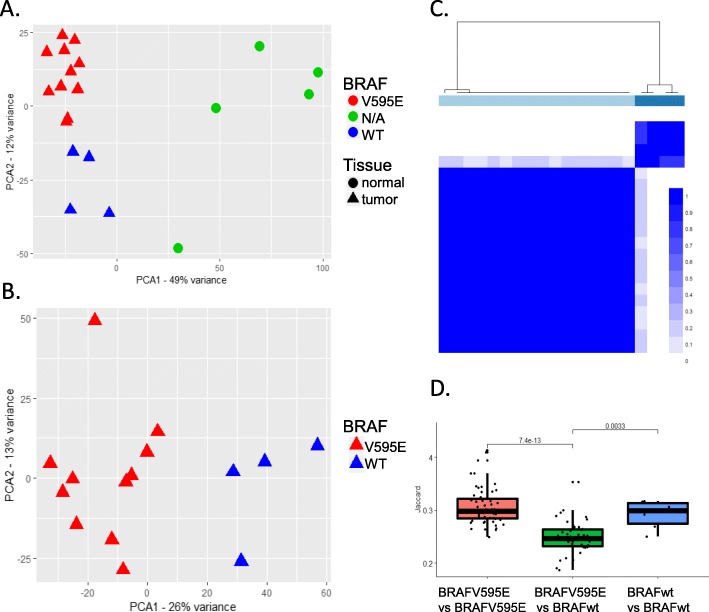
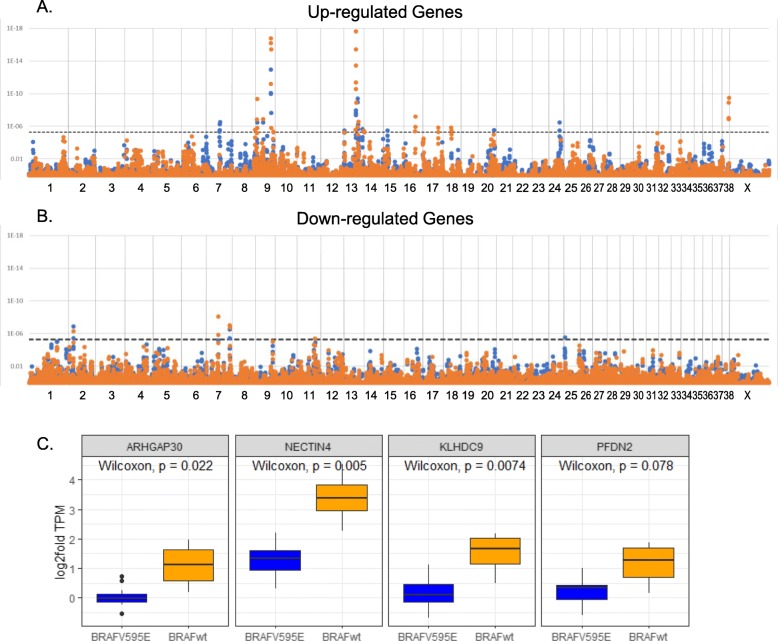
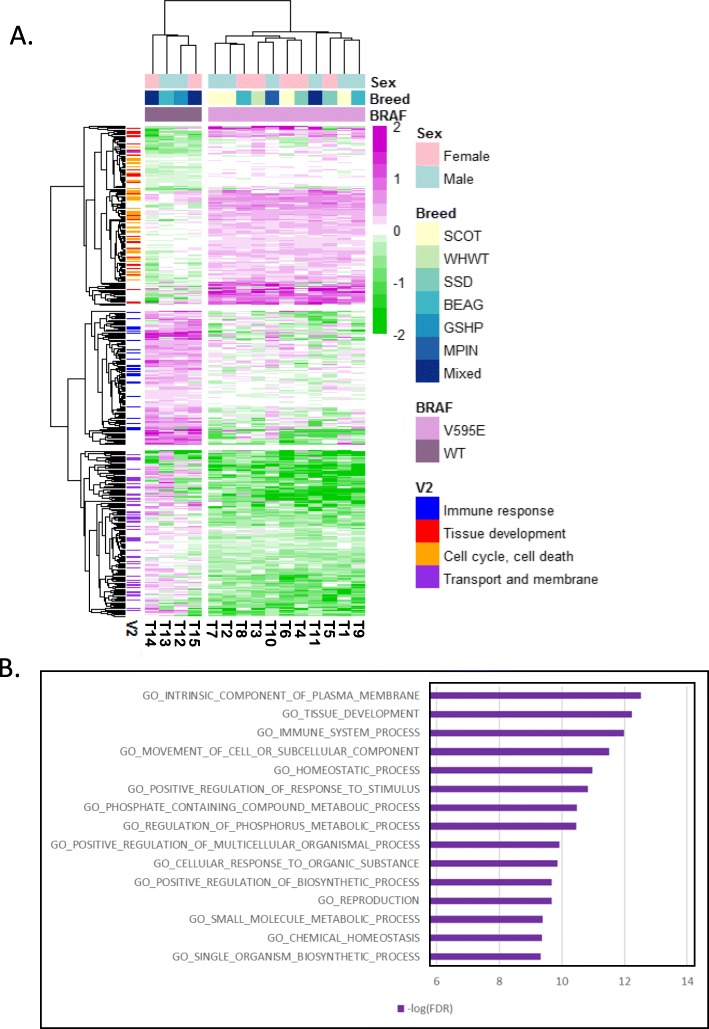
We identified two expression clusters that are defined by the presence/absence of a BRAFV595E (BRAFV600E in humans) somatic mutation. BRAFV595E tumors shared significantly more dysregulated genes than BRAF wild-type tumors, and vice versa, with 398 genes differentiating the two clusters. Key genes fall into clades of limited function: tissue development, cell cycle regulation, immune response, and membrane transport. The genomic site with highest number of dysregulated genes overall lies in a locus corresponding to human chromosome 8q24, a region frequently amplified in human urothelial cancers.
These data identify critical sets of genes that are differently regulated in association with an activating mutation in the MAPK/ERK pathway in canine iUC tumors. The experiments also highlight the value of the canine system in identifying expression patterns associated with a common, shared cancer.
在病理表现、分子亚型、对治疗的反应和发病年龄方面,犬浸润性尿路上皮癌(iUC)与人高度相似。因此,狗是一种已确立的相关模型,可用于测试和开发对犬和人类患者都有益的靶向药物。我们试图确定与两种主要类型的犬 iUC 肿瘤相关的基因表达模式:一种是表达 BRAF 基因常见体细胞突变的肿瘤,另一种是不表达该突变的肿瘤。
我们对宠物狗的肿瘤和正常组织进行了 RNAseq 分析。通过差异表达和聚类分析、位置和个体表达分析,开发了基因集富集谱,以区分具有和不具有 BRAFV595E 突变的 iUC 肿瘤,以及含有过多失调基因的基因组区域。
我们确定了两个表达簇,它们由 BRAFV595E(人类中的 BRAFV600E)体细胞突变的存在/不存在定义。BRAFV595E 肿瘤比 BRAF 野生型肿瘤共享更多失调基因,反之亦然,有 398 个基因区分了这两个簇。关键基因属于功能有限的类群:组织发育、细胞周期调控、免疫反应和膜转运。整体上失调基因数量最多的基因组位点位于与人类 8q24 染色体相对应的基因座,该区域是人尿路上皮癌中经常扩增的区域。
这些数据确定了与犬 iUC 肿瘤中 MAPK/ERK 通路激活突变相关的关键基因集,这些基因集的表达受到不同调节。这些实验还突出了犬系统在识别与常见共享癌症相关的表达模式方面的价值。