Division of Clinical Medicine, Faculty of Medicine, University of Tsukuba, 1-1-1 Tennoudai, Tsukuba, 305-8575, Ibaraki, Japan.
Graduate School of Comprehensive Human Sciences, University of Tsukuba, 1-1-1 Tennoudai, Tsukuba, 305-8575, Ibaraki, Japan.
BMC Palliat Care. 2020 Mar 24;19(1):38. doi: 10.1186/s12904-020-00546-9.
A better understanding of differences between the preferences of the general public and the recommendations of healthcare providers with regard to end-of-life (EOL) care may facilitate EOL discussion.
The aim of this study was to clarify differences between preferences of the general public and recommendations of healthcare providers with regard to treatment, EOL care, and life-sustaining treatment (LST) based on a hypothetical scenario involving a patient with advanced cancer. This study comprised exploratory post-hoc analyses of "The Survey of Public Attitude Towards Medical Care at the End of life", which was a population based, cross-sectional anonymous survey in Japan to investigate public attitudes toward medical care at the end of life. Persons living in Japan over 20 years old were randomly selected nationwide. Physicians, nurses, and care staff were recruited at randomly selected facilities throughout Japan. The general public data from the original study was combined to the data of healthcare providers in order to conduct exploratory post-hoc analyses. The preferences of the general public and recommendations of healthcare providers with regard to EOL care and LST was assessed based on the hypothetical scenario of an advanced cancer patient.
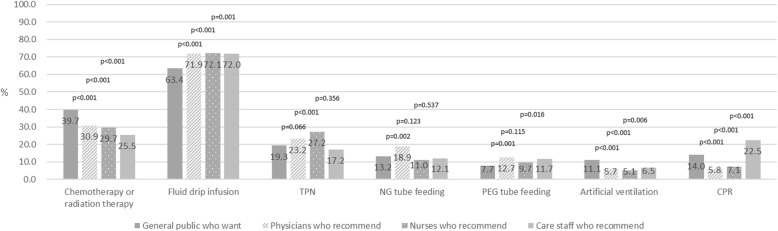
All returned questionnaires were analyzed: 973 from the general public, 1039 from physicians, 1854 from nurses, and 752 from care staff (response rates of 16.2, 23.1, 30.9, and 37.6%, respectively). The proportion of the general public who wanted "chemotherapy or radiation", "ventilation", and "cardiopulmonary resuscitation" was significantly higher than the frequency of these options being recommended by physicians, nurses, and care staff, but the general public preference for "cardiopulmonary resuscitation" was significantly lower than the frequency of its recommendation by care staff.
Regarding a hypothetical scenario for advanced cancer, the general public preferred more aggressive treatment and more frequent LST than that recommended by healthcare providers.
更好地理解普通公众对临终关怀的偏好与医疗保健提供者的建议之间的差异,可能有助于进行临终关怀讨论。
本研究旨在根据涉及晚期癌症患者的假设情况,阐明普通公众对治疗、临终关怀和生命支持治疗(LST)的偏好与医疗保健提供者的建议之间的差异。本研究是对“公众对生命末期医疗态度调查”的探索性事后分析,该调查是一项基于人群的、横断面的、匿名的日本生命末期医疗态度调查,旨在调查公众对生命末期医疗的态度。日本全国范围内随机选择 20 岁以上的人。在日本各地随机选择的设施中招募医生、护士和护理人员。将原始研究中的普通公众数据与医疗保健提供者的数据相结合,以进行探索性事后分析。根据晚期癌症患者的假设情况,评估普通公众和医疗保健提供者对临终关怀和 LST 的偏好。
分析了所有返回的问卷:普通公众 973 份,医生 1039 份,护士 1854 份,护理人员 752 份(响应率分别为 16.2%、23.1%、30.9%和 37.6%)。普通公众希望“化疗或放疗”、“通气”和“心肺复苏”的比例明显高于医生、护士和护理人员推荐这些选择的频率,但普通公众对“心肺复苏”的偏好明显低于护理人员推荐的频率。
对于晚期癌症的假设情况,普通公众比医疗保健提供者更倾向于采用更积极的治疗方法和更频繁的 LST。