State Key Laboratory of Cancer Biology, Department of Pathology, Xijing Hospital and School of Basic Medicine, Fourth Military Medical University, Changle West Road #169, Xi'an, 710032, Shaan Xi Province, China.
Department of Pathology, The 960th Hospital of PLA, Jinan, Shandong, China.
Diagn Pathol. 2020 Mar 24;15(1):28. doi: 10.1186/s13000-020-00948-6.
To investigate the expression and function of RSK4, MMP-9 and CD44 in primary clear cell renal cell carcinoma (primary ccRCC) and metastatic clear cell renal cell carcinoma (metastatic ccRCC), as well as the correlation with clinicopathological features of patients.
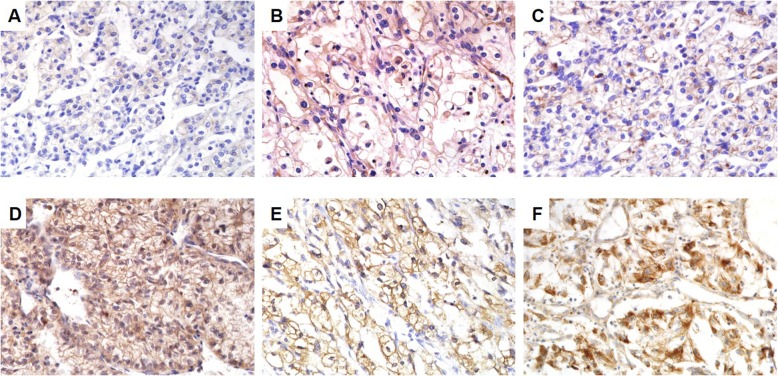
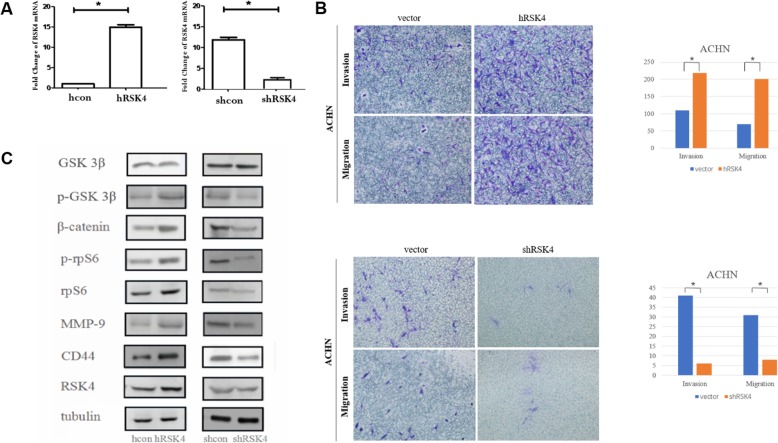
The expression levels of RSK4, CD44 and MMP-9 in 52 primary ccRCC samples and 48 metastatic ccRCC samples were detected by immunohistochemistry, and the relationship between RSK4, CD44 and MMP-9 expression and clinicopathological features as well as prognosis of metastatic ccRCC patients was statistically analysed. Ectopic RSK4 expression in ccRCC cell lines was performed to determine its effect on cell cycle regulation, tumour invasiveness, and metastatic capability.
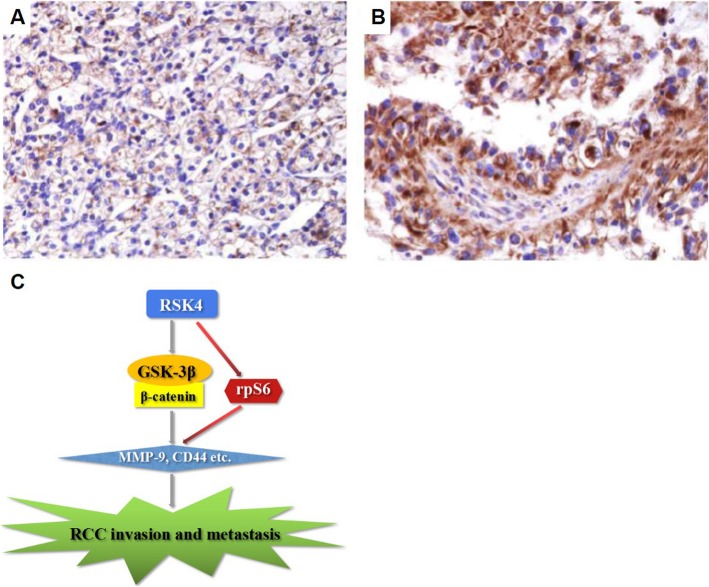
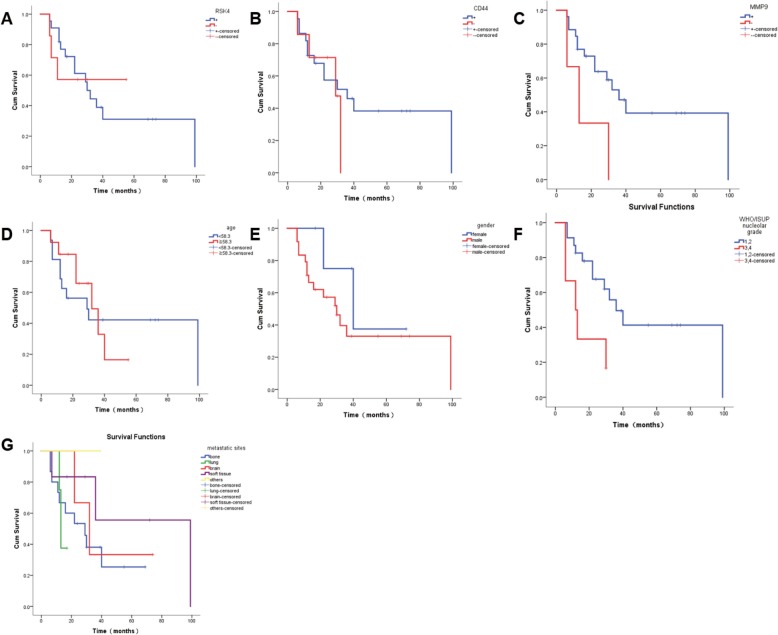
The positive rates of RSK4, MMP-9 and CD44 expression in metastatic ccRCC tissues were 75, 68.75 and 91.7%, respectively, while the rates in primary ccRCC tissues were 44.2, 34.6 and 69.2%, respectively. Thus, the positive rates in metastatic ccRCC were higher than those in primary ccRCC (P = 0. 002; P = 0. 002; P = 0. 001). However, the expression of RSK4, CD44 and MMP-9 was unrelated to age, gender, or metastatic sites (P > 0.05) but was related to WHO/ISUP nucleolar grade (P = 0.019; P = 0.026; P = 0.049). In metastatic ccRCC, expression among the three proteins showed a positive correlation (P = 0.008). Moreover, expression between RSK4 and CD44 (P = 0.019) and MMP-9 and CD44 (P = 0.05) also showed positive correlations, whereas RSK4 and MMP-9 showed no significant correlation (P = 1.00). Molecular studies showed that overexpression of RSK4 could enhance the invasive and migratory abilities of ccRCC cell lines through the regulation of CD44 and MMP-9 expression and vice versa.
The overexpression of RSK4, MMP-9 and CD44 is associated with the invasion and metastasis of ccRCC, indicating that they could be potential prognostic factors and serve as new potential therapeutic targets for ccRCC.
研究 RSK4、MMP-9 和 CD44 在原发性肾透明细胞癌(原发性 ccRCC)和转移性肾透明细胞癌(转移性 ccRCC)中的表达和功能,以及与患者临床病理特征的相关性。
采用免疫组织化学法检测 52 例原发性 ccRCC 标本和 48 例转移性 ccRCC 标本中 RSK4、CD44 和 MMP-9 的表达水平,并对 RSK4、CD44 和 MMP-9 表达与转移性 ccRCC 患者临床病理特征和预后的关系进行统计学分析。在 ccRCC 细胞系中异位表达 RSK4,以确定其对细胞周期调控、肿瘤侵袭性和转移能力的影响。
转移性 ccRCC 组织中 RSK4、MMP-9 和 CD44 的阳性率分别为 75%、68.75%和 91.7%,而原发性 ccRCC 组织中的阳性率分别为 44.2%、34.6%和 69.2%。因此,转移性 ccRCC 中的阳性率高于原发性 ccRCC(P=0.002;P=0.002;P=0.001)。然而,RSK4、CD44 和 MMP-9 的表达与年龄、性别或转移部位无关(P>0.05),但与 WHO/ISUP 核仁分级有关(P=0.019;P=0.026;P=0.049)。在转移性 ccRCC 中,这三种蛋白的表达呈正相关(P=0.008)。此外,RSK4 与 CD44 之间(P=0.019)和 MMP-9 与 CD44 之间(P=0.05)的表达也呈正相关,而 RSK4 与 MMP-9 之间无显著相关性(P=1.00)。分子研究表明,RSK4 的过表达可通过调节 CD44 和 MMP-9 的表达增强 ccRCC 细胞系的侵袭和迁移能力,反之亦然。
RSK4、MMP-9 和 CD44 的过度表达与 ccRCC 的侵袭和转移有关,表明它们可能是潜在的预后因素,并可能成为 ccRCC 的新的潜在治疗靶点。