Puertas-Neyra Kevin, Usategui-Martín Ricardo, Coco Rosa M, Fernandez-Bueno Ivan
Instituto Universitario de Oftalmobiología Aplicada, Universidad de Valladolid, Valladolid, Spain.
Instituto Universitario de Oftalmobiología Aplicada, Universidad de Valladolid; Centro en Red de Medicina Regenerativa y Terapia Celular de Castilla y León; Red Temática de Investigación Cooperativa en Salud, Oftared, Instituto de Salud Carlos III, Valladolid, Spain.
Neural Regen Res. 2020 Sep;15(9):1631-1638. doi: 10.4103/1673-5374.276324.
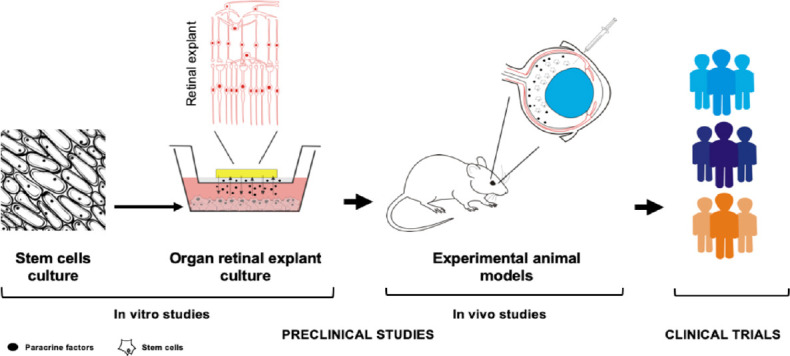
Retinal degenerations are the leading causes of irreversible visual loss worldwide. Many pathologies included under this umbrella involve progressive degeneration and ultimate loss of the photoreceptor cells, with age-related macular degeneration and inherited and ischemic retinal diseases the most relevant. These diseases greatly impact patients' daily lives, with accompanying marked social and economic consequences. However, the currently available treatments only delay the onset or slow progression of visual impairment, and there are no cures for these photoreceptor diseases. Therefore, new therapeutic strategies are being investigated, such as gene therapy, optogenetics, cell replacement, or cell-based neuroprotection. Specifically, stem cells can secrete neurotrophic, immunomodulatory, and anti-angiogenic factors that potentially protect and preserve retinal cells from neurodegeneration. Further, neuroprotection can be used in different types of retinal degenerative diseases and at different disease stages, unlike other potential therapies. This review summarizes stem cell-based paracrine neuroprotective strategies for photoreceptor degeneration, which are under study in clinical trials, and the latest preclinical studies. Effective retinal neuroprotection could be the next frontier in photoreceptor diseases, and the development of novel neuroprotective strategies will address the unmet therapeutic needs.
视网膜变性是全球不可逆视力丧失的主要原因。这一范畴内包含的许多病理状况都涉及光感受器细胞的渐进性退化及最终丧失,其中年龄相关性黄斑变性、遗传性视网膜疾病和缺血性视网膜疾病最为常见。这些疾病对患者的日常生活产生了极大影响,并带来了显著的社会和经济后果。然而,目前可用的治疗方法只能延缓视力损害的发作或减缓其进展,这些光感受器疾病尚无治愈方法。因此,人们正在研究新的治疗策略,如基因治疗、光遗传学、细胞替代或基于细胞的神经保护。具体而言,干细胞可以分泌神经营养、免疫调节和抗血管生成因子,这些因子有可能保护视网膜细胞免受神经退行性变。此外,与其他潜在疗法不同,神经保护可用于不同类型的视网膜退行性疾病及不同的疾病阶段。本综述总结了基于干细胞的旁分泌神经保护策略用于光感受器变性的研究情况,这些策略正在临床试验中进行研究,并介绍了最新的临床前研究。有效的视网膜神经保护可能是光感受器疾病的下一个前沿领域,新型神经保护策略的开发将满足未被满足的治疗需求。